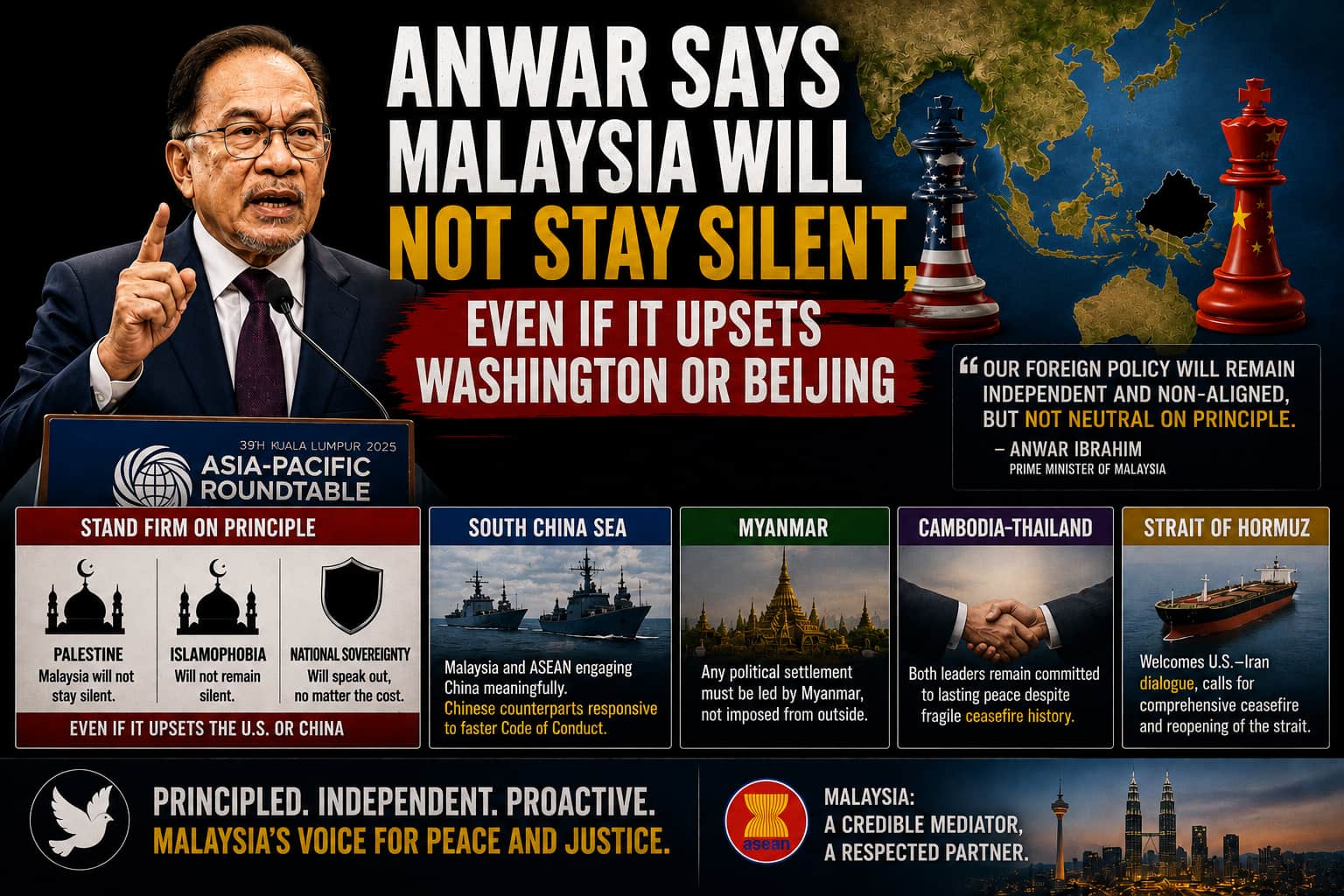
Prime Minister Anwar Ibrahim used a major regional forum this week to draw a clear line around Malaysia's foreign policy, insisting the country will remain independent and non-aligned, but not neutral on certain issues that matter to him personally.
Speaking at the 39th Asia-Pacific Roundtable in Kuala Lumpur, Anwar said Malaysia's foreign policy will stay fiercely independent and proactive, but that the country will not remain silent on the Palestinian cause, Islamophobia, or matters involving national sovereignty, even when doing so involves powerful partners such as the United States and China. It is a deliberately balanced position, trying to keep doors open with both superpowers while still taking public stances that could irritate either one.
On the South China Sea, Anwar struck a more diplomatic tone, saying Malaysia and ASEAN continue engaging meaningfully with China and that Chinese counterparts have responded reasonably to calls for a faster Code of Conduct covering the contested waters. He also addressed Myanmar, stressing that any political settlement there needs to be led by Myanmar itself rather than imposed from outside, and touched on the Cambodia-Thailand border situation, noting both countries' leaders remain committed to lasting peace despite the shaky ceasefire history.
Perhaps most notable was his comment on the Strait of Hormuz, where he welcomed signs of a possible resolution between the United States and Iran and called for a comprehensive ceasefire along with a reopening of the strait, a critical corridor for global oil shipments that has been a source of tension for months.
This kind of speech matters more than it might seem at first glance. As ASEAN chair last year, Malaysia positioned itself as a credible mediator in regional disputes, including the Cambodia-Thailand border conflict, and Anwar clearly wants to extend that reputation onto the world stage more broadly. Speaking at a roundtable that draws diplomats, academics, and policymakers from across the Asia-Pacific gave him a platform to lay out these positions in front of an audience that actually shapes regional opinion, rather than just delivering them for a domestic crowd.
The risk, of course, is that talk is easy and consequences are not. Standing firm on Palestine or sovereignty issues costs little when relations with the US and China remain otherwise stable, but if either relationship comes under real strain, Malaysia's small size means it has limited leverage to back up strong words with meaningful action. For now, though, the stated principles give a fairly clear sense of where Putrajaya intends to plant its flag.
My Opinion
I actually appreciate this kind of positioning, even if it is a tightrope walk. Malaysia is a small country trying to have both an independent voice and functional relationships with the biggest powers on earth, and that is genuinely hard to pull off without looking wishy-washy. Standing firm on Palestine while still keeping trade and diplomatic channels open with the US and China takes some skill. Whether that balance holds up under real pressure is another question entirely, but at least the stated principle is clear.
Ronny M (ronny76netstuff@gmail.com) is a content creator under the Newswav Creator programme, where you get to express yourself, be a citizen journalist, and at the same time monetize your content & reach millions of users on Newswav. Log in to creator.newswav.com and become a Newswav Creator now!
The User Content (as defined on Newswav Terms of Use) above including the views expressed and media (pictures, videos, citations etc) were submitted & posted by the author. Newswav is solely an aggregation platform that hosts the User Content. If you have any questions about the content, copyright or other issues of the work, please contact creator@newswav.com.