MALACAÑANG on Tuesday said the Marcos administration will ensure it does not enter into any foreign government transaction that would be disadvantageous to the Philippines and the Filipino people.
Presidential Communications Office Undersecretary Claire Castro said the reported trade deal forged between the Philippines and the United States should not affect the country’s interests. On Nov. 18, the White House said US President Donald Trump and President Ferdinand Marcos Jr. agreed to eliminate the US trade deficit with the Philippines through increased Philippine imports of American energy and agricultural products, which will support the jobs of tens of thousands of American engineers, technicians and farmers.
Pressed on whether the deal was lopsided as it appeared more advantageous to the US, Castro said, “In whatever transaction the government enters into under the leadership of President Ferdinand Marcos Jr., regardless of the country, our nation and our fellow citizens must not be put at a disadvantage. All transactions must be beneficial — if not mutually beneficial to both countries — they must at least benefit the Filipino people.” She said the two countries have yet to finalize the trade deal’s terms.
“This should not affect our local products or the interests of our country; rather, it should benefit our nation and our citizens. So, no details are being discussed yet regarding the deal or the transaction to be entered into,” Castro said.
“What was only discussed was to speed up whatever transaction might happen, speed up the work from the representative of the Philippines and from the representative of the United States,” she said.
“So let’s see what the suggestions of the concerned agencies and concerned department secretaries might be. And as of now, nothing has really been discussed yet,” Castro added.
Weapons deal
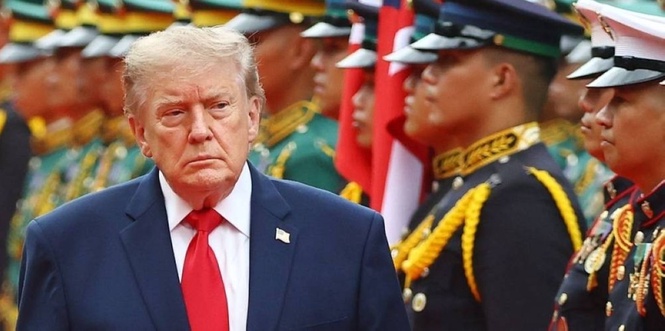
The Department of National Defense (DND) confirmed on Tuesday that the US is set to sell sensitive defensive weapons exclusively to the Philippines under the $2.4-billion defense deal President Donald Trump promised during his two-day visit to Manila this November.
According to the White House, the US will provide $2 billion in foreign military financing (FMF), alongside a $400-million Maritime Defense Allocation to strengthen the Philippine military’s operational reach and deterrence capabilities in the West Philippine Sea.
“The $400 [million] is FMF, Foreign Military funded. That’s a grant. That’s for the security sector road map items. The $2 billion is financed for capability acquisitions under the security sector road map, and some of those are not freely sold to other countries,” Defense Secretary Gilberto Teodoro Jr. told reporters.
He said there was a $100-million grant, as well as another $50-million to $60-million grant, for an ongoing Super Intelligence program hosted on the DND-Armed Forces of the Philippines cloud, fully financed.
“These items that we selected are very hard to get,” Teodoro said, without elaborating on the weapons to be procured.
A reliable partner
Teodoro also mentioned the US’ ironclad commitment to the Mutual Defense Treaty (MDT), amid questions about Washington’s credibility as a defense partner.
The MDT, Teodoro said, contains several provisions, with a focus on Article 4, the retaliation provision, and he believes being ironclad on deterrence — more than retaliation — should be the prime focus.
“You can be ironclad on Article 4, which is useless also because an attack has already occurred. So what we’re working on is Articles 2 and 3, meaning to say to work with one another to build deterrence,” he said.
“If something has already happened, you cannot reverse a death. You cannot reverse any damage to your society, but you can deter it. So that’s where we should work on, and that to me, as I see it now, is ironclad because they’re putting, proverbially, their money where their mouth is,” he said.
Article 2 of the 75-year-old treaty focuses on the individual and collective capacity to resist an armed attack through “self-help and mutual aid.” Article 3, meanwhile, requires both countries to hold regular check-ins on how the treaty is working and to immediately talk to each other if either feels threatened by a foreign attack.
Article 4, the core mutual defense clause, states that both nations promise to step in and respond to that shared threat.