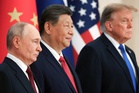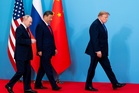
THE historic Trump-Xi-Putin summit may have opened a new chapter in global diplomacy. But will the rest of the world benefit from great power cooperation or merely watch as the superpowers make decisions?
History occasionally produces diplomatic moments whose significance extends beyond the agreements signed and photographs taken. The unprecedented trilateral summit among Chinese President Xi Jinping, United States President Donald Trump and Russian President Vladimir Putin in Shenzhen on Nov. 19, 2026, is one such moment.
Held on the sidelines of the 33rd Asia-Pacific Economic Cooperation (APEC) Economic Leaders’ Meeting, the gathering brought together three nuclear powers whose strategic competition profoundly influences international security, economic stability and the future global order.
The symbolism was unmistakable: Three leaders representing competing geopolitical interests chose engagement over diplomatic estrangement. The fundamental question is whether Shenzhen represents the beginning of sustainable great-power accommodation or merely a temporary convergence of interests among three powerful countries and leaders.
The wisdom of dialogue
and politics of power
Xi captured the meeting’s underlying rationale when he observed that history shows how peace among major powers strengthens global security, while confrontation produces turmoil. Trump concurred, declaring: “No peace was ever forged by declining opportunities for engagement and speech.”
These statements reflect an enduring diplomatic truth: Adversaries do not have to become friends before they begin talking. Indeed, dialogue becomes most indispensable when distrust is deepest and conflict most dangerous.
In this respect, Shenzhen offers a timely reminder that diplomacy is not capitulation, engagement is not endorsement, and negotiations are not signs of weakness.
Yet another reality deserves equal attention. When powerful countries negotiate among themselves, whose interests are represented and whose concerns might be overlooked? That distinction separates a cooperative international order from a modern concert of great powers.
Four principles
Xi articulated four principles for managing major-power relations: mutual respect, peaceful coexistence, mutually beneficial cooperation, and dialogue and consultation. His emphasis on sovereignty, territorial integrity, noninterference and respect for different political systems offers an alternative to relationships dominated by ideological confrontation and coercive pressure.
These principles have particular appeal for developing countries that have experienced foreign intervention, unequal economic relationships and external political pressure. However, principles become credible only through consistent application.
Respect for sovereignty must extend beyond powerful countries to smaller states. Noninterference cannot become a convenient shield against legitimate international obligations. And peaceful coexistence must mean more than avoiding direct military confrontation while conflicts continue elsewhere.
The summit’s four-point “Declaration toward Peace” addressed United Nations reform, increased refined petroleum supplies, international criminal jurisdiction and reducing nuclear risk. The nuclear provision was particularly significant. The leaders reaffirmed that nuclear war cannot be won and must never be fought, committing themselves to dialogue on reducing nuclear risks.
A new Yalta?
The trilateral inevitably invites comparisons with the 1945 Yalta Conference, where Allied leaders negotiated arrangements affecting the postwar international order. The analogy is imperfect, but its underlying warning remains relevant. Great-power cooperation can reduce systemic instability. Yet it can also produce arrangements in which smaller countries’ interests are subordinated to the calculations of stronger states.
A contemporary US-China-Russia accommodation could reduce military escalation, stabilize energy markets and create opportunities for arms-control negotiations. But an exclusive three-power arrangement could also marginalize Europe, Asean, Africa, Latin America and other countries whose security and development would be affected by its decisions. For the rest of the world, the essential question is not simply whether the US, China and Russia can coexist peacefully. It is whether their coexistence will expand other nations’ strategic autonomy or constrain it. A durable international order cannot be built on an implicit division of the world into privileged spheres of influence. Peace negotiated by powerful states must not come at the expense of less powerful states’ sovereignty.
Trump’s revealing
admission: What
happens after him?
Perhaps the most politically revealing statement surrounding Shenzhen came from Trump himself. “Now, what happens after me? That I can’t tell you.” That admission exposes a fundamental vulnerability in personalized diplomacy. Trump’s willingness to engage Xi and Putin may create openings that conventional diplomatic approaches have struggled to achieve. Personal relationships can facilitate communication, overcome bureaucratic resistance and enable difficult negotiations. But personal chemistry is not an institutional guarantee.
American foreign policy is influenced by Congress, defense establishments, intelligence agencies, ideological constituencies, economic interests and competing strategic schools of thought. There are influential voices in Washington that regard China as America’s principal strategic competitor and Russia as an enduring security threat. Some will also question whether accommodation weakens deterrence or undermines established alliances. Others may resist agreements they perceive as compromising US strategic primacy. Thus, a successful peace initiative is measured not by whether it survives a summit photograph, but by whether it survives political opposition, strategic disagreements and domestic leadership changes, insofar as the US is concerned. Hence, institutionalized dialogue, practical agreements, monitoring mechanisms and durable diplomatic commitments are needed. Otherwise, Shenzhen risks becoming another fleeting episode in a seemingly personality-driven international politics.
APEC and the economic foundations of peace
While the trilateral captured international attention, the broader APEC Summit reinforced commitments to regional economic integration, technological innovation, digital transformation and resilient supply chains. This economic dimension matters.
China, the US and Russia possess complementary economic strengths in manufacturing, consumption, technology, energy and strategic resources. Greater cooperation could potentially reduce supply disruptions, improve energy security and moderate economic uncertainty.
For developing economies, these benefits could be substantial. However, greater cooperation among major powers does not automatically guarantee equitable development. The real question is whether smaller economies gain better market access, technology transfers, investment opportunities and meaningful participation in setting international standards.
Economic interdependence contributes to peace most effectively when its benefits are broadly distributed, and political disagreements can be managed without weaponizing trade and technology.
What Shenzhen means
for Asean, the Philippines
For Asean, the trilateral summit among the three superpowers offers an opportunity to reduce confrontation among major powers and create more diplomatic space for Southeast Asian countries to pursue economic development without pressure to choose exclusive geopolitical alignments, while preserving independent judgment.
For the Philippines, the implications are equally consequential. Manila must protect its maritime rights and legitimate security interests while preserving opportunities for diplomacy, trade, investment and regional cooperation. The Philippines must avoid becoming unnecessarily exposed to conflicts beyond its direct national interests by pursuing an independent foreign policy anchored in national interests, international law, credible defense, economic pragmatism and sustained diplomacy.
Conclusion
The Shenzhen trilateral among the three major powers, China, the US and Russia, demonstrated that dialogue remains possible even among deeply competing superpowers. That alone has diplomatic significance. But the world should keep working toward peace because conflicts still remain in different parts of the globe, strategic distrust persists and institutional disagreements remain unresolved.
Above all, the countries outside the trilateral must insist that their security and development cannot be negotiated away without their participation. Insofar as peace and development are concerned, the ultimate achievement would not be a world governed by understandings among superpowers, but one in which their cooperation makes every nation more secure.