
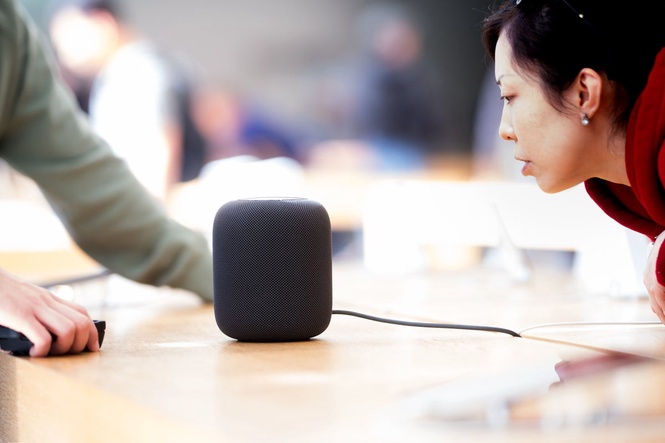
Apple is about to try and break into a whole new product category – and it might be coming at a pivotal time for the future of the company.
This week, on 13 October, Apple is hosting a “Welcome Home” event that will represent a major attempt to break into the smart home. The headline of the launch event is rumoured to be the “HomeView”, a new screen meant to be placed around people’s houses that will allow them to interact with Siri and see information.
But it represents not just a new kind of product for Apple, in a new category. It could also help decide whether the iPhone maker is really able to make the most of the latest developments in artificial intelligence, or if it will be overtaken by rivals such as Google and OpenAI.
Because the HomeView and the smart home push more generally also represent an opportunity to make Apple and its Siri virtual assistant the way that people organise their lives. And the two cannot easily be split apart.
Apple has tried to break into the smart home before. But all of its attempts have run into various troubles.
It launched its HomeKit framework in 2014, to allow different devices to work together, and in 2016 released a devoted Home app for controlling those devices. Neither really took off, however, with some pointing to the limitations of Siri and others suggesting that Apple’s strongest requirements for devices held the products back.
It has also tried with hardware: in 2017, it released the HomePod, before discontinuing it in 2021 and bringing it back in 2023, and since 2020 it has also offered a smaller and less powerful HomePod Mini. But they too have struggled to gain adoption, with Siri once again blamed as well as their high prices relative to other products made by Google and Amazon as well as devoted audio companies such as Sonos.
Now, however, Apple says that it has fixed Siri, with a new version announced in summer that arrived last month. That update completely overhauled the voice assistant, adding new artificial intelligence features in an attempt to catch up with rivals such as Google.
The new home products – which along with the HomeView also include an updated HomePod Mini and Apple TV, both focused around Siri – have long been rumoured to be on their way. In recent months, reports have suggested they have actually been finished for some time, but that Apple was waiting until its redesign of Siri was ready.
That is evidence of just how important the virtual assistant is to those devices, and the ways that Apple will try and convince people that the products are useful. But the fact they are arriving now is evidence of both the belief that Apple has in that new update to Siri, as well as the central role it now plays in its strategy generally.
The updated virtual assistant – which Apple has branded as Siri AI – is not simply an improvement to the user experience, and a complete overhaul of the technology to allow that improvement. It also represented a change of the ways that Apple thinks about Siri, with the company positioning it as a new way to interact with devices, built around the fact that it can now access all of a users’ data and act on it.
As such, it is not just a product improvement, but also an attempt to see off the threat from rivals such as OpenAI, Meta and others, all of which are making hardware products that allow people to carry artificial intelligence around in their pockets. Those products are based on a new vision of the way that people will interact with technology: by speaking to their devices and then having them take actions on their behalf, rather than the now-traditional model of tapping through menus.
Many of those rival companies present their products as ways of moving past the phone, which some have even suggested could be under threat entirely. Apple on the other hand has continued to stress that the new technology will be accessed through existing devices – for perhaps obvious reasons, given the centrality of the iPhone to its profits – but that they could be augmented by new products, from its rumoured smart glasses to the upcoming home devices.
Apple clearly believes that the iPhone is at the centre of its strategy for a new AI-powered era: at the launch of its latest versions, last month, new chief executive John Ternus laid out a vision of the phone being at the centre of an “intelligent personal hub”. He pointed out that a version of this product designed from the ground-up would require a powerful processor, a display, sensors such as cameras and more – exactly like an iPhone, in short.
But the company has also suggested that part of the power of that vision is that the iPhone is the hub at the centre of a whole range of other products. In the same event, for instance, it announced a controversial new Apple Watch feature that allows it to use its microphones to produce notes on important conversations, presumably in part so that they can be used to feed that AI system.
The home products are presumably part of the same strategy: giving people different ways to both give and receive information from that digital assistant, distributed through a network of different Apple-branded products. The iPhone will still sit at the heart of it – as well as being the device that is with people wherever they are, rumours suggest that the HomeView will be able to connect to phones for authentication and to share data – but Apple looks set to try and put Siri wherever you need it, in whatever form works best.
Whether that works will depend entirely on whether those new devices – from smart glasses to the smart home – are enough to see off the threat from companies that want their products not only to sit alongside the iPhone but make it obsolete. Doing so will require Apple to rely on two products that have long been among the company’s relative weaknesses: Siri and its AI offering more broadly, and the smart home.
The success of those will decide the future of Apple itself: if it can move Siri into the centre of our lives, then it could retain its position at the top of the personal technology industry, but failing to do so could allow it to be overtaken. But that will also decide the future for the rest of us, too, changing the role that technology takes in our lives.
Read MoreAnthropic forced to ban models from the internet to stop them going ‘rogue’
People are saying something huge just happened on social media. It’s not quite true
Mathematicians are very, very angry at OpenAI. Here’s why
Apple is about to launch a whole new kind of Mac
Using AI for even 10 minutes makes it harder to do difficult things, study finds
Online ‘safe space’ tool for domestic abuse survivors launched by Nationwide


