
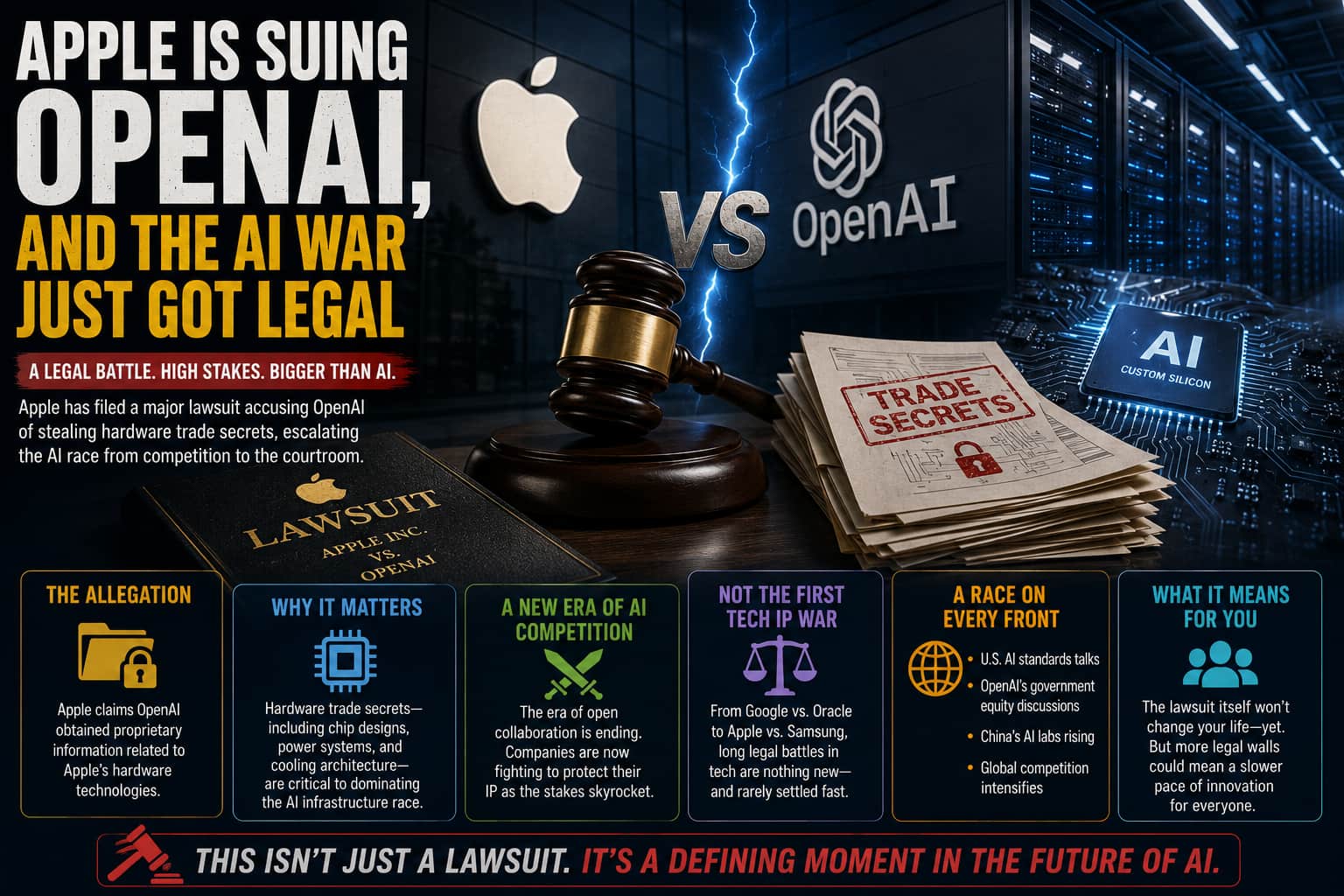
The competition between technology companies to dominate artificial intelligence has been fierce for years. Companies have poached each other's researchers, undercut pricing, and raced to release bigger models faster. But until now, the battle has mostly played out in product launches and press releases. That changed when Apple filed a major lawsuit accusing OpenAI of stealing hardware trade secrets.
The details of the lawsuit have not been fully disclosed publicly, but reports indicate Apple alleges that OpenAI obtained proprietary information related to Apple's hardware technologies. If the allegations hold up, this would represent one of the most significant intellectual property disputes in the AI industry to date.
The lawsuit arrives at a moment when the AI race has moved beyond who builds the best model. The focus now is on infrastructure: chips, data centres, energy, and the physical hardware that makes large-scale AI possible. Companies are securing custom chips, building power infrastructure, and locking down supply chains in ways that look more like the oil industry than the software business.
In that context, hardware trade secrets are enormously valuable. The design of custom silicon, power management systems, and cooling architectures can provide lasting competitive advantages that software alone cannot replicate. If OpenAI did access Apple's proprietary hardware knowledge, the implications go beyond a legal settlement. It could reshape how AI companies interact with the broader technology ecosystem.
For the broader industry, the lawsuit signals a shift. The early years of the AI boom were characterised by relatively open collaboration, with researchers publishing papers, sharing code, and moving freely between companies. That era appears to be ending. As the commercial stakes grow, so does the incentive to protect intellectual property aggressively.
This is not the first time IP disputes have erupted in the tech world. Google and Oracle spent a decade fighting over Java APIs. Apple and Samsung waged a global patent war over smartphone designs. These disputes tend to be long, expensive, and difficult to resolve cleanly. The Apple-OpenAI case could follow a similar path.
The timing also coincides with other shifts in the AI landscape. The U.S. government is in advanced discussions with AI companies about voluntary standards for model releases. OpenAI has floated an equity stake to the government. China's AI labs are challenging American models on open benchmarks. The competitive environment is intensifying on every front.
For consumers, the lawsuit itself will not change much in the short term. But the broader trend it represents, of AI companies moving from cooperation to confrontation, could slow down the pace of innovation if companies become more protective and less willing to share advances.
My Opinion
Lawsuits in tech tend to be as much about signalling as they are about actual damages. Apple suing OpenAI sends a message to the entire industry: the days of treating hardware and software IP casually are over. Whether or not Apple wins this specific case, every AI company is now on notice that the rules of engagement have changed. The question is whether that leads to more careful innovation or just more lawyers.
Ronny M (ronny76netstuff@gmail.com) is a content creator under the Newswav Creator programme, where you get to express yourself, be a citizen journalist, and at the same time monetize your content & reach millions of users on Newswav. Log in to creator.newswav.com and become a Newswav Creator now!
The User Content (as defined on Newswav Terms of Use) above including the views expressed and media (pictures, videos, citations etc) were submitted & posted by the author. Newswav is solely an aggregation platform that hosts the User Content. If you have any questions about the content, copyright or other issues of the work, please contact creator@newswav.com.