

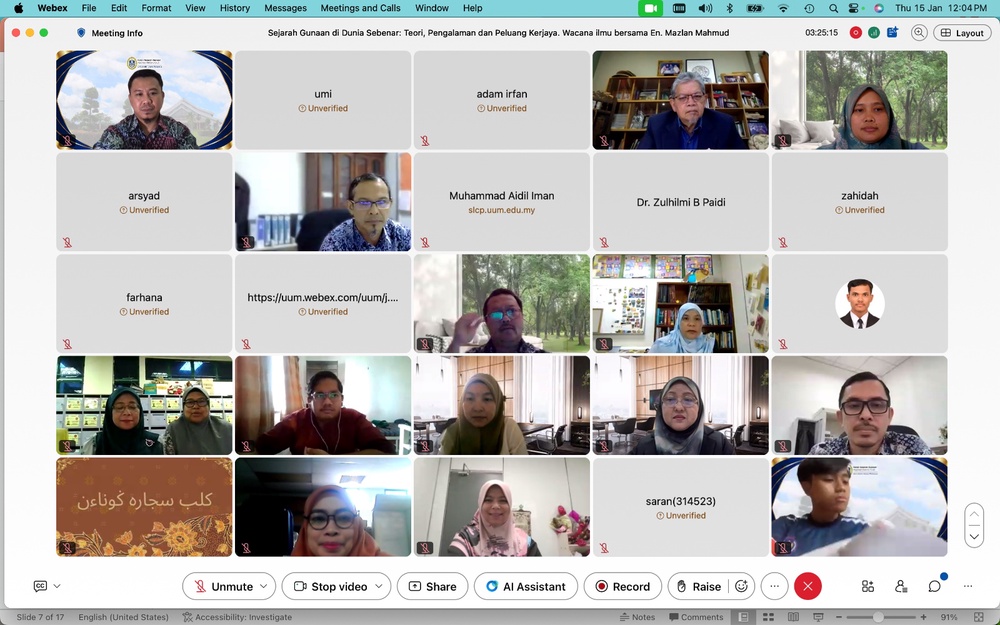
On 15 January 2026, I was invited by the Malaysian History and Nationhood Unit, School of Languages, Civilisation and Philosophy, Universiti Utara Malaysia (UUM), together with the Applied History Club, to present a talk entitled “Applied History in the Real World: Theory, Experience and Career Opportunities.” I was invited in my capacity as an External Industry Assessor for the Bachelor of Applied History with Honours Programme. The webinar was attended by more than 100 participants, comprising students and lecturers.
One of the most thought-provoking questions raised during the session was whether history truly repeats itself. My response was based on the ideas of the renowned Islamic historian and philosopher, Ibn Khaldun, who argued that history moves in cyclical patterns. The rise and fall of civilizations occur through four main stages: first, the nomadic phase marked by strong social cohesion and competition for power; second, the phase of urbanisation and empire-building; third, the phase of glory characterised by prosperity and complacency; and finally, the phase of decline when the welfare of the people and the state is neglected. This cycle of rise and fall recurs across civilizations throughout history. Between the Circle and the Line: Ibn Khaldunâ•Žs View of History and Change
Universiti Utara Malaysia is the only public university in Malaysia that offers a Bachelor of Applied History with Honours Programme under the School of Languages, Civilisation and Philosophy. Attracting students to this programme is not an easy task, as interest in history has been steadily declining, particularly at the school level, where history is often perceived as a dull and difficult subject with limited career prospects compared to fields such as science, medicine, business and law. This perception reflects the mindset of today’s generation.
In reality, however, history should be viewed as a field capable of creating jobs rather than merely seeking them. Graduates of applied history have the potential to become histo-preneurs by developing historical icons and narratives tailored to market demand. Through academic excellence and scholarly publications, research findings can be transformed into tourism products, digital storytelling, film production and other creative outputs. Graduates must be innovative, entrepreneurial and capable of championing the historical products they develop.
During the session, I also shared my experience in promoting archaeotourism, including the challenges faced when archaeological discoveries in Lenggong and the Bujang Valley initially failed to generate economic benefits for local communities. This was largely due to the wide gap between academia and society, as academic discourse often remains confined within exclusive scholarly circles.
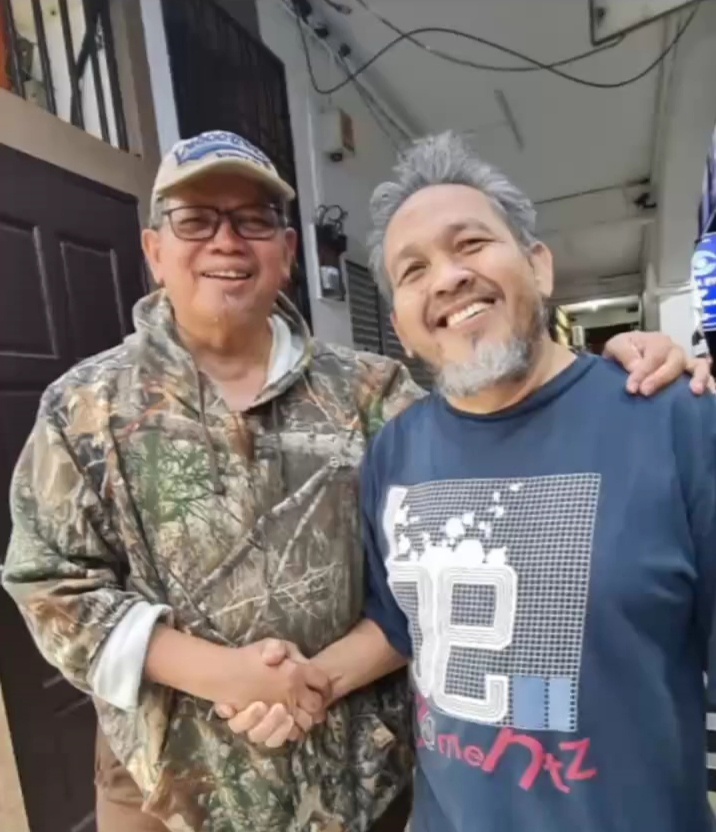
Nevertheless, I was fortunate to receive close collaboration from Dr. Mokhtar Saidin, former Director of the Global Archaeology Research Centre, Universiti Sains Malaysia, who was also my mentor in archaeology and geology. Together, we developed archaeotourism and geotourism initiatives at the UNESCO World Heritage Site of Lenggong, the Guar Kepah Neolithic site, and the early civilisation site of Sungai Batu in the Bujang Valley. Although much work remains to be done to further refine these initiatives, archaeotourism products have now been recognised by Tourism Malaysia as one of the country’s tourism offerings, alongside ecotourism, medical tourism, educational tourism and others.
In closing, I would like to share an inspirational message with students of applied history from Dr. Muhammad Yunus, the 2006 Nobel Peace Prize laureate and founder of microcredit and micro-finance in Bangladesh:
“Be a job creator, not a job seeker.” Universities should create entrepreneurs, not just job seekers: Dr Yunus
Citra Alam (ancientkedahheritage@gmail.com) is a content creator under the Newswav Creator programme, where you get to express yourself, be a citizen journalist, and at the same time monetize your content & reach millions of users on Newswav. Log in to creator.newswav.com and become a Newswav Creator now!
The User Content (as defined on Newswav Terms of Use) above including the views expressed and media (pictures, videos, citations etc) were submitted & posted by the author. Newswav is solely an aggregation platform that hosts the User Content. If you have any questions about the content, copyright or other issues of the work, please contact creator@newswav.com.