In a dim corner of Riyadh, a woman wearing a black niqab lifts a frosty glass to her lips. She is not breaking any law. She is not clinking real beer. Instead, she sips a non-alcoholic, “halal” brew. The scene has gone viral veiled Saudis sipping pints in a café that mimics a Western-style pub. For many in the conservative kingdom, it’s a quiet cultural earthquake.
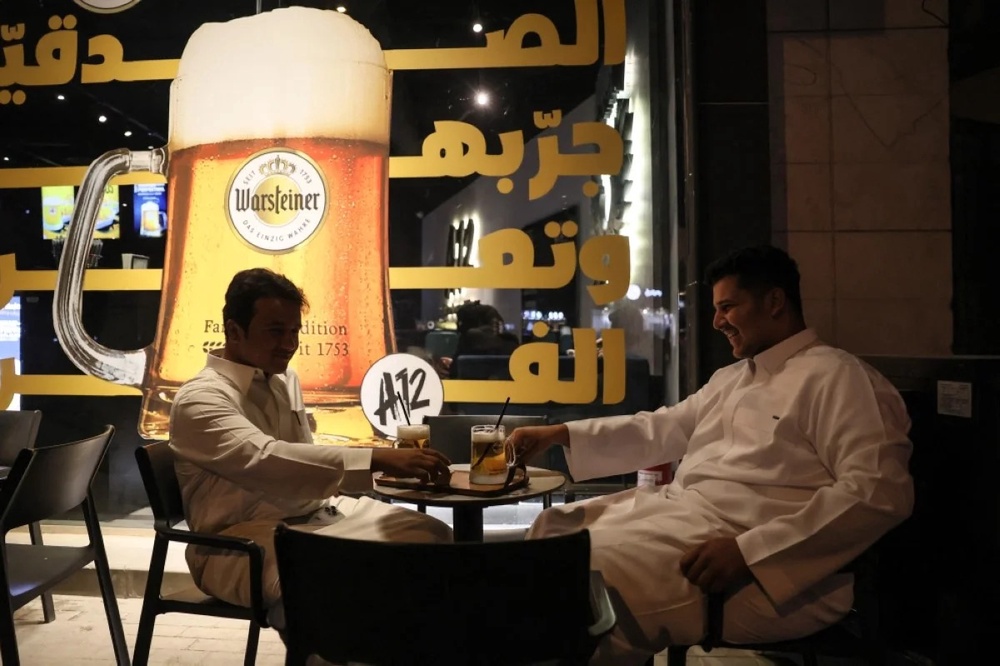
In recent months, photos and videos from A12 café in Riyadh have circulated widely: men in white thobes, women lifting their niqabs to take a sip, laughter, peanuts, big-screen sports, and beer-style glasses but no alcohol content and no hangovers. (IOL)
The manager, Abdallah Islam, told AFP that the idea is to give Saudis an “original experience they can share on social media.” (IOL) The beverage being served? A 0.0 percent non-alcoholic draft beer, described as a German Warsteiner-style malt drink. (Kuwait Times)
This isn’t about rebellion. It’s about a carefully calibrated evolution. Saudi Arabia still bans intoxicating drinks under Sharia law, and public sale of alcohol remains prohibited. But what’s changing is not the religion. It is how Saudis are redefining the boundaries of social life, leisure, and even pleasure.
The Fine Line Halal or Haram?
To some Western eyes, non-alcoholic beer might seem like a compromise. To many Muslim scholars, it is an acceptable indulgence if it truly contains no intoxicants.
According to IslamQA, a respected religious authority, non-intoxicating beer even if it contains minuscule traces of alcohol is permissible. (Islam-QA) And the late Grand Mufti Shaykh Abdul-Azeez ibn Baaz ruled similarly: “If the beer is free of intoxication, there is no harm.” (binbaaz.com)
One notable precedent comes from Shaykh Saleh Al Uthaymeen, who said that malt-style drinks with negligible alcohol are allowed. (Prima Quran)
These rulings carry real weight in Saudi Arabia. They make a “halal beer pub” not just plausible, but socially and religiously legible.
The Broader Trend
This phenomenon at A12 café is far from isolated. It reflects the steady growth of a non-alcoholic beverage culture across the kingdom part of a broader social shift under Crown Prince Mohammed bin Salman’s modernization drive, Vision 2030. (DialoguePakistan)
Non-alcoholic malt drinks such as Barbican, Moussy, and Holsten 0.0 are widely available in Saudi supermarkets, cafés, and even social media posts. (The Beer Atlas) Meanwhile, limited versions of alcohol sales are creeping in though only for non-Muslim diplomats via a tightly controlled liquor store in Riyadh’s Diplomatic Quarter. (TIME)
In a surprising twist, authorities plan to allow alcohol in up to 600 designated zones but only for non-Muslim visitors in luxury hotels and tourist areas such as NEOM and the Red Sea Project. (DialoguePakistan)
Saudi cultural life is opening, step by step. But in many spaces, for many Saudis, the preference leans toward familiar tradition coated with a hint of modern playfulness.
Why This Moment Feels Big
On the surface, a cafe serving zero-alcohol beer might seem trivial. But culturally, it speaks volumes.
Breaking Taboos
For decades, alcohol was a non-negotiable line in public life. By introducing non-alcoholic malt drinks in a public “pub” environment, A12 is subtly redrawing that line without challenging religion.
Social Media Amplification
The café’s Instagrammable design pints, peanuts, screens is exactly what Abdallah Islam envisioned: shareable, aspirational. Social media has amplified this tiny shift into something symbolic.
Women in Focus
The viral images of niqab-wearing women holding beer-like glasses test assumptions. They complicate Western narratives about Saudi women. These women aren’t rejecting faith. They’re embracing a space where self-expression and leisure are not mutually exclusive.
Economic Dimensions
The growth of non‑alcoholic drink culture feeds into Saudi’s economic diversification. These drinks are consumer goods, retail products, social experiences all aligned with Vision 2030 goals to boost tourism and local spending.
Voices from the Kingdom
Religious scholars affirm the legitimacy of non-intoxicating malt drinks. But entrepreneurs in Saudi see them also as a social experiment.
Abdallah Islam, the A12 café manager, put it simply: “We wanted something familiar, yet new. A place Saudis can relax, enjoy, and feel safe.” (Images)
Patrons expressed a mix of excitement and caution. One frequent visitor asked: “Is there alcohol in this?” when handed his pint. The laughter that followed told its own story. (Kuwait Times)
The Risks and Limits
This is not a full cultural “liberation.” Legal curbs remain tight.
- Public sale of alcoholic drinks is still a red line.
- There’s no guarantee that more liberal zones for real alcohol will be widely accepted or fully implemented.
- Conservative voices remain skeptical. Even non-alcoholic beer can spark theological debate. Some argue that marketing malt drinks like beer risks confusing young Muslims about the real definition of khamr (intoxicants).
- And while non-alcoholic beer is “permitted” by many scholars, it is not necessarily encouraged. It raises questions: is it morally neutral, or a symbolic concession?
Why Women in Niqabs Sipping “Beer” Matters
The image of a veiled woman lifting a glass of non-alcoholic beer is powerful. It is, in many ways, an emblem of modern Saudi tension:
- Tension between tradition and globalization: Saudis want new experiences, but not at the cost of their religious identity.
- Tension between youth culture and religious conservatism: younger Saudis, especially women, are testing the boundaries of what is culturally permissible.
- Tension in gender dynamics: in more liberal societies, drinking beer is often coded as masculine. In Saudi Arabia, a woman in abaya holding a cold glass disrupts that.
It’s not a rebellion. It’s a negotiation.
The Bigger Picture
This isn’t just about a café. It’s part of a broader narrative: Saudi Arabia is evolving on its own terms. Rather than importing a Western-style bar culture, parts of society are cultivating a halal space for leisure.
For foreign observers, it’s easy to view reform in binary terms: conservative vs liberal, religious vs secular. But what’s playing out in Riyadh is more nuanced. It’s not about “allowing alcohol.” It’s about reimagining permissible pleasures in a way that stays rooted in religious values.
The viral image of a niqab‑clad woman cheering with a beer‑style glass is more than a social media moment. It is a reflection of a country in transition where piety and pleasure are being re‑balanced.
In the heart of Riyadh, a little café became a testing ground for something much bigger: a new social contract. For some Saudis, enjoying a cold, “halal” pint is not about defiance. It is about belonging to their faith, their society, and a modern identity they are shaping with care.
As the world watches Saudi Arabia prepare for more tourism, more business, and more global spectacle, the sip of a non-alcoholic beer in a pub-like café may turn out to be one of the most meaningful gestures of change.
AM World (tameer.work88@gmail.com) is a content creator under the Newswav Creator programme, where you get to express yourself, be a citizen journalist, and at the same time monetize your content & reach millions of users on Newswav. Log in to creator.newswav.com and become a Newswav Creator now!
The User Content (as defined on Newswav Terms of Use) above including the views expressed and media (pictures, videos, citations etc) were submitted & posted by the author. Newswav is solely an aggregation platform that hosts the User Content. If you have any questions about the content, copyright or other issues of the work, please contact creator@newswav.com.