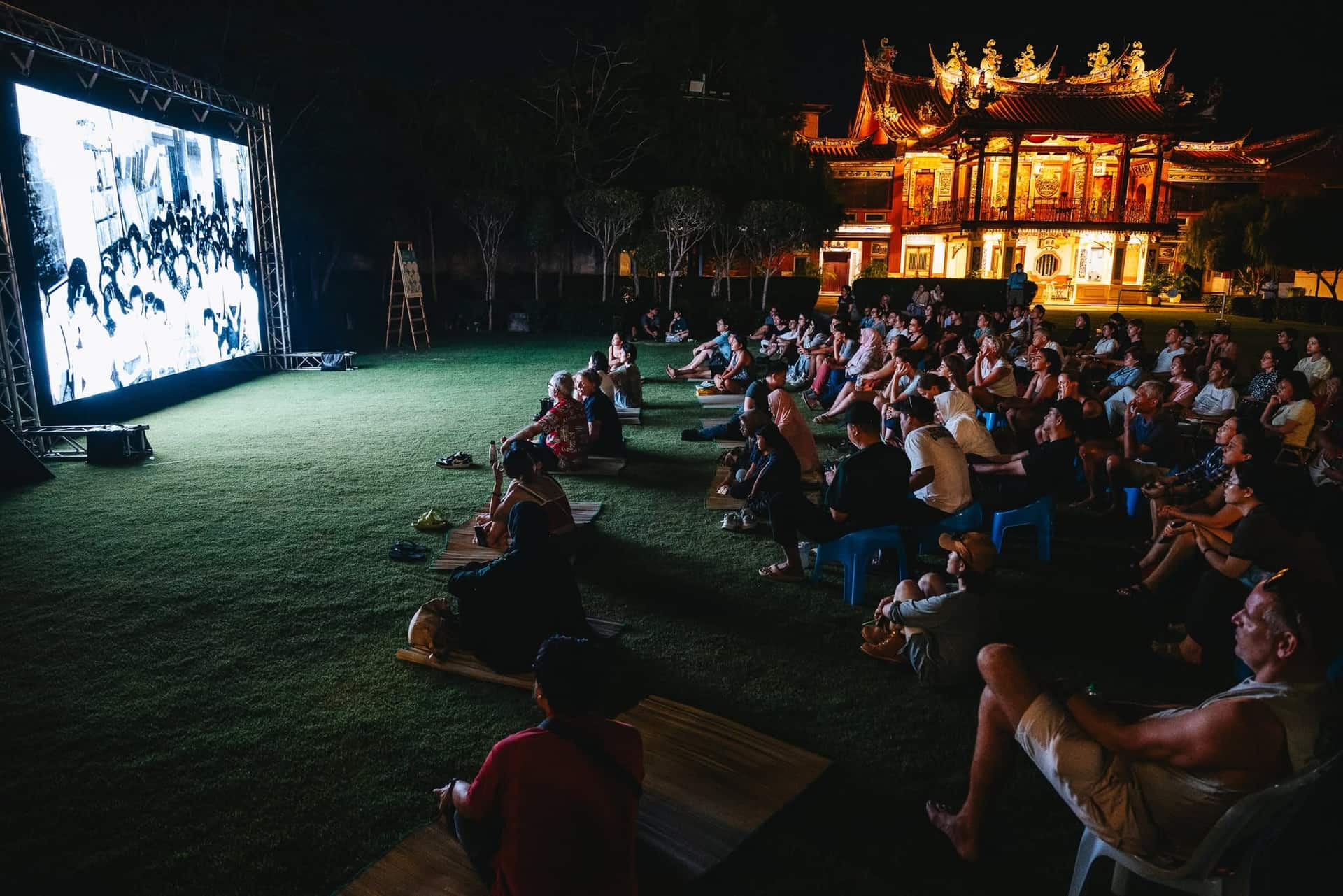
Stars gleaming in a velvet sky.
Mats dotting a well-manicured lawn.
Faint glow of a giant screen.
Plastic and foldable chairs beckoning the guests.
Cool eventide breeze gently brushing against the arms.
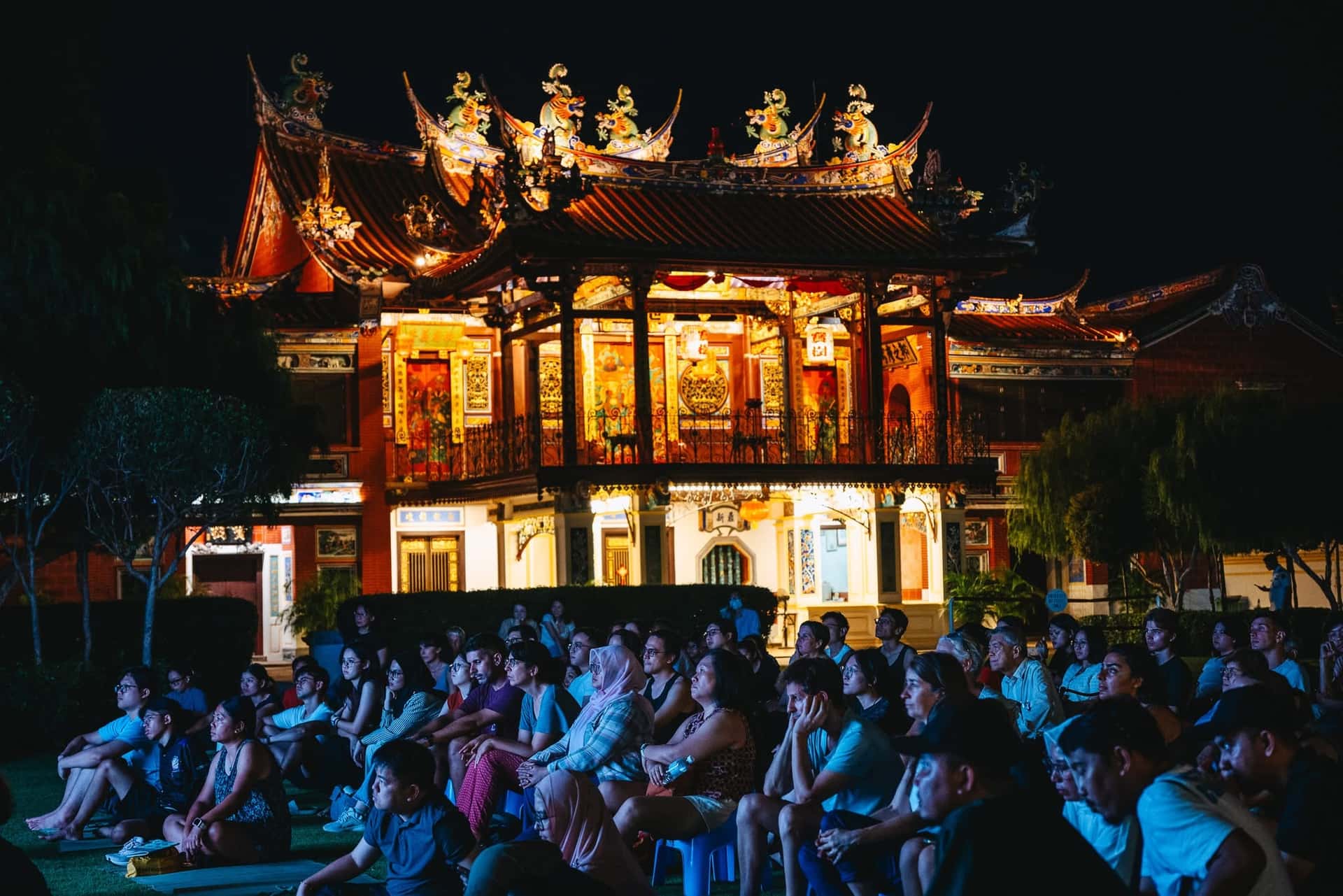
Seh Tek Tong Cheah Kongsi majestically lit and standing proud.
Such was the setting for Wayang Pacak at the latest edition of the George Town Festival 2026, where I found myself one evening.
There was something almost magical about watching a film outdoors. It felt less like entering a cinema and more like being invited into someone’s backyard for a shared evening of stories. Except this backyard happened to be one of George Town’s beautiful heritage spaces, and instead of a television in the living room, there was a giant screen glowing against the night sky.
Wayang Pacak brought together a curated selection of Malaysian and Asian independent films, documentaries, animations and feature presentations, reviving the nostalgia of open-air cinema while creating a space for people to come together, watch, reflect and connect. This free-admission event ran from August 3rd to 9th at the lovely grounds of Seh Tek Tong Cheah Kongsi, right in the heart of Penang’s heritage area.
People trickled in as the evening grew darker. Some settled themselves on the mats, while others opted for the chairs. There was a casualness to it all that made the experience feel quite different from the usual cinema outing. Nobody was rushing to find their numbered seat or whispering apologies as they squeezed past someone to get to the middle of a row. We were simply there, under the stars, waiting for the stories to begin.
I made it to the August 6th screening of TRACE/US and The Weight of Silence. The theme was “Silence, Love and Loss.” As it turned out, it was a theme that would stay with me long after the screening ended.
TRACE/US was shown first. It was an interesting, albeit visually distracting, format of two documentary video essays, each occupying one half of the screen and running simultaneously side by side. At first, I found myself unsure where to look. My eyes kept darting between the two halves, trying to take in both stories at once. It was almost like having two conversations happening beside each other and having to decide which one to listen to.
But perhaps that slight sense of disorientation was part of what made the work interesting.
TRACE/US followed the journeys of two artists, Leysha Al-yahya and Theyvapaalan S. Jayaratnam, as they pieced together avatars of people they have loved and lost.
Both videos featured old photographs of the artists’ loved ones, tracing their life journeys through captured memories. Leysha showed excerpts from her late grandfather’s diary entries. Theyvapaalan shared her late father’s poetic love notes to her mother.
There was something deeply intimate about being allowed into these fragments of other people’s lives. Old photographs have a strange power. We look at a face frozen in time and, for a moment, imagine the life that existed beyond that photograph — the conversations, the laughter, the disagreements, the ordinary days that never seemed important enough to record.
Although strangers to me, I felt oddly connected to the artists through the nostalgic ache of those archival materials, and the overwhelming sense of wanting to preserve a person’s essence through the bits and bobs of them left behind.
Perhaps that is what grief does. We become accidental archivists of the people we have lost. We keep their photographs, their handwriting, their messages, their favourite things. We hold on to these little pieces because somehow, they make the person feel less gone.
TRACE/US left me with that feeling of wanting to look back at the people and moments I have loved, and wondering what fragments of them I have kept without even realising it.
Then came Ezzah Mahmud’s The Weight of Silence.
If TRACE/US explored the traces people leave behind after they are gone, The Weight of Silence turned its gaze towards the things that remain unspoken among those who are still here.
The Weight of Silence must be commended for its courageous vulnerability. Ezzah’s personal documentary laid bare her relationship with her sister, which bore the scars of emotional silence stemming from their mother’s mental health struggles.
This video also used old photographs, this time to trace their shared childhood trauma. The photographs were familiar in the way old family photographs often are — moments that might have looked perfectly ordinary to an outsider. But behind those images was a childhood shaped by experiences the sisters had not known how to articulate at the time.
When asked by Ezzah why they had not talked openly about how they felt growing up with their mother’s condition, her sister Faridah said it was because they were never taught how to — that broke my heart.
It was such a simple answer, but perhaps that was what made it hurt even more. Sometimes silence is not a choice. Sometimes it is simply the only language we were taught.
Children can grow up surrounded by love and still not know how to talk about pain. Families can care deeply for one another and yet become very good at avoiding the conversations that hurt. And years later, those unspoken words can become a weight of their own.
It was a bonus to have Ezzah join us via a call for a Q&A session after the screening. There was something particularly meaningful about hearing from the person behind the film after watching such an intensely personal piece of work. It gave the audience a chance not only to understand the film better, but also to hear the voice behind the vulnerability we had just witnessed on screen.
By then, the night had become much more than an evening of watching films.
I had not expected to have my heart put through the wringer like that at my first experience of “outdoor cinema”. I am glad I went.
There’s something special about sharing a communal space and bearing witness to other people’s personal stories that is both comforting and healing. Around me were strangers who had come for the same reason — to watch. Yet for that hour or so, we sat in silence and collectively held space for stories about love, grief, family and the things we struggle to say.
Maybe that is the magic of Wayang Pacak. It is not just about watching a film under the stars. It is about being reminded that behind every face, every family photograph and every silence, there is a story.
And sometimes, all we need is a little darkness, a patch of grass and a screen under the stars to make us brave enough to listen.
I would gladly do it again.
About the writer:
La Ling is a writer drawn to the intersections of books, education and the arts, where stories become both mirror and map. Dreamy by nature yet pragmatic at heart, she is endlessly lit up by stories—told in books, on stages, in songs, through movement, and in the lives of people from all walks of life. Often finding herself swimming in opposite directions, she is always going somewhere, even if she’s not quite sure where she will arrive.
Seni:Kita (pentaspena.pg@gmail.com) is a content creator under the Newswav Creator programme, where you get to express yourself, be a citizen journalist, and at the same time monetize your content & reach millions of users on Newswav. Log in to creator.newswav.com and become a Newswav Creator now!
The User Content (as defined on Newswav Terms of Use) above including the views expressed and media (pictures, videos, citations etc) were submitted & posted by the author. Newswav is solely an aggregation platform that hosts the User Content. If you have any questions about the content, copyright or other issues of the work, please contact creator@newswav.com.