
There are plays you enjoy, and then there are plays that quietly sit with you long after the lights come up. Dua Darah belongs firmly in the latter.
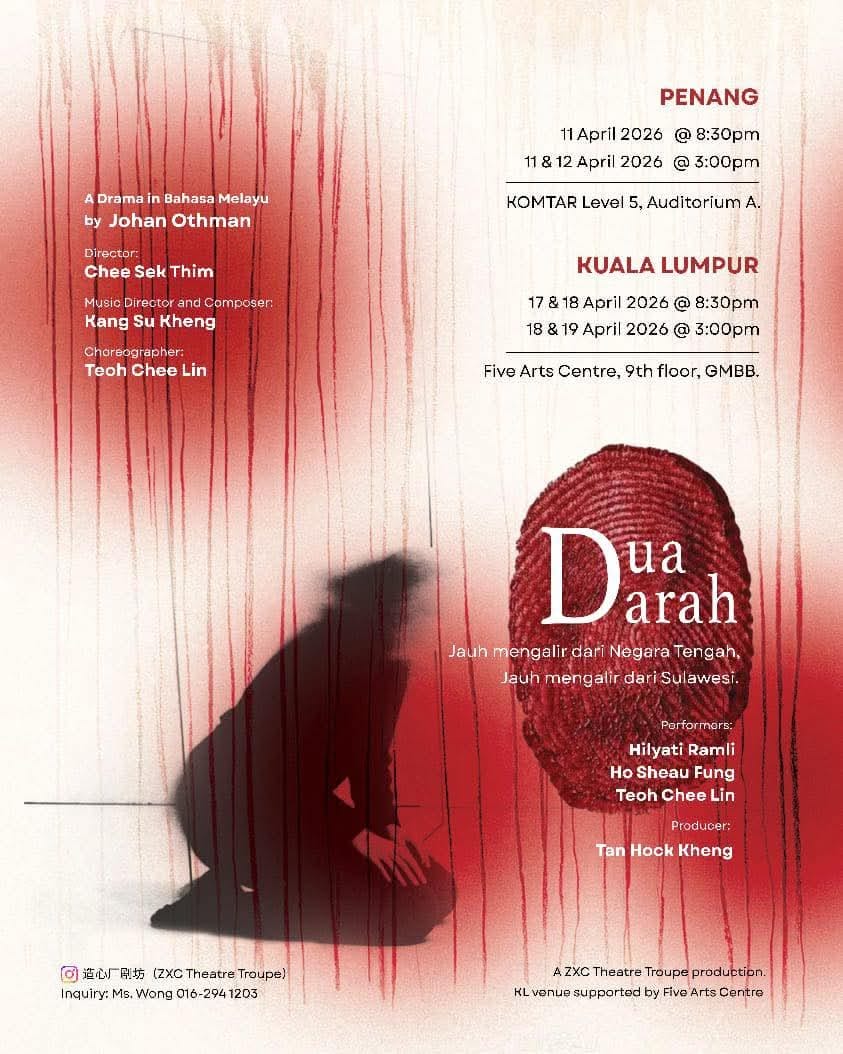
Dua Darah explores the inner racial and religious conflict of a Chinese-Malay man who is given the responsibility of attending and performing the Chinese funeral rites for his deceased aunt. During the three-day funeral, he revisits the personal struggles he and his family endured as Malay-Chinese Muslims.
Developed over time by playwright Johan Othman, director Chee Sek Thim, and producer Tan Hock Kheng, the work didn’t appear overnight. It was shaped through months of discussion and refinement, eventually evolving from an English script into a richly layered multilingual piece, blending Bahasa Melayu with English, Hokkien, and Mandarin.
That layering is felt throughout the performance. This is not just a story about identity, it is identity in motion.
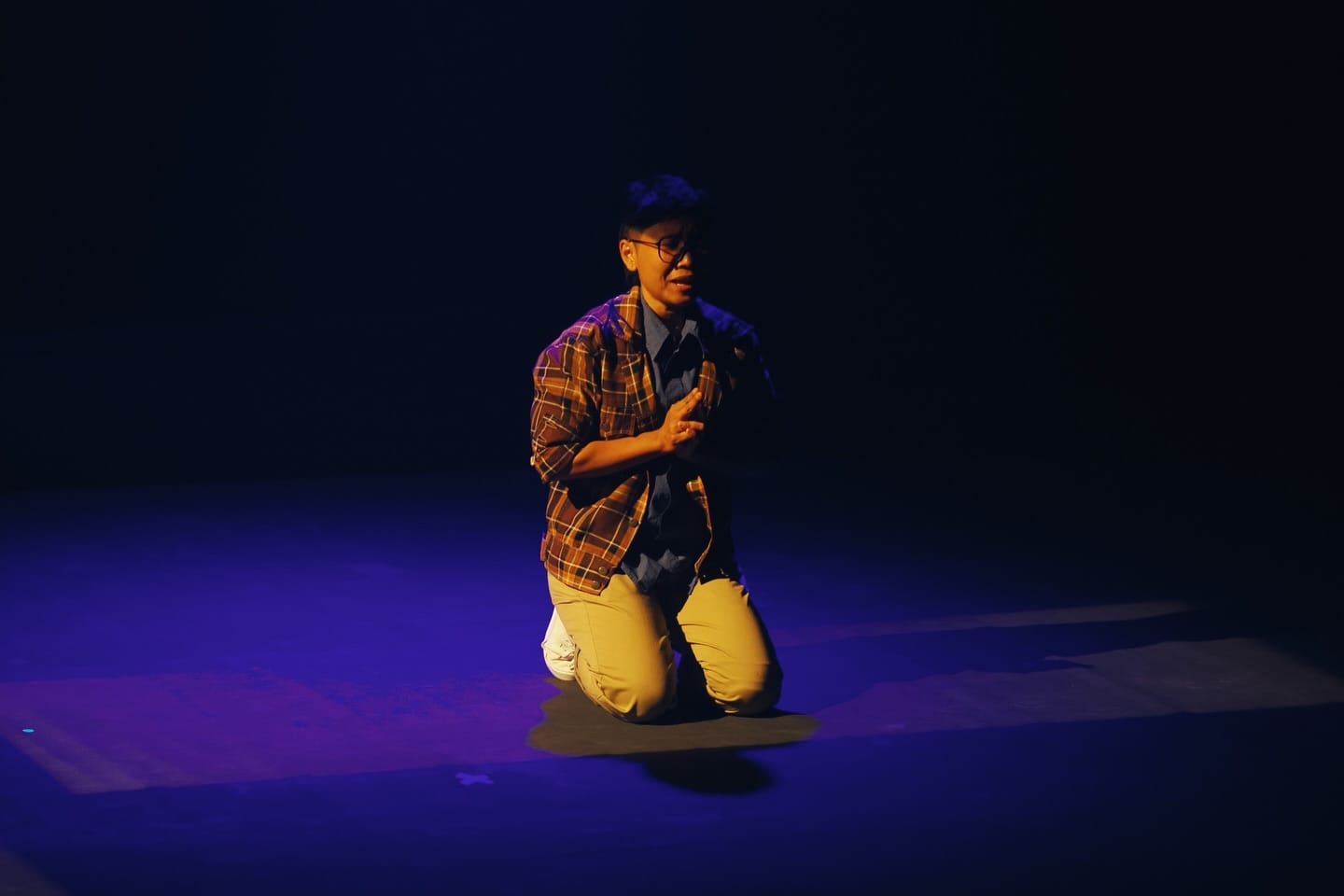
At the centre of it all is the man, tasked with performing the final Buddhist rites for his aunt while grappling with the contradictions of being Malay-Chinese and Muslim.
Performed by Hilyati Ramli, this is the anchor of the entire production—and what a performance it is. With short hair and dressed in male attire, she doesn’t “play” the man; she becomes him. Her presence is immediate, grounded, and unwavering.
What truly stands out is her vocal control; every line feels personal and intimate, as though she is letting us in on something private rather than performing. It draws you in, holds you there, and refuses to let go. You don’t watch her—you listen, you lean in, you follow.
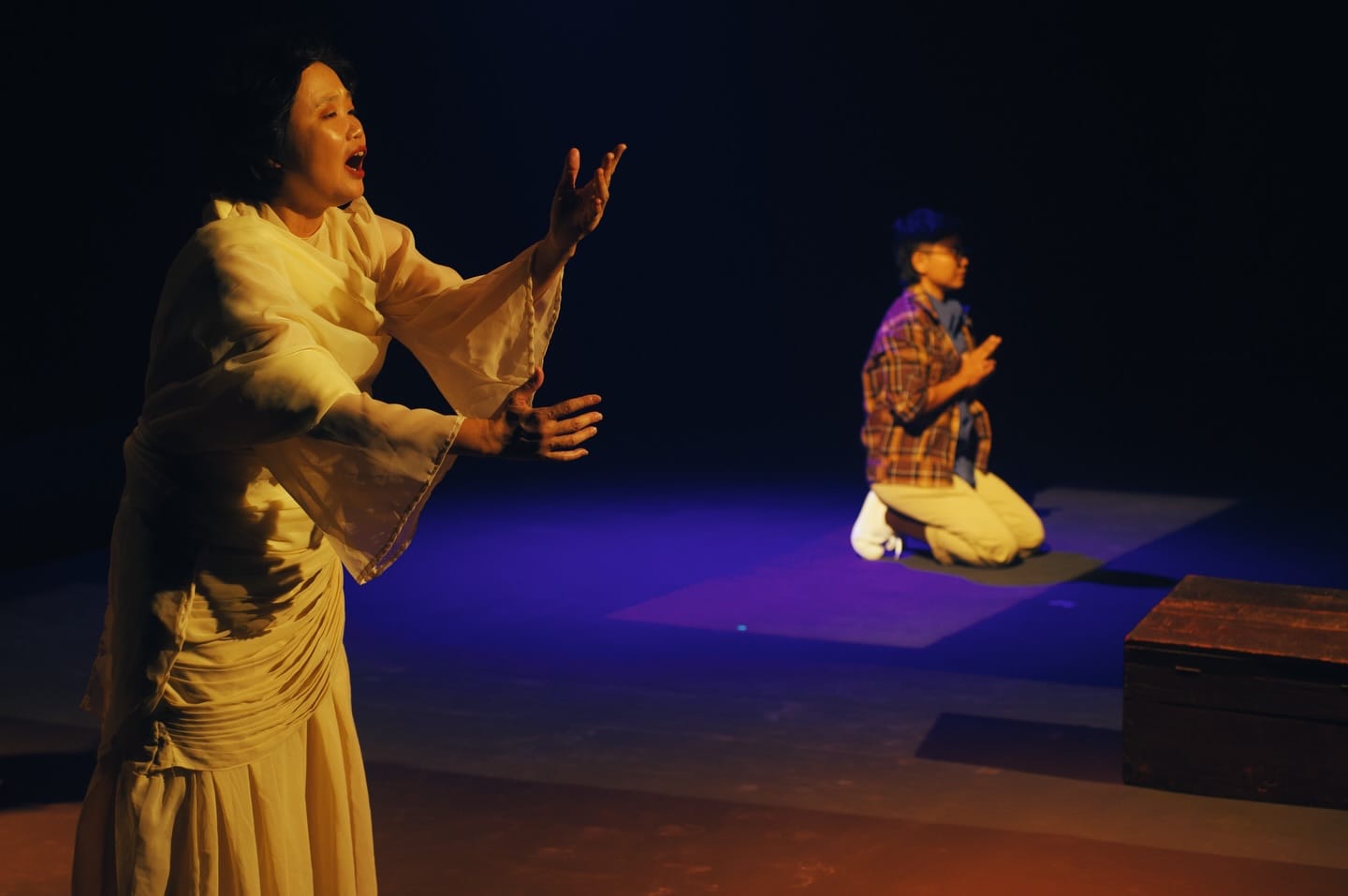
Alongside the man are two equally important presences that complete the emotional landscape: the mother (played by Ho Sheau Fung) and the priest (played by Teoh Chee Lin).
The mother’s journey is perhaps the most visually poetic. Wrapped in layers of cloth when she first appears, she slowly unwraps herself as her story unfolds, each layer falling away like years of unspoken weight. It doesn’t feel theatrical for its own sake. It feels… necessary. Like watching someone release years of quiet burden. There’s something deeply familiar in that act—we all do it, don’t we? Given the right ears, the right space, we begin to loosen the knots we’ve tied around ourselves, just to breathe a little easier.
Her story resonates strongly, especially for those who understand what it means to live between expectations. A Muslim convert, she stands at the intersection of judgment and belonging, questioned by both her new community and her past. Her delivery, at times rendered in a lyrical, almost syair-like form, is mesmerising—pain softened into poetry.
Then there is the priest—quiet, steady, almost ever-present. His role may be minimal in dialogue, but his impact is undeniable. The chanting, the rhythm, and the soundscape of ritual create a haunting backdrop that carries the entire performance. Through him, I found myself learning, almost subconsciously, about the intricacies and solemn beauty of Buddhist funeral rites, something rarely explored with this level of sensitivity on our stages.
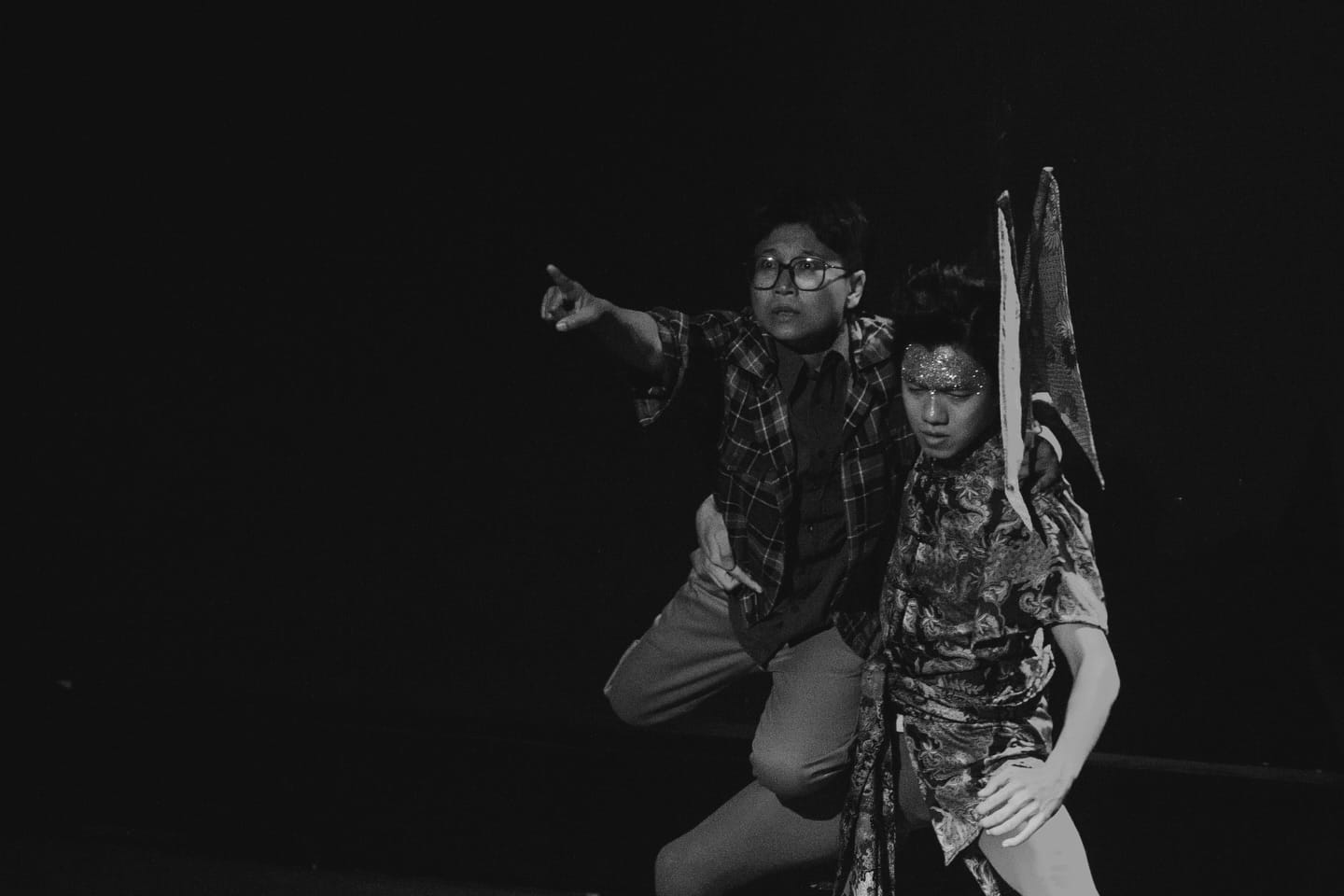
The play doesn’t just tell a story, it holds up a mirror. As a Muslim with Indian blood, I found myself leaning into it more than I expected. That persistent question, aiming to fit you into a box, echoes louder than it should. It’s a question that sounds harmless, but carries the weight of needing to choose, to rank, to define.
Playwright Johan’s own reflection, shared after the show, lands with quiet force—when people learn his father is Malay, they conclude he is “more Malay than Chinese.” The play captures this tension beautifully, asking a question that feels almost too simple, yet remains unresolved in our society—why must bloodlines compete? Why can’t they simply coexist? Why can’t we just be?
It is this very tension that the production handles with remarkable restraint. Director Sek Thim responds with quiet confidence. The staging is minimal but never empty. Lighting is used with precision to carve intimacy into the space, drawing the audience closer rather than keeping them at a distance. It is theatre that trusts its performers, and they rise to it beautifully.
And just when you think the play has given you all it can, it offers one final, unforgettable moment—the interweaving of Buddhist Sanskrit chants with verses from the Quran. It’s not loud. It’s not dramatic. It simply exists. And in that coexistence, it says everything the play has been building towards.
In a theatre landscape where we often crave something honest and brave, Dua Darah arrives like a quiet revelation. Rarely do we get to witness work this thoughtful, this precise, and this emotionally resonant in Penang.
And perhaps that’s what makes it linger.
Not just as a performance, but as a conversation we’re still learning how to have.
For those who missed its Penang run, or are ready to experience it again, Dua Darah will tour Kuala Lumpur from 17 - 19 April at Five Arts Centre (9th floor, GMBB). Tickets are available at bit.ly/duadarah.
About the writer:
Tau Foo Fah is a creature of impulse and odd rituals who claims her best writing happens in her car—where profound ideas and questionable decisions collide. Equal parts observer and instigator, her work blends sharp wit with truths that linger longer than they should. Offstage, she collects stories, eavesdrops with intent, and turns everyday absurdities into something dangerously close to art.
Seni:Kita (pentaspena.pg@gmail.com) is a content creator under the Newswav Creator programme, where you get to express yourself, be a citizen journalist, and at the same time monetize your content & reach millions of users on Newswav. Log in to creator.newswav.com and become a Newswav Creator now!
The User Content (as defined on Newswav Terms of Use) above including the views expressed and media (pictures, videos, citations etc) were submitted & posted by the author. Newswav is solely an aggregation platform that hosts the User Content. If you have any questions about the content, copyright or other issues of the work, please contact creator@newswav.com.