
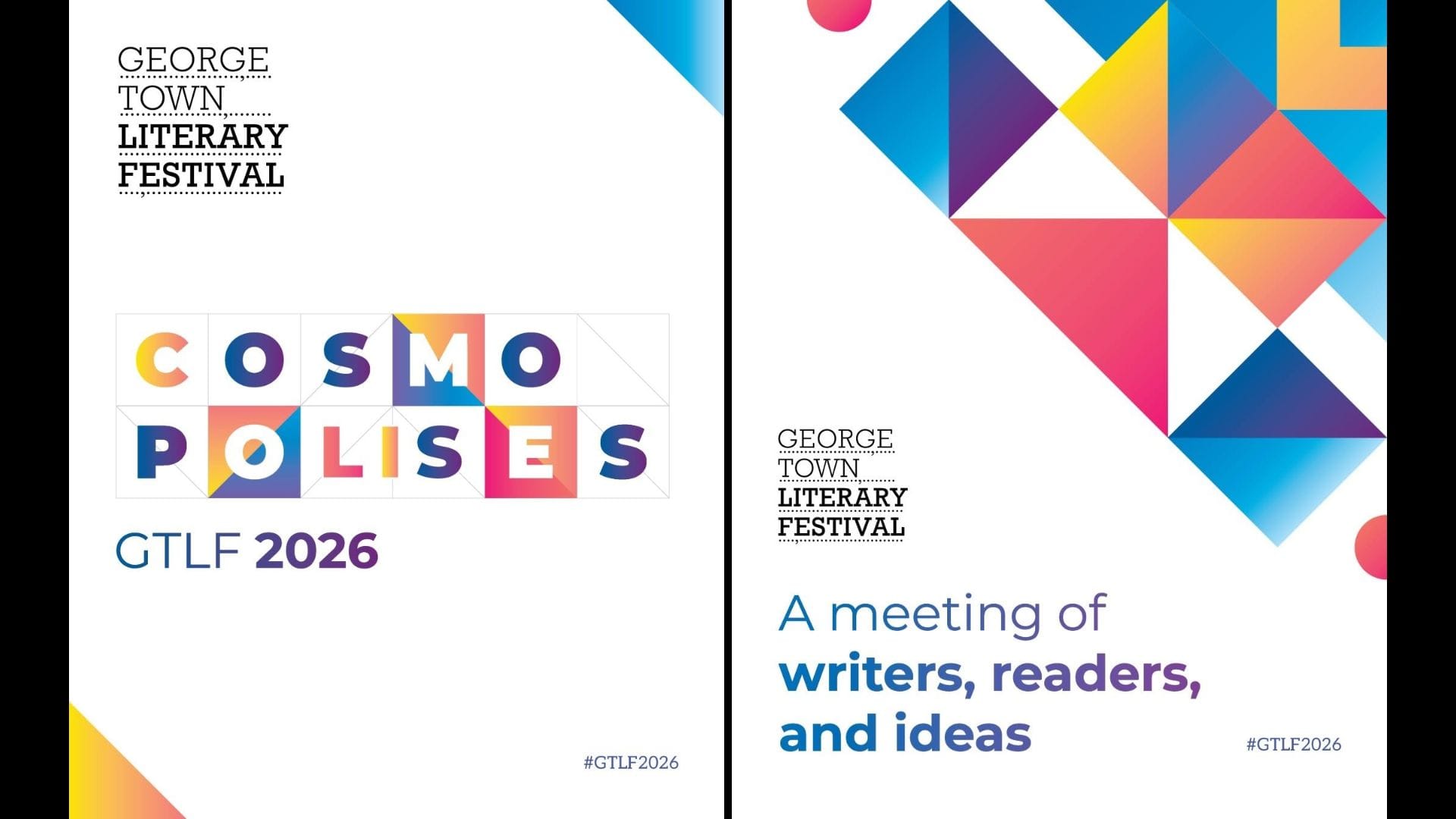
There is something rather lovely about a city coming together to celebrate words, stories and the people who write them. Every year, George Town Literary Festival (GTLF) brings together writers, poets, academics and literary enthusiasts from Malaysia and around the world. And over the years, it has grown into one of Southeast Asia's more recognised literary gatherings. Something Penang should be proud of.
The 16th edition returns this weekend, from 27 to 29 November, with the rather interesting theme Cosmopolises. This year, the festival explores cities as meeting points of languages, cultures, faiths, migration and shared histories. With 72 authors and speakers, there is certainly plenty to look forward to.
The programme looks promising too. There are discussions on censorship and freedom of expression, literary translation, migration, food writing, memory and identity. Throw in book launches, poetry performances, workshops and other cultural activities across two heritage venues, and there is quite a lot to keep literary enthusiasts occupied.
On paper, everything looks good. But having attended the festival last year, I do have a few reservations. And judging from some of the comments I've come across online, I am certainly not alone.
Before anyone gets the wrong idea, I want GTLF to do well. In fact, I want it to do really well. But surely wanting something to do better also means being able to talk about what isn't working.
When the same familiar names keep returning
Some comments I recently came across online questioned why certain personalities, who are arguably not among Malaysia's greatest literary talents, seem to be pushed to the forefront of the festival almost every single year.
To be frank, there is nothing wrong with inviting established writers back. Some writers have so much to offer that you could probably listen to them every year and still walk away with something new. But when the same familiar faces keep occupying the spotlight, it does make one wonder: are we celebrating literary excellence, or have we simply run out of people to invite?
A literary festival should be a place to discover writers, not just revisit the ones we already know. There are plenty of accomplished writers, thinkers and storytellers in Malaysia who deserve a platform. Some may not have the international recognition, the connections or the familiar names that attract an audience, but that doesn't make their contributions any less valuable.
Perhaps it's time to widen the circle a little. Give someone new a chance. Surprise us. That's part of the excitement of attending a literary festival, isn't it?
Where are our Bahasa Malaysia literary voices?
Another comment that caught my attention was someone describing the lack of prominent Bahasa Malaysia writers in this year's line-up as a disgrace and an embarrassment to our local talent.
That's a strong statement, but I do think it raises a legitimate concern.
To be fair, this year's programme does feature established Malaysian literary figures, including National Laureate Muhammad Haji Salleh, alongside writers working in different languages. So, the issue isn't necessarily about the complete absence of BM writers. It's about whether their presence and prominence adequately reflect the depth of our literary community.
Malaysia doesn't just produce writers in English. We have a rich literary tradition in Bahasa Malaysia, Chinese, Tamil and other languages. And some of our finest literary works are not necessarily written in English.
I sometimes wonder whether we have become so accustomed to looking outward for literary recognition that we forget to appreciate the talent we have at home.
By all means, bring in international writers. That's what makes GTLF exciting. But let's not make international participation the main attraction while our own literary talents are relegated to the sidelines.
If this year's theme is about cosmopolitanism, cultural exchange and different worlds coming together, surely our own literary diversity deserves a proper seat at the table.
Different panels, same conversations
Now, this is where I have a more personal bone to pick.
Last year, I attended several sessions with different themes and different combinations of writers. But somewhere along the way, I found myself listening to variations of the same conversation.
For instance, if a writer is invited to talk about a particular novel, I expect to hear about the inspiration behind it, the research, the writing process, the challenges and perhaps the personal journey of getting the book published. Fair enough. That's what the session is about.
But when the same writer appears in another panel with a completely different group of writers, why are we hearing essentially the same story all over again? Surely there is more to discuss.
I understand that writers have their own experiences and areas of expertise. And yes, they will naturally draw from their own work when discussing different subjects. But there is a difference between bringing a fresh perspective to a conversation and simply recycling the same anecdotes.
If I have already heard about your novel and how you wrote it in one session, I really don't need to hear the same story again in another session with a different title. Unless, of course, there's something new you're bringing to the table.
This is where I think the programme curation and moderation need more thought. Different sessions should offer different perspectives, even when the writers overlap. Otherwise, we might as well attend one session and call it a day.
With so many interesting writers gathered in one place, it would be such a waste to have them going around in circles. We come to a literary festival to be introduced to new ideas, not to hear the same conversation packaged under different titles.
Can we have more than an hour, please?
Another issue is the duration of the sessions.
Most panel discussions I attended last year were allocated approximately one hour. On paper, that sounds reasonable. In reality, it is hardly enough time to get into a meaningful discussion.
By the time the moderator introduces the speakers, everyone exchanges a little introductory banter, and the panellists finally get their first opportunity to speak, a good portion of the hour is already gone.
And just when the conversation starts getting interesting, everyone has to start watching the clock. Suddenly, there's a rush to wrap things up and squeeze in a quick Q&A. The discussion barely gets going before we're already thinking about the next session.
In some cases, we also get moderators who love to interject, sometimes a little too much. I know moderators have a job to do, but there is a fine line between facilitating a conversation and becoming the conversation. A moderator's job is to guide, not dominate. We are there to hear from the writers, after all.
And then comes the Q&A, which is often the most interesting part of a session. It gives the audience an opportunity to move beyond the prepared questions, challenge ideas and take the conversation somewhere unexpected. Yet, more often than not, this is the part that gets rushed or sacrificed altogether. What a pity.
Of course, not every conversation needs two hours. Some topics are better suited to shorter discussions. But when we're talking about literature, politics, history, identity or social issues, surely we should allow enough time to explore the subject properly.
Personally, I'd much rather attend fewer sessions with meaningful, thought-provoking conversations than rush from one panel to another only to leave feeling that none of them went deep enough.
Good conversations need room to breathe. And sometimes, the best ones happen when we stop looking at the clock.
Please do your homework before coming
Now, here's another thing that bothered me last year.
International writers are invited to literary festivals because they bring different perspectives and experiences. That's wonderful. But surely there is also a responsibility to familiarise oneself with the country and community one is visiting, especially when the subject being discussed is closely connected to them.
I remember a session featuring an Indian writer who had written about the history, culture and global diaspora of the Tamil people. When asked about the migration of Tamils to Malaysia, she admitted that she didn't know much about it.
I found that rather disappointing.
I mean, we're talking about a country with a significant Tamil community and a long history of Tamil migration. If you're writing about the evolution and diaspora of Tamil people, wouldn't it make sense to familiarise yourself with one of the communities you're discussing?
Nobody expects an international writer to know everything about every country - but a little homework goes a long way. It makes the discussion more relevant to the audience. After all, the point of inviting international writers isn't simply to give them a platform to talk about their books. It's to create an exchange of ideas between their experiences and ours.
A literary festival should be accessible to everyone
While we're talking about making a literary festival more inclusive, perhaps we should also look at the venues.
Last year, I remember a few book launches being held on the first floor of Bangunan Wawasan, which meant audiences had to climb quite a flight of stairs to get there. I happened to be behind an elderly gentleman who was slowly making his way up with the help of his walking stick. Watching him struggle up those stairs made me wonder, what about those who are wheelchair-bound?
I know we can't always expect every heritage building in George Town to come equipped with modern facilities. But surely accessibility should be part of the consideration when selecting venues, especially for a festival that welcomes people from all walks of life.
It's encouraging that Bangunan Wawasan is not among this year's main festival venues. The U.A.B. Building and Wisma Yeap Chor Ee will host the main programme, with additional events taking place around George Town. I hope the organisers have given some thought to accessibility at these locations too.
After all, what good is a festival that celebrates diversity and brings people together if some people are inadvertently left out simply because they cannot get through the door?
Inclusivity shouldn't just be something we talk about on stage. It should also be reflected in how we organise the festival and the spaces we choose to bring people together.
A Little More Thought, Please
GTLF has come a long way since its beginnings in 2011, but with growth comes expectations. And when a festival has established itself as an important literary gathering, I don't think it's unreasonable for audiences to expect more.
This year's theme is about the meeting of cultures, histories and ideas. It's about understanding different perspectives and recognising the stories that shape our shared worlds. I hope we see that reflected in the actual programming too.
So, despite my reservations, I would still encourage everyone to make their way to George Town this weekend. Attend a panel, discover a new writer, sit in on a book launch or simply strike up a conversation with someone who shares your love for literature.
There is plenty to appreciate, and I genuinely hope this year's festival delivers some wonderful conversations.
Let's give GTLF 2026 a chance. Let's hope this year will be different. More diverse, more engaging and, above all, more meaningful. Get your free passes here.
And if we find ourselves having some of the same conversations all over again? Well, there's always next year.
After all, even a literary festival deserves a little room for improvement. And perhaps, a better story to tell next time.
About the writer:
Tau Foo Fah is a creature of impulse and odd rituals who claims her best writing happens in her car—where profound ideas and questionable decisions collide. Equal parts observer and instigator, her work blends sharp wit with truths that linger longer than they should. Offstage, she collects stories, eavesdrops with intent, and turns everyday absurdities into something dangerously close to art.
Seni:Kita (pentaspena.pg@gmail.com) is a content creator under the Newswav Creator programme, where you get to express yourself, be a citizen journalist, and at the same time monetize your content & reach millions of users on Newswav. Log in to creator.newswav.com and become a Newswav Creator now!
The User Content (as defined on Newswav Terms of Use) above including the views expressed and media (pictures, videos, citations etc) were submitted & posted by the author. Newswav is solely an aggregation platform that hosts the User Content. If you have any questions about the content, copyright or other issues of the work, please contact creator@newswav.com.