
In my household, I am usually the one seeking out events for us to attend.
I am the unofficial family event planner — although nobody actually appointed me to the position, nor do I recall anyone offering me a salary.
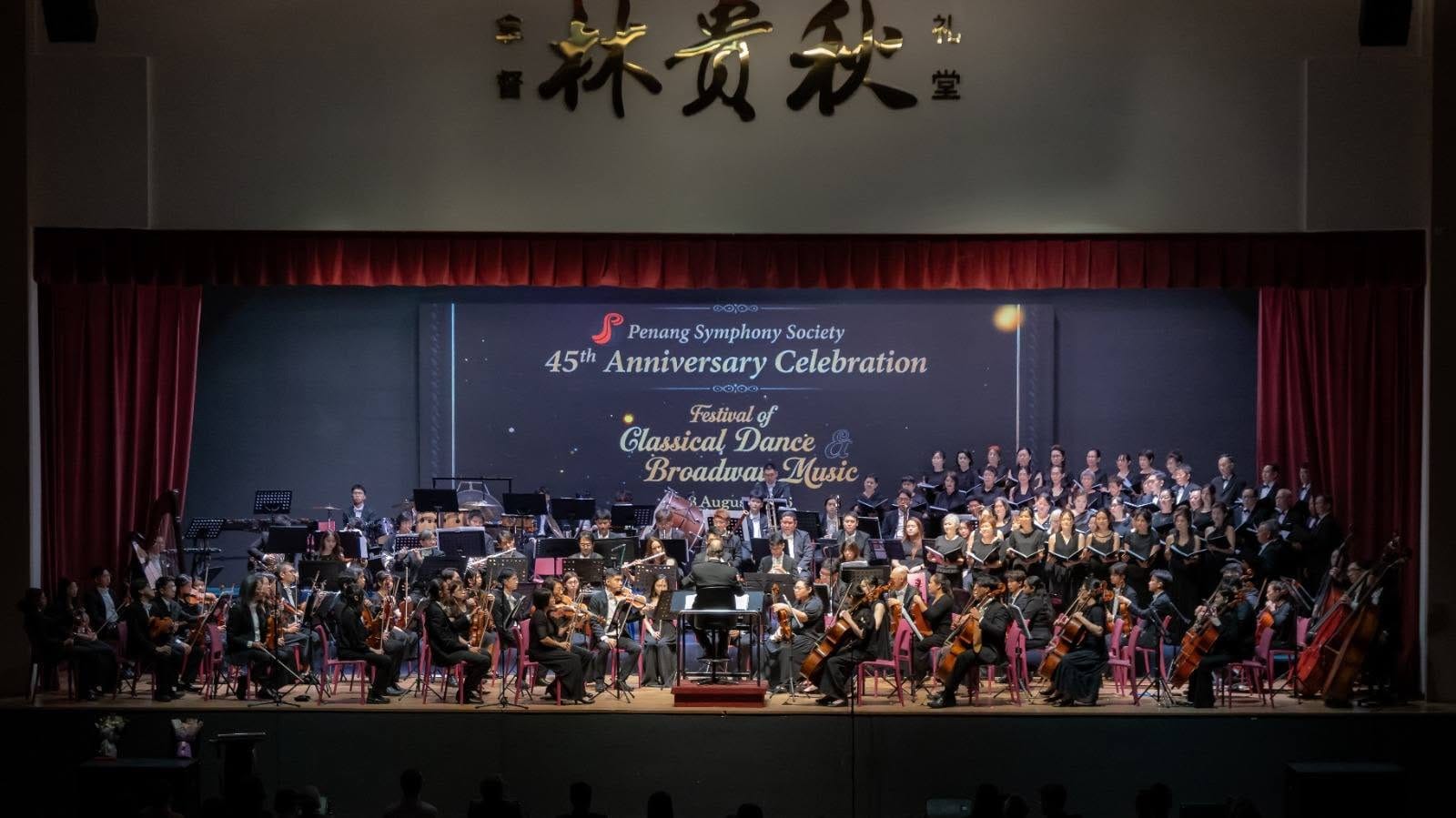
So, it was rather lovely when, this time, it was my older son who invited us to an evening of orchestra music. He was keen to watch his friend perform as part of the Festival of Classical Dance & Broadway Music, presented by the Penang Symphony Society in celebration of its 45th anniversary.
Naturally, the whole family went along.
I love music. I don’t think I know anyone who doesn’t. But when it comes to live music, I am more of a pop and rock concert person. Give me words I can sing along to, a beat I can move to and a crowd that is perfectly happy to make a fool of itself together, and I am in my element.
Classical music, on the other hand, has always felt a little more… intimidating.
Not because I don’t appreciate it. I do. There is something undeniably beautiful about an orchestra — the precision, discipline and sheer number of people required to create one piece of music.
But there is also something about sitting in front of an orchestra that makes me feel I should suddenly become a more refined version of myself.
Sit properly.
Don’t fidget.
Don’t cough.
Don’t clap at the wrong time.
And whatever you do, don’t look like you’re waiting for the real music to begin.
On the few occasions when I had attended an orchestra performance, I often felt an inexplicable need to be prim and proper.
Go figure.
So, on August 8, when the lights at Aik Hua Performance Hall dimmed and the musicians began preparing their instruments, I sat back with a mixture of curiosity and anticipation.
There were nine pieces on the programme, taking us through a rather wonderful musical journey — from Overture to The Merry Wives of Windsor and Tribal Dance of Yao, to Polonaise Op. 40, No. 1, Malay Dance Suite, selections from The Sound of Music and The Phantom of the Opera, Huapango, Swan Lake Op. 20 and finally Polovtsian Dances No. 17, featuring vocals from the Hibiscus Choir and Resonance Choir.
It was quite the musical buffet.
And much like a buffet, there were things I recognised immediately and others I simply enjoyed without knowing exactly what I was consuming.
My personal favourites were, unsurprisingly, the two featured musicals. The Sound of Music and The Phantom of the Opera already had a little space reserved in my musical memory, so hearing them interpreted by an orchestra made them feel both familiar and new at the same time.
But what surprised me was how much I enjoyed the pieces I was less familiar with.
Perhaps because I am not musically trained, I tend to experience music more through feeling than technical understanding. I may not know the difference between one complicated musical term and another, but I know what catches my ear.
And my eyes.
I was particularly taken by the violinists.
There was something almost hypnotic about watching the bows move together — slow and measured at one moment, then suddenly fast and furious. Dozens of individual musicians seemed to disappear into one collective movement.
I found myself watching the conductor too, wondering how one person manages to keep track of so many musicians, instruments, rhythms and musical cues at the same time.
Under the baton of Dato’ Woon Wen Kin, the orchestra moved through moments of tenderness, drama and intensity, shifting between different cultures and musical traditions with remarkable fluidity.
There was something quite powerful about listening to an orchestra. What had begun as individual musicians became one enormous sound filling the hall.
And perhaps that is what I find most fascinating about an orchestra. It is, in many ways, a lesson in togetherness.
Every musician has a part to play. Everyone has to listen. Everyone has to know when to come in, when to hold back and, perhaps most importantly, when to let someone else take the lead.
No one person can make the music alone. There is something rather beautiful about that.
And isn’t that what makes music such a universal language?
Whether we prefer Beethoven or Bon Jovi, Mozart or Metallica, Swan Lake or The Sound of Music, music has this curious ability to cross boundaries that words sometimes struggle to bridge
We may not speak the same language. We may come from different cultures, generations or backgrounds. We may even have completely different ideas about what constitutes “good music”. But put a beautiful piece of music in a room and, for a few moments at least, we are all simply listening.
Perhaps that was what I took away from the evening.
Not a newfound appreciation for classical music — I have always appreciated it — but a renewed appreciation for the experience of listening to it live, of watching all those individual musicians come together and create something far greater than any one of them could create alone.
And, perhaps, a little appreciation for my son too.
I went because he wanted to watch his friend perform.
I left grateful that he had given me a reason to be there — not just for the extraordinary talent of the musicians, but for the simple pleasure of having spent an evening with my family, experiencing something together.
Perhaps that is the best part of live music.
You don’t just hear it.
You share it.
Thank you for the music.
About the writer:
La Ling is a writer drawn to the intersections of books, education and the arts, where stories become both mirror and map. Dreamy by nature yet pragmatic at heart, she is endlessly lit up by stories—told in books, on stages, in songs, through movement, and in the lives of people from all walks of life. Often finding herself swimming in opposite directions, she is always going somewhere, even if she’s not quite sure where she will arrive.
Seni:Kita (pentaspena.pg@gmail.com) is a content creator under the Newswav Creator programme, where you get to express yourself, be a citizen journalist, and at the same time monetize your content & reach millions of users on Newswav. Log in to creator.newswav.com and become a Newswav Creator now!
The User Content (as defined on Newswav Terms of Use) above including the views expressed and media (pictures, videos, citations etc) were submitted & posted by the author. Newswav is solely an aggregation platform that hosts the User Content. If you have any questions about the content, copyright or other issues of the work, please contact creator@newswav.com.

