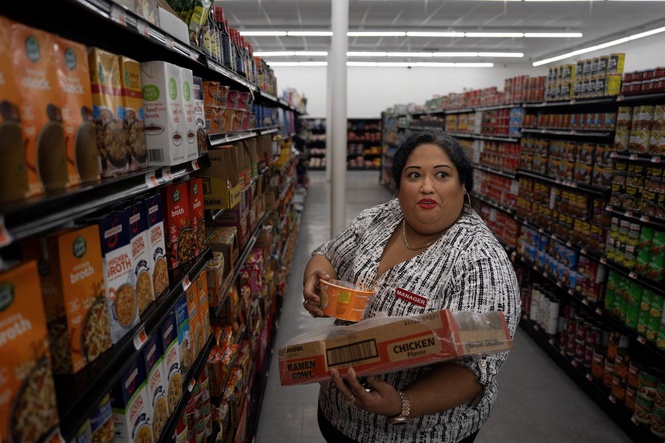
While Americans continue to say everyday goods are costing too much, grocery prices saw their biggest jump in months.
In October, grocery prices rose 0.5 percent, their biggest month-to-month jump since April, according to a recent inflation report from the Bureau of Labor Statistics. The surprising increase follows a period when price jumps steadily fell from 0.5 percent in April to 0 percent in September.
Higher gas prices are to blame for the October surprise, said Andy Harig, vice president of tax, trade, sustainability and policy development at retail food advocate FMI - The Food Industry Association.
"When fuel and diesel costs rise, those higher costs are ultimately reflected in what it takes to produce and deliver food, and it can take months for them to show up in grocery prices, which we are now witnessing,” Harig said in a statement this week.
The news comes as consumers and lawmakers look to Democrats to follow through on pre-midterm promises of lowering the cost of groceries, gas, and other key daily expenses.
“Trump is set to kick millions more people off of SNAP, when Americans are already struggling with grocery prices,” Democratic Senator Cory Booker wrote Monday on X, referring to President Donald Trump’s plan to cut Supplemental Nutrition Assistance Program benefits for 6.3 million of the roughly 36 million people in the program.
“It is despicable. We need to be helping people afford groceries, not deepening cuts to the safety net that keeps families from going hungry.”
Stock prices at the nation’s four largest grocers - Walmart, Costco, Target and Kroger - have risen since the midterms.
As for consumers, it may take months for Democrats to bring down grocery prices, if at all, Ali Bustamante, an economics professor at Louisiana State University, told New Orleans’ WVUE two days after the midterms.
“The expectation is really not for prices to go down in the short-term or even the long-term. It’s really the aim for policymakers to ultimately slow the pace of price growth over time,” Bustamante said.
Standing in the party’s way is Trump himself, who has said after the midterm results that he’s willing to work with his opponents in Congress.
However, experts are skeptical of that claim.
“I think the president would certainly want to find ways to reduce the cost of groceries - Democrats [also] see that in their interest," Lehigh University Political Science Professor Chris Borick told NPR Monday.
"The mechanisms, the tools, the levers that would be most readily available to do that - there's quite a bit of distance between the president and Democrats that'll be taking over both the House and the Senate."
Social Security 2027: 10 states with the largest cost-of-living adjustments
Goldman Sachs forecasts AI spending will hit $1.4 trillion by end of 2027
Every American will see heating bills rise 7%, leaving millions at risk this winter
AI saw its worst day on Wall Street after midterms blue wave. Here’s what to know
Here’s how much the average person has in their IRA. How do you compare?
Despite monumental scandal, Nvidia isn’t facing record stock plunge. Here’s who did