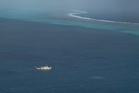
China's Liaoning aircraft carrier strike group has circled the Philippines and entered the Philippine Sea, and the PLA's Eastern Theater Command kept sending ships into the Western Pacific on October 28, with coast guard vessels joining the long range training. For Lu Wen-hao, a researcher at the Chinese Society for Strategic Studies, the signs suggest that the PLA's response to the expanded US Japan Keen Sword 27 exercise did not end when the drills closed on October 29. With the US carrier heading to the Middle East, he writes, Japan is being left to hold the line in the Western Pacific alone.
Lu had wondered whether the Southern Theater Command's fleet would join in, and worried that it could set off a large scale PLA exercise. That evening, Taiwan's National Security Council Secretary General Joseph Wu revealed that all three PLA fleets were training beyond the first island chain, posing an obvious threat to Taiwan, Japan and the Philippines at the same time. Some media outlets framed the move as China meddling again ahead of the 2026 Taiwan local elections, drawing wide regional attention.
At the same time, US Secretary of War Pete Hegseth and Japanese Defense Minister Shinjiro Koizumi agreed in the Philippines to cooperate on a "first island chain" defense network linking Japan's Southwest Islands with Taiwan and the Philippines to deter China. Lu sees the PLA's large scale deployments as a response to the steadily expanding US Japan alliance exercises, and expects PLA long range voyages to become more frequent as Japan leads military cooperation along the island chain.
Meanwhile, a new storm, Typhoon In-fa, formed deep in the Pacific on October 25 and moved toward Taiwan. Lu expects the Liaoning and other ships to keep training in the Philippine Sea, where the storm's impact is limited and their route appears to shadow US carrier activity.
Keen Sword 27 And The Typhoon Test
Keen Sword 27 ran from October 19 to 29. Japan's Self Defense Forces committed about 45,000 personnel, 6,100 vehicles, 40 ships and 260 aircraft, while the US contributed about 12,000 troops. Australia, Canada, France, Germany, the Netherlands, New Zealand and the Philippines also took part.
On October 21, as Typhoon Champi churned east of the Philippines, the US said the carrier USS Theodore Roosevelt (CVN-71), cruiser USS Chancellorsville, Japanese helicopter destroyer Ise, destroyers Kongo and Asahi, Australian frigate HMAS Stuart, Canadian frigate HMCS Regina and a French frigate had formed up in the Philippine Sea. Lu suspects the allied fleet moved away from the typhoon's outer bands to practice joint operations in complex weather and sea conditions. Curiously, a Chinese website tracking the South China Sea placed the US carrier and the Canadian ship south of Japan, east of the Osumi Strait, on October 23. The carrier was reportedly east of Shikoku on October 25 and moving south on October 26, prompting some Chinese military experts to predict a US China carrier standoff in the Philippine Sea.
Typhoon Champi, which formed on October 14 and grew into a strong typhoon heading for Taiwan and Japan's Southwest Islands, added a real world test of environmental and safety management. Japanese media reported on October 22 that US forces would reassess safety day by day, saying bad weather also gives troops experience operating in extreme conditions. Rather than an interruption, Lu writes, the typhoon became a variable that tested air transport, sea navigation, base support, logistics and personnel safety at once.
Only some training was suspended. On October 23 and 24, US Marine Corps units and aircraft from the Theodore Roosevelt worked with ground launch systems to strike floating targets at sea. On October 25, Japan's Ground Self Defense Force carried out a simulated drill without live munitions using its Type 25 anti ship missile launchers at the Ono Hara training area on the border of Nagasaki and Saga, simulating attacks on enemy ships off Shikoku and southwest of Kyushu. On October 28, HIMARS live fire training was held at the East Fuji Maneuver Area in Shizuoka.
How This Keen Sword Compares With 2024
Keen Sword 25, held from October 23 to November 1, 2024, involved about 33,000 Japanese personnel, 30 ships and 250 aircraft, plus about 12,000 US troops, 10 ships and 120 aircraft, with Australia and Canada in some segments. That year, the PLA launched its Joint Sword 2024B exercise around Taiwan on October 14, nine days before Keen Sword began, after President Lai Ching-te's National Day speech. Taiwan's defense ministry detected 153 military aircraft sorties, 14 warships and 12 government vessels in 24 hours, with 111 sorties crossing the median line or entering Taiwan's northern, southwestern and eastern airspace.
Lu notes that while the two exercises share comparable elements such as air and sea coordination, sea lanes, air defense and anti ship strikes, their areas, command structures and stated objectives differ, so the sequence does not prove the PLA was responding to Keen Sword 25.
This year, Japan raised its declared participation by about 12,000 personnel, 10 ships and 10 aircraft, with seven partner nations and a clear emphasis on space, cyber and electromagnetic operations. MV-22 Ospreys used the airports on Miyako and Ishigaki. Lu cautions, however, that larger numbers alone do not prove a matching rise in combat effectiveness. For the PLA, he adds, the drills are an important case study of how US and Japanese bases, sea and air corridors and multinational coordination work, though the responses of the PLA's army, air force and rocket force remain invisible. Only some naval deployments can be seen.
China And Russia Watch From Sea And Air
Lu says he tracked the PLA's moves through decades of study of naval history and PLA literature and by comparing Japanese announcements of Chinese ship movements, rather than guesswork or eye catching headlines.
On October 20, he concluded that the Liaoning group's carrier flight training on October 14 about 250 km south of Ishigaki Island was aimed at the US and Japan's deployment of HIMARS on Ishigaki and shore based anti ship missiles on Yonaguni during Keen Sword. Combined with an Eastern Theater Command "joint combat readiness patrol," he argued, two theater commands formed a "campaign level" joint operation squeezing Taiwan from front and back and deterring the alliance in the Southwest Islands. A scholar at a government think tank later reached a similar conclusion, describing the Liaoning's two day exercise as a show of force ahead of the US Japan drills.
Lu also dismisses media claims that the Liaoning appeared in the Sulu Sea near Mindanao to support the Duterte family as clickbait, arguing it is implausible that Beijing would intervene militarily in another country's politics in that way. In his reading, the Liaoning's southern voyage served several purposes: supporting joint training with the Eastern Theater Command; standing in for the carrier Shandong, which is undergoing maintenance, to deter the Philippines; and circling the Philippines counterclockwise to take position ahead of the Theodore Roosevelt group, which is due to head to the Middle East after Keen Sword. That leaves another gap in US carrier presence in the Pacific, during which the Liaoning is training in the Philippine Sea and meeting the destroyer Qiqihar (121) and supply ship Hulunhu (901) for replenishment.
Russia's Pacific Fleet joined in from the north. Il-20 reconnaissance aircraft flew along Japan's coasts on October 17, 22 and 23, and an intelligence ship entered the East China Sea through the Tsushima Strait on October 27. Japan reported PLA BZK-005 and TB-001 drones and Y-9 electronic and anti submarine warfare aircraft flying from the East China Sea into the Western Pacific between October 19 and 28. Lu believes Russian intelligence gathering in the Sea of Japan helps fill China's gaps there.
At sea, Japan reported multiple PLA groups moving through the Miyako and Osumi straits between October 16 and 28, including destroyers, frigates, supply ships and electronic reconnaissance ships from both the Northern and Eastern theater commands. On October 27, the Type 055 destroyer Lhasa, the Type 052D Xining, the Type 054A Yancheng and supply ship Hoh Xil Lake sailed through the Miyako Strait. On October 28, the Type 055 Dongguan, Type 052D Baotou, Type 054A Xuzhou and China Coast Guard ship 2307 passed through the Osumi Strait. With Wu also revealing Southern Theater Command ships drilling east of Luzon, Lu warns that the three fleets gathering together goes beyond what a "campaign level" joint operation can explain, and that a large "Joint Sword" or "Strait Thunder" style exercise could be imminent.
As the US and Japan draw NATO members into the Asia Pacific, Lu argues, China and Russia are deepening their military cooperation, with joint drills, patrols and strategic air patrols. Over the past decade, he has observed them using intelligence gathering ships and aircraft to build a "strategic level" joint surveillance system, while Japan and the Philippines are building their own capacity to track PLA carriers and warships from the first island chain to the Western Pacific.
What The Two Keen Sword Exercises Show
Comparing 2024 and 2026, Lu says the US and Japan are clearly expanding their joint capabilities, with visible multi service integration, multinational participation and cross domain training, though base operations, communications, logistics, weather and coordination among nations still limit their effectiveness. The PLA's strength is sustaining activity in multiple directions with different types of ships and aircraft and demonstrating its far seas reach through public tracks. Increased forces and activity alone, he concludes, cannot determine who has the advantage.
He also highlights intelligence sharing. Some Chinese military experts claimed the Liaoning "disappeared" for a week after Japan tracked it through the Bashi Channel on October 15. In fact, Lu notes, the Philippine military and media later revealed that Philippine air and naval forces and coast guard monitored it throughout. That kind of intelligence exchange and target tracking marks a significant step up in Japan Philippines military cooperation, and as Japan continues to donate and sell aircraft, ships, radars and sensors, Manila's ability to monitor targets at sea and in the air will keep improving.
Lu Wen-hao is a researcher at the Chinese Society for Strategic Studies. The views expressed are the author's own.