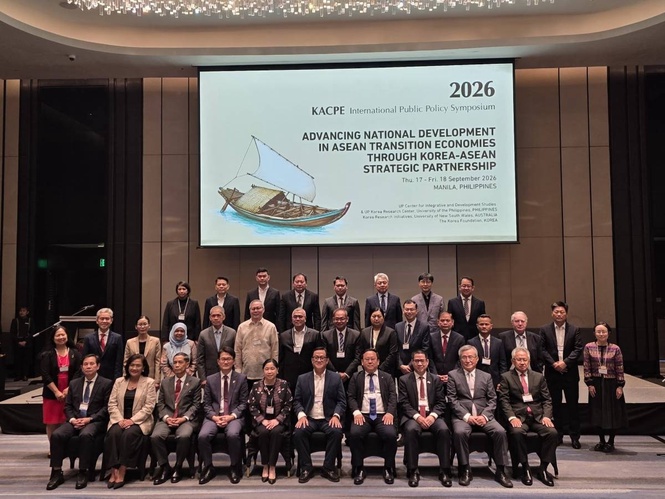
THE University of the Philippines (UP) said there is a need for expanded academic collaboration among members of the Association of Southeast Asian Nations (Asean).
“We are also, at the university level, we are pushing for greater collaboration and greater partnership on education,” UP President Angelo Jimenez said on the sidelines of the Korea-Asean Community of Policy Exchange in Pasay City on Friday.
He noted that South Korea, being Asean’s second largest trading partner, has the technical know-how that the region can adapt in drafting human development policies.
“I can speak on human development. They have a very, very advanced program on science and technology. And we do have a partnership with them to enable us to avail of higher level learning and technical know-how,” Jimenez said.
Jimenez highlighted the value of establishing common academic credit transfer systems across Asean universities. “Knowledge fulfills its purpose when it helps improve lives, strengthen communities, inform decisions, and prepare us to respond to challenges in an increasingly complex world.”
He said national growth cannot occur in isolation, given interconnected maritime, economic, and geopolitical pressures.
“Our geographic proximity means that the challenges we face are often interconnected,” Jimenez said, noting maritime disputes is an example of how security issues directly impact trade, investment, and local livelihood.
He added that partnering with advanced economies like South Korea supports a rules-based international system for settling disputes and securing vital economic sea lanes.
“The strength of our diplomacy or our politics depends always on the strength of our economy,” Jimenez said, noting that South Korea’s state-led development model offers key insights for transitional Asean nations like Vietnam, Laos, Cambodia, and Myanmar.
Meanwhile, Foreign Affairs Undersecretary Maria Theresa Dizon-De Vega said the importance of educational and institutional capacity-building is evident under the Korea-Asean Comprehensive Strategic Partnership.
Dizon-De Vega noted that two-way trade between Asean and South Korea reached $204 billion in 2025, alongside $9.7 billion in foreign direct investment.
“No development strategy can succeed without putting people at its center,” Dizon-De Vega said.
“The Asean-Republic of Korea partnership puts education, skills development, research, innovation, and youth empowerment at the core of its initiatives,” she added.