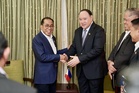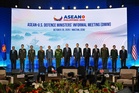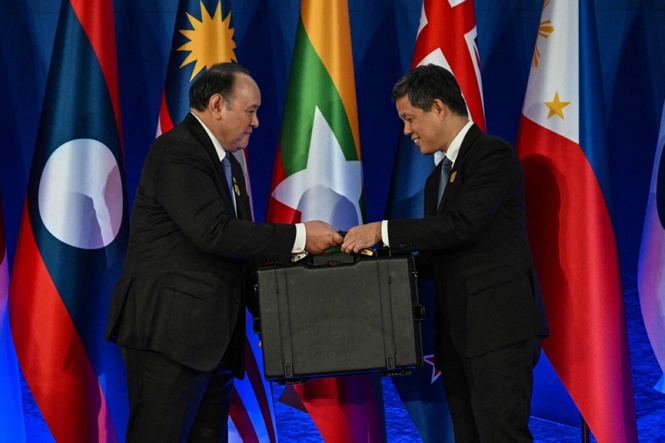
LAPU-LAPU CITY — Defense Secretary Gilberto Teodoro Jr. on Thursday asserted Association of Southeast Asian Nations (Asean) member states’ authority over the bloc’s processes after China accused the Philippines of undermining the regional grouping.
“So far as Asean is concerned, I do not believe our Asean member countries feel that way. If not, they would have let me know. So it is China’s position, it is not Asean’s position,” Teodoro said at a press briefing after the 13th Asean Defense Ministers’ Meeting-Plus (ADMM-Plus) in Lapu-Lapu City, Cebu.
He was responding to a question about a Chinese defense ministry statement accusing the Philippines of undermining Asean’s spirit and China’s legitimate rights as a dialogue partner.
He said China had been allowed to present its position on regional and international security, including maritime issues, but emphasized that Asean member states, not its dialogue partners, determine the bloc’s processes.
“No country has the right to characterize Asean processes except Asean member countries,” Teodoro said.
He added that China’s remarks largely repeated positions it had expressed previously.
China was represented at Thursday’s ADMM-Plus by Senior Capt. Yang Lei, its defense attaché in the Philippines. Asked why he did not receive the Chinese representative, Teodoro said there should be parity in rank and stature, adding that an undersecretary receiving an attaché was more than courteous.
Teodoro also defended the Philippines’ military modernization and security partnerships with treaty allies and other countries, saying Manila had the right to strengthen its defenses against threats to its sovereignty and territorial integrity.
He was responding to a separate question about whether the Philippines’ defense arrangements with external powers, including its hosting of the Typhon missile system, could undermine Asean’s regional security architecture.
Teodoro said Asean member states had not publicly raised such concerns and described the country’s defense buildup as an internal matter. He cited the 2016 arbitral award on the South China Sea and rejected China’s maritime claims over areas the Philippines considers part of its maritime domain.
While stressing that Asean unity and solidarity remained central to the ADMM, Teodoro said the Philippines would continue to use its defense partnerships to protect its sovereignty and territorial integrity.
During Wednesday’s 20th ADMM, participating defense ministers adopted five initiatives.
These include promoting exchanges among emerging defense and military leaders, and strengthening individual and collective resilience against chemical, biological and radiological threats.
The ministers also agreed to improve coordination between the ADMM-Plus and the Asean Regional Forum, and develop a comprehensive guide to ADMM and ADMM-Plus practices and protocols.
The Philippines and India will co-host the Maritime Security Resilience Amid Emerging Technologies Conference in 2027.
The ministers also adopted a joint statement commemorating the 50th anniversary of the Treaty of Amity and Cooperation in Southeast Asia. They issued the Manila Joint Declaration marking the ADMM’s 20th anniversary, titled “Navigating Our Future Together.” On Thursday, defense ministers exchanged views on regional and international security and adopted a joint statement on youth, security and peace. The statement complements a program to develop emerging defense and military leaders from Asean member states and dialogue partners.
The Philippines also hosted informal meetings between Asean defense ministers and United States Secretary of War Pete Hegseth and Japanese Defense Minister Shinjiro Koizumi on Wednesday.
Teodoro described the discussions as open, candid and productive, saying Asean members had called for greater and more robust engagement by Washington and Tokyo in the region.
The meetings also covered practical defense cooperation, including cybersecurity, artificial intelligence in defense, future warfare, military operations, intelligence and military medicine.
In his opening remarks at Thursday’s ADMM-Plus, Teodoro urged Asean members and their dialogue partners to uphold international law, sustain defense cooperation, and address disruptions to food and energy security.
He emphasized adherence to the United Nations Charter and the 1982 United Nations Convention on the Law of the Sea, respect for sovereignty and territorial integrity, peaceful settlement of disputes and rejection of the threat or use of force.
Teodoro also called for stronger protection of migrant workers and seafarers affected by overseas conflicts, citing their contributions to the global economy.