
Reporters Without Borders urges Asia-Pacific journalists to persevere against legal threats, economic pressures, and national security laws.
TAIPEI: Journalists across Asia must not give up in the face of growing political, economic and technological pressures, with independent reporting remaining a crucial safeguard against unchecked power, says Reporters Without Borders (RSF).
RSF Asia-Pacific Bureau advocacy manager Aleksandra Bielakowska said journalism remained an essential “antidote” to the challenges confronting democracies, stressing that independent journalists were needed to scrutinise those in power.
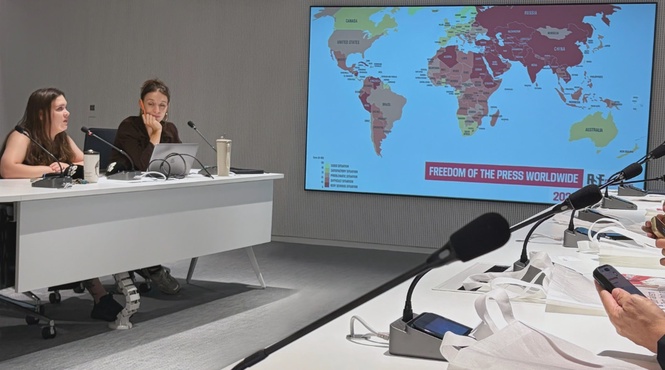
“Keep doing the amazing work that you do,” she told a delegation of foreign journalists during a briefing in Taipei, which included theSun and representatives from invited media groups across the Asia-Pacific region.
Her warning comes as RSF monitors about 200 detained media professionals across the Asia-Pacific, where journalists face growing restrictions, legal pressure, economic uncertainty and attempts to manipulate public discourse.
Bielakowska highlighted what she described as a “troublesome trend” in which even democratic governments are increasingly invoking national security laws to target or silence journalists.
She said such measures could create an environment of fear and self-censorship, undermining journalists’ ability to report freely.
Economic pressure is another major threat to press freedom, with declining advertising revenue, the dominance of social media platforms and pressure from powerful media owners making it increasingly difficult for news organisations to sustain independent journalism.
The concerns are reflected in RSF’s 2026 World Press Freedom Index, where economic factors contributed to some of the lowest scores recorded by countries in the region.
Bielakowska said the changing media business model was particularly challenging for smaller news organisations, which must compete for audiences and advertising in an increasingly fragmented information environment.
The shift has also raised concerns over how information is shaped and consumed, with social media, foreign funding and other forms of influence playing an increasingly prominent role. RSF has investigated the impact of external funding on local media and information ecosystems in countries including the Philippines and across the Pacific Islands.
Bielakowska noted that even relatively open media environments such as Taiwan face challenges in maintaining public confidence, with political polarisation and an increasingly fragmented information landscape adding to the complexity.
To help strengthen confidence in professional journalism, RSF is promoting the Journalism Trust Initiative (JTI), an independent certification system designed to help audiences identify news organisations that adhere to standards of transparency and professional journalism.
More than 2,000 media outlets worldwide are involved in the initiative.
RSF, an international nongovernmental organisation defending the right to information, has sought to counter mounting pressures through advocacy, emergency assistance and capacitybuilding programmes.
Its Asia-Pacific bureau, which relocated from Paris to Taipei in 2017, now monitors media freedom across 33 countries and territories.
The organisation works with international bodies such as the United Nations and national governments to push for better media laws and regulations, while providing journalists facing threats with assistance ranging from legal costs and relocation support to safety equipment such as bulletproof vests.
It also provides training in digital security, fact-checking and media sustainability.
Bielakowska said much of RSF’s work depended on local journalists, media organisations and representatives who serve as its “eyes and ears on the ground”, particularly in countries where the organisation has no permanent presence.
Through these networks, RSF is able to document violations, assess threats and provide emergency support to journalists at risk.
As governments increasingly block or restrict access to news websites, RSF has also developed its “Collateral Freedom” initiative, which uses mirror websites to restore access to news platforms that have been censored.
The initiative allows independent news organisations to continue reaching audiences even when their original websites are blocked.
Bielakowska said the rapid development of artificial intelligence, shifting geopolitics and the changing media business model would create further challenges for journalists. But the fundamental role of journalism remained unchanged – providing reliable information and ensuring those in power could be scrutinised.
“The primary message is not to give up,” Bielakowska said, stressing that the commitment of individual journalists remained crucial to preserving the information systems on which societies depend.
