
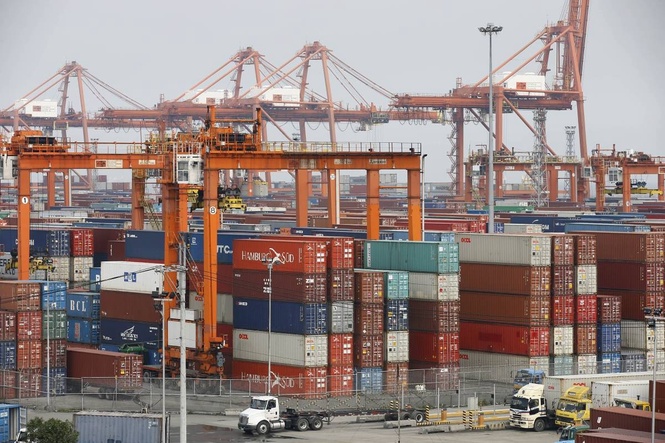
MANILA, Philippines — Congestion at major Asian container ports is tying up about 8.5 percent of the global containership fleet, raising the prospect of a prolonged shipping capacity crunch and higher freight rates that could extend into 2027, maritime analysts said.
Sam Chambers, maritime analyst and editorial director of Asia Shipping Media, said the disruptions increasingly appeared to be more than a temporary problem as weather disturbances and operational bottlenecks continued to delay vessels and disrupt cargo flows across Asia.
The delays are effectively removing about three million twenty-foot equivalent units (TEUs) of shipping capacity from service, according to Sea-Intelligence data cited by Chambers.
That represents a fleet larger than those of all but four global container shipping lines.
Sea-Intelligence estimates that it could take seven to 10 months for congestion to return to the relatively low levels recorded in June 2025, based on recovery patterns following the Covid-19 pandemic and the initial Red Sea shipping crisis.
A return to conditions prevailing at the end of 2025 could take six to eight months, it said.
The prolonged recovery could mean Asian ports will still be dealing with congestion during the next peak cargo season and possibly into the period leading to Chinese New Year on Feb. 6, 2027.
“History suggests the disruption will take months rather than weeks to unwind,” Chambers said.
Repeated typhoons have compounded the problem, with congestion at Far East origin ports worsening as vessel delays cascade into major transshipment hubs.
Freightos said carriers skipping heavily affected ports could also shift pressure to other ports across the regional network, spreading congestion rather than eliminating it.
Its mid-September assessment warned that backlogs could persist well into October.
The disruption is already being reflected in intra-Asia freight rates.
Drewry’s Intra-Asia Container Index has reached record levels, with rates on several major routes hitting historic highs.
Rates from Shanghai to Laem Chabang rose 22 percent to $1,609 per 40-foot container, while Shanghai-Jakarta rates increased 12 percent to $2,300 as demand around China’s Golden Week collided with constrained vessel capacity.
“The bottlenecks are showing up sharply in intra-Asia pricing,” Chambers said.
The congestion is also distorting measurements of how much shipping capacity is actually being deployed.
Sea-Intelligence calculated that capacity deployed on Asia-North Europe services around Golden Week reached 1.5 million TEUs over four weeks, 27 percent higher than a year earlier and 60 percent above pre-pandemic averages.
The increase, however, does not necessarily mean carriers deliberately added that much capacity.
Vessel bunching caused by port congestion has inflated the amount of capacity appearing to be deployed, with ships accumulating around ports and subsequently arriving in clusters.
The capacity squeeze could spread further across Asia.
HSBC expects delays to prolong effective capacity constraints as congestion migrates toward Southeast Asia and the Indian subcontinent.
Xeneta also reported that Asia-U.S. freight rates remained near pandemic-era levels, with its chief analyst, Peter Sand, warning shippers preparing 2027 contracts not to assume that current disruptions will quickly disappear.
The charter market is showing similar signs of tightness.
Braemar’s BOXi index reached a 52-week high of 315.59, with the shipbroker reporting an “extremely tight supply situation” and virtually no available Panamax or post-Panamax tonnage.
The container shipping industry has a substantial orderbook of new vessels that could eventually add capacity, but the additional ships have yet to significantly ease the market while existing vessels remain caught in congestion.
Chambers said the effect of the new-vessel orderbook is currently being masked by ships waiting outside ports instead of carrying containers.