
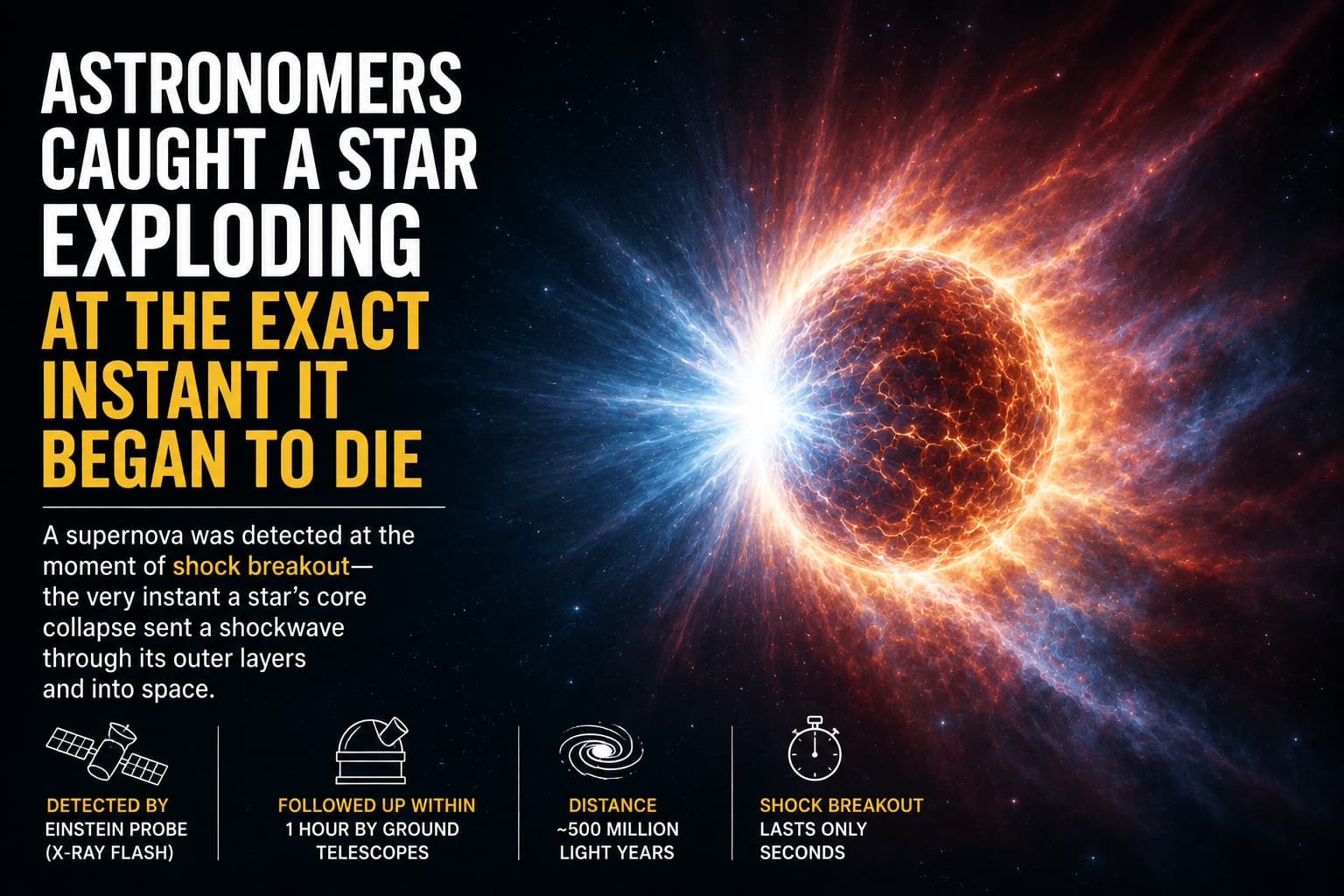
Most supernovae are discovered after the fact, once the explosion is already well underway and visible from Earth. On March 21, 2026, astronomers caught one at the actual moment it started.
SciTechDaily reported that the Einstein Probe detected a brief X-ray flash, designated EP260321a, coming from a star roughly 500 million light years away. Ground based telescopes were pointed at the source within an hour of the detection, catching what astronomers call a shock breakout, the precise instant a star's collapsing core sends a shockwave through its outer layers and into space, visible for only a very brief window before the more familiar, longer lasting supernova glow takes over.
What Kind of Star This Was
Carnegie Mellon University's release on the findings identified the progenitor as a Wolf-Rayet star roughly 20 times the mass of the Sun, which went on to become supernova SN 2026gzf. Researchers Brendan O'Connor of Carnegie Mellon, along with Jillian Rastinejad and Gokul Srinivasaragavan of the University of Maryland, led the analysis, confirming this as the first verified shock breakout detection for this particular category of supernova, known as a broad lined Type Ic, and the faintest X-ray shock breakout ever recorded for one.
A Detail That Surprised the Researchers
Despite how energetic the event appeared, no gamma ray burst or relativistic jet was detected, something astronomers would typically expect from a supernova this violent. The team's leading explanation involves what they call a choked jet, where an enormous burst of explosive energy forms deep inside the collapsing star but fails to break free, trapped either by the star's own surface or by dense material surrounding it left over from irregular mass loss before the explosion.
Why Catching the Very Start Matters
Almost everything astronomers know about supernovae comes from observations made after the explosion is already visible and evolving. Catching the shock breakout itself, the literal first instant of the process, gives researchers a data point about the star's condition in the seconds before death that no amount of after the fact observation can recover. Getting there within an hour of detection was, frankly, a stroke of extremely good timing.
How Rare This Kind of Catch Actually Is
Shock breakouts last only minutes, sometimes less, before fading into the far more familiar and much longer supernova glow that telescopes usually pick up instead. Catching one requires an automated detection system fast enough to notice the flash, alert a network of ground telescopes, and get them pointed at the right patch of sky within an hour, a level of coordination that has only recently become realistically achievable.
Ronny M (ronny76netstuff@gmail.com) is a content creator under the Newswav Creator programme, where you get to express yourself, be a citizen journalist, and at the same time monetize your content & reach millions of users on Newswav. Log in to creator.newswav.com and become a Newswav Creator now!
The User Content (as defined on Newswav Terms of Use) above including the views expressed and media (pictures, videos, citations etc) were submitted & posted by the author. Newswav is solely an aggregation platform that hosts the User Content. If you have any questions about the content, copyright or other issues of the work, please contact creator@newswav.com.