
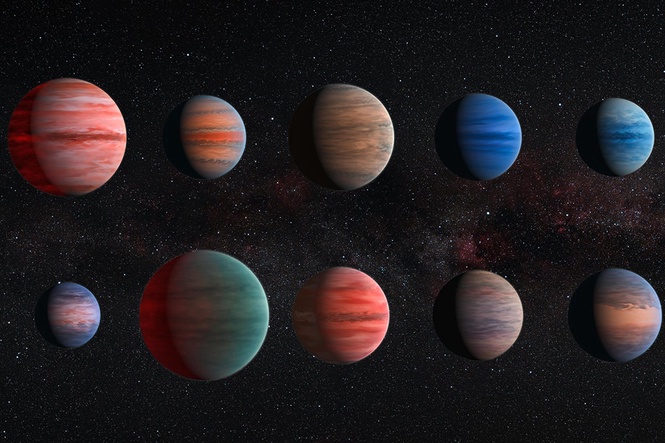
Scientists have found what they believe to be the first ever disappearing planet.
The distant world, known as TOI-2535 b, has been followed by astronomers for years, allowing them to establish that it was a “hot Jupiter” where a year takes only 8.25 days. But, this year, it disappeared entirely.
The researchers behind the study, however, believe that the planet did not actually disappear. Instead, gravity from a neighbouring planet has tilted its orbit in such a way as to stop it being visible to us.
Astronomers generally find such planets by watching for the dip in brightness that happens as they pass in front of their star. They use telescopes such as Nasa’s Transiting Exoplanet Survey Satellite, or TESS, which found the planet in 2019 and has been watching it ever since.
By watching it repeatedly over the seven years that have followed, astronomers were able to spot that the planet passed in front of its star not on a regular schedule but sometimes six hours early or late. Those transits were also getting shorter and shallower – until they stopped entirely, earlier this year.
They believe that happened because the planet is pulled by another unseen planet, with a tilted orbit. That means that the two planets make each other wobble like a spinning top, they suggest, meaning that they vanish from view when they are tilted out of alignment.
“We think of the universe as resembling clockwork, where everything is regular, but that’s not true. If there are multiple planets in a system, they can affect each other’s orbits. We know of a few systems that are like this,” said Samuel Yee, an author on the new paper.
“This is the most extreme example we’ve seen because the two planets are interacting so strongly. The planet’s orbit is tilting so quickly that its transit disappeared while we were watching.”
The disappearing planet should become visible again in the next 30 to 50 years. The hidden planet that made it disappear could come into view sooner, the researchers believe.
The same process that led the planet to vanish is the one that accounts for eclipses on Earth, making them so rare. If the Moon’s orbit was perfectly aligned, there would be an eclipse each month – but in fact it is tilted, making eclipses less common, which is a result of its violent formation.
Read MoreNasa is looking for astronauts to live on the Moon. Here's what you need to qualify
