.jpg)
At 80, I Refuse to Be Digitally Dead
By Mihar Dias August 2026
There is something wonderfully dramatic about a WhatsApp message announcing that technology has finally declared war on the elderly.
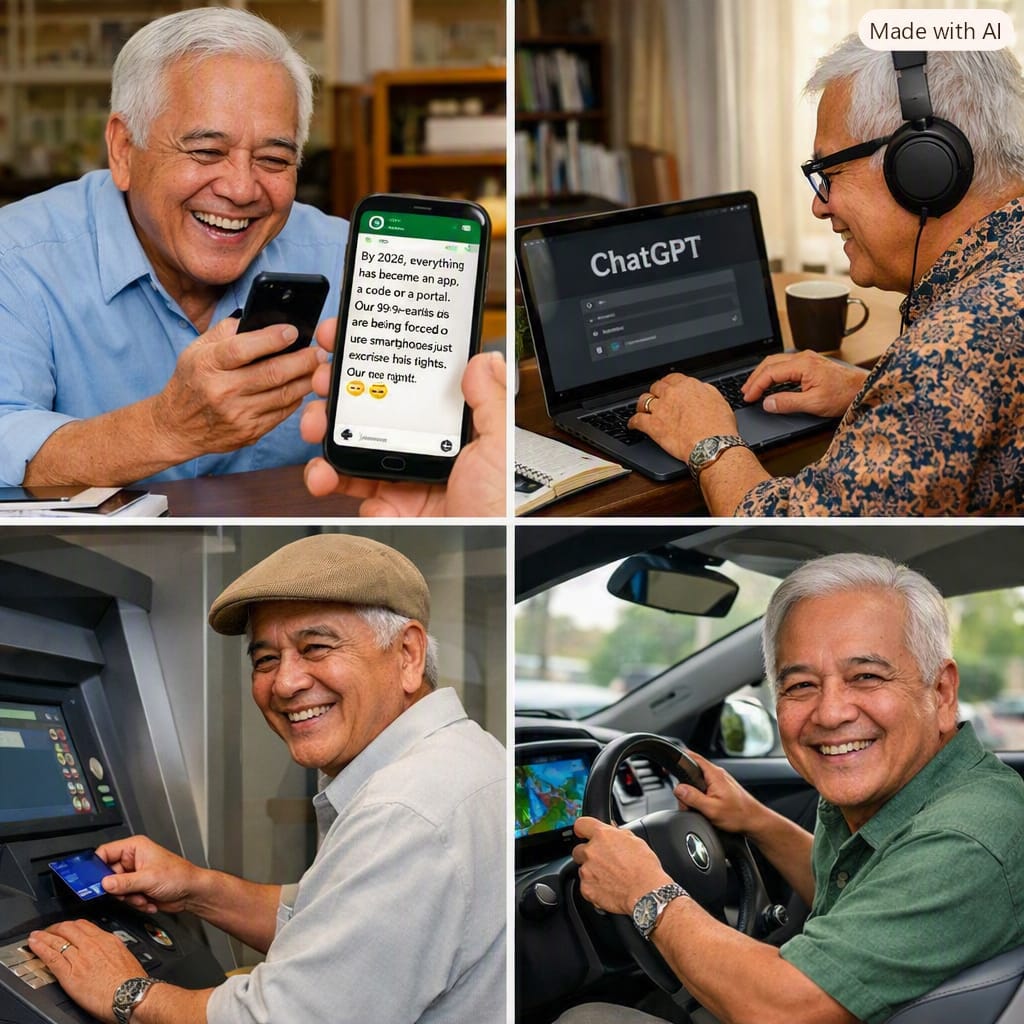
The latest lament doing the rounds of our Class of 1961–65 WhatsApp group goes something like this: by 2026, everything has become an app, a code or a portal, and our 90-year-olds are being forced to use smartphones just to exercise their basic rights. This, we are told, is not innovation but exclusion.
It is a powerful sentiment. It is also rather convenient.
Because there is another way of looking at it.
I am approaching 80 myself. And instead of declaring war on technology, I decided to surrender.
Not only did I take up ChatGPT; I embraced it so enthusiastically that I now find myself producing two columns a day with the help of artificial intelligence. At an age when some people are contemplating whether the television remote is becoming unnecessarily complicated, I am asking a machine to help me research, organise, challenge and polish my thoughts.
And no, ChatGPT has not stolen my brain.
It has simply made my brain more productive.
Which makes me wonder whether we old boys of Sultan Abdul Hamid College have got the wrong enemy.
Technology is not the problem. Our refusal to learn it is.
We did this before.
Remember when the computer arrived?
Many of us regarded it with the same suspicion with which some today regard ChatGPT. Why on earth should anyone need a machine to type a letter when a perfectly good typewriter had served humanity for decades?
Then came the ATM.
Banks practically told us: “Here is your money. Now take it yourself.”
Some complained. Others queued at the counter and muttered about the end of civilisation.
Eventually we learnt to insert the card, remember the PIN and press the appropriate buttons. Miraculously, most of us survived.
Then came the electric cooker.
Why would anyone need all this fancy technology when fire had been cooking food successfully since the Stone Age?
And now, increasingly, the electric car.
Instead of petrol, we have batteries. Instead of the satisfying roar of an engine, we have something that sounds like a mosquito with a university degree.
Yet we adapt.
Because that is what human beings have always done.
The telephone replaced the telegram. Television replaced radio as the dominant medium. Email replaced letters. Google replaced encyclopaedias. Smartphones replaced cameras, diaries, maps, calculators, alarm clocks and, increasingly, common sense.
And now artificial intelligence has arrived.
Naturally, our generation is entitled to ask: “What on earth is this?”
But perhaps the next question should be: “How can I use it?”
That is the crucial difference between being left behind and refusing to move.
Of course, there is a legitimate issue here. Governments, banks, hospitals and businesses should not design systems on the assumption that every citizen is 25 years old, owns the latest smartphone and spends his life tapping QR codes.
There must always be alternatives for the genuinely vulnerable—the elderly, disabled, digitally excluded and those who simply cannot cope with technology.
But there is a danger in turning every older person into a helpless victim.
We are not.
We are the generation that survived without Google Maps. We drove without GPS. We travelled with paper maps. We memorised telephone numbers. We wrote letters by hand. We waited weeks for overseas correspondence. We went to banks and queued. We used encyclopaedias instead of asking Google.
In other words, we are perfectly capable of learning.
Indeed, we have already learnt far more than the younger generation sometimes gives us credit for.
The real tragedy would be if, after surviving all those technological revolutions, we voluntarily decided that the latest one was the one we were too old to understand.
I have found ChatGPT rather liberating.
It does not tell me what to think. It helps me think.
It does not replace my experience. It gives that experience another set of tools.
I still provide the opinions, memories, arguments, sarcasm and occasional nonsense. The machine helps me arrange them into something resembling coherent prose.
At our age, that is not surrender.
That is outsourcing the typing.
And perhaps that is how we should approach technology generally.
Don't worship it. Don't fear it.
Use it.
If the ATM makes banking easier, use the ATM.
If the smartphone makes communication easier, use the smartphone.
If an electric cooker saves time, use the electric cooker.
If an electric car takes you from A to B without petrol, why not?
And if artificial intelligence can help an almost-80-year-old produce two columns a day, then perhaps it deserves a little respect.
There is a wonderful irony in all this.
Our generation spent much of our youth embracing modernity. We were the generation that watched Malaysia transform from a largely rural society into a modern nation.
Now, having reached the age when we are supposed to complain about everything, we suddenly discover that modernity has not stopped.
It has merely become faster.
So to my fellow classmates from Sultan Abdul Hamid College, I say this:
Don't be afraid of the machine.
We have survived British rule, Independence, Konfrontasi, May 13, recessions, inflation, political upheavals, cassette tapes, fax machines, Windows updates and WhatsApp family groups.
Surely we can survive an app.
And if we cannot beat ChatGPT, we might as well ask it to help us write the complaint.
At nearly 80, I have decided that growing old is unavoidable.
Growing obsolete is optional.
Mihar Dias (mihardias@gmail.com) is a content creator under the Newswav Creator programme, where you get to express yourself, be a citizen journalist, and at the same time monetize your content & reach millions of users on Newswav. Log in to creator.newswav.com and become a Newswav Creator now!
The User Content (as defined on Newswav Terms of Use) above including the views expressed and media (pictures, videos, citations etc) were submitted & posted by the author. Newswav is solely an aggregation platform that hosts the User Content. If you have any questions about the content, copyright or other issues of the work, please contact creator@newswav.com.