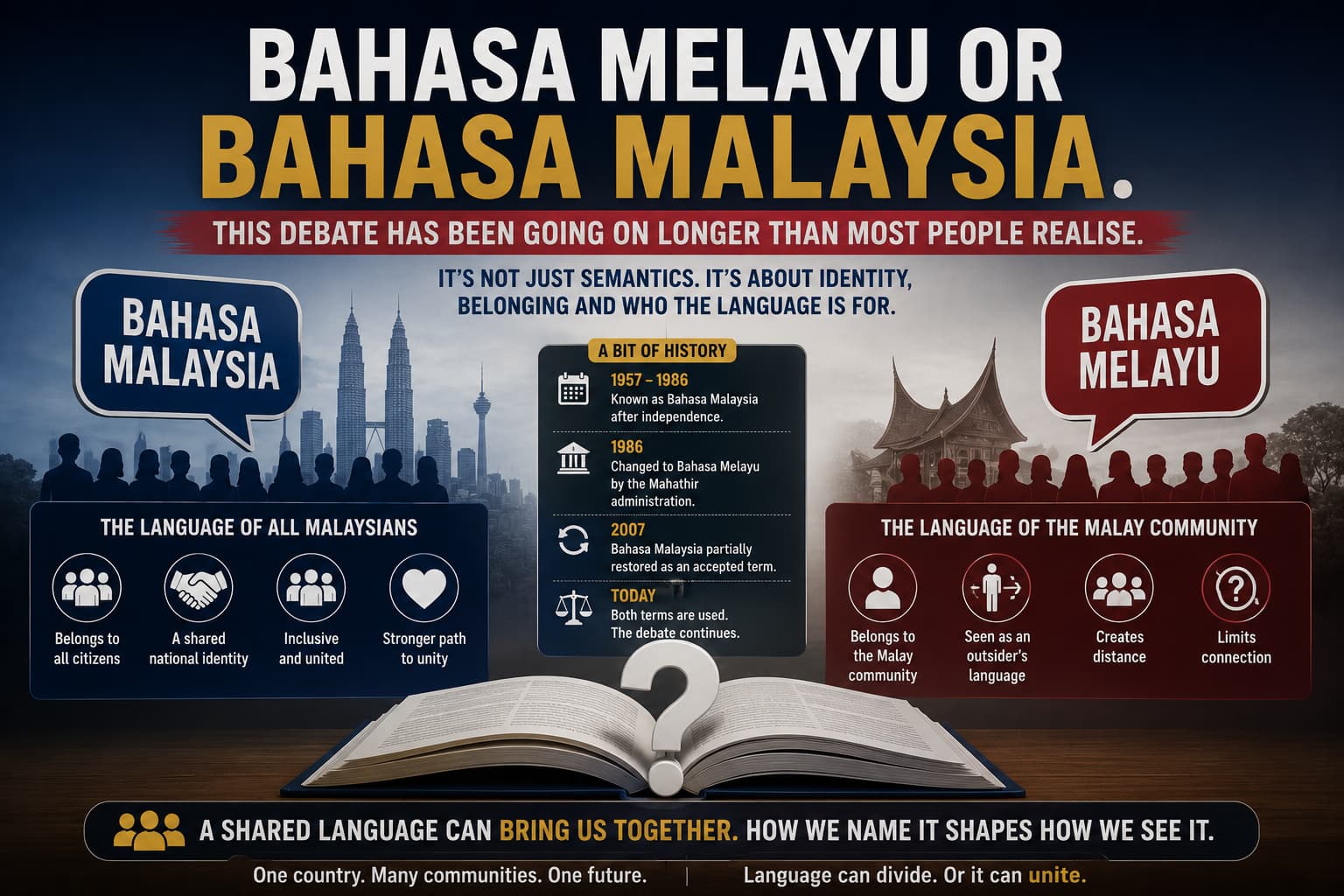
Whether the national language should be called Bahasa Melayu or Bahasa Malaysia sounds like a semantic argument. It is not. It is a question about identity, national belonging, and who the language is understood to be for.
FMT ran a piece in June 2026 framing it as a question about "the language of unity," noting the name has "yo-yoed" between Bahasa Malaysia and Bahasa Melayu driven by nationalism and pragmatism in turns. The framing itself tells you what is at stake.
A bit of history
Officially, Article 152(1) of the Federal Constitution names the national language Bahasa Melayu. It was renamed Bahasa Malaysia after the formation of Malaysia in 1963 in a bid to foster unity among the country's ethnic groups. In 1986, under the Mahathir administration, it was changed back to Bahasa Melayu, then reverted to Bahasa Malaysia under the Abdullah Ahmad Badawi administration. Malaysian Linguistic Society president Nor Hashimah Jalaluddin called the back and forth "a wrong move," arguing that a language should be named after its speakers rather than the country, the same way English is not called the British language. The result is a country where both terms exist, both are used, and your choice of term often signals something about your political or communal position even when you did not intend it to.
Why the name difference actually matters
For non-Malay Malaysians, Bahasa Malaysia signals a language that belongs to all citizens, one you are learning as part of a shared national identity. Bahasa Melayu signals a language that belongs to the Malay community, one you are learning as an outsider picking up someone else's language.
That distinction affects how Chinese, Indian, Kadazan, and other Malaysian communities relate to the language. And how they relate to it affects how fluently and willingly it is used across communities in real life.
The unity question
If the goal is genuine national unity through a shared language, Bahasa Malaysia is the more effective framing. It positions the language as a collective project rather than a concession. Whether that framing is politically acceptable within the Malay community is a separate question, and not a simple one.
Where things stand
There is no imminent move to change anything constitutionally. The debate surfaces periodically because it represents something real about how different Malaysians understand what this country is supposed to be.
My Opinion
My Malay is functional. I use it when I need to. I grew up with Hokkien and English (HokkLish) at home and Cantonese with my Chinese friends, learned Malay at school, and the language has been a practical tool rather than an emotional one for me. When someone says "Bahasa Melayu" it does not personally bother me. But I understand why the name matters to communities who want to feel like stakeholders in the national language, not guests who were allowed to use it. Names tell you who the thing is for. That is not a small thing.
Which term do you use in your daily life? And does it matter to you which one the government uses officially?
Ronny M (ronny76netstuff@gmail.com) is a content creator under the Newswav Creator programme, where you get to express yourself, be a citizen journalist, and at the same time monetize your content & reach millions of users on Newswav. Log in to creator.newswav.com and become a Newswav Creator now!
The User Content (as defined on Newswav Terms of Use) above including the views expressed and media (pictures, videos, citations etc) were submitted & posted by the author. Newswav is solely an aggregation platform that hosts the User Content. If you have any questions about the content, copyright or other issues of the work, please contact creator@newswav.com.