
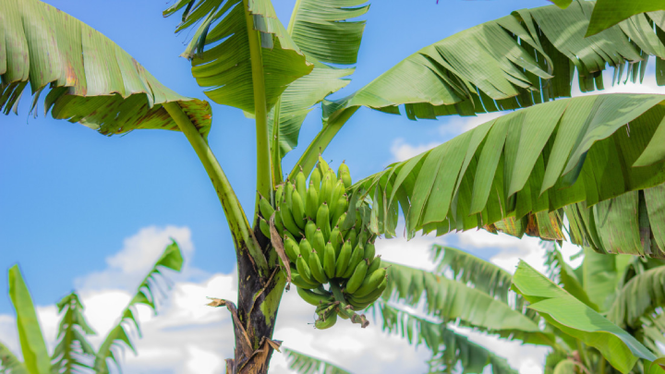
Banana Pseudostems Could Drive Green Nanotechnology Innovation in Malaysia
Malaysia, as a tropical country rich in biodiversity, produces a wide range of agricultural biomass from crops such as bananas, rice, oil palm and pineapples. However, much of this biomass remains underutilised despite its potential to generate significant added value.
Bananas remain one of the country’s major fruit crops and are widely cultivated across Malaysia, ranging from smallholder farms to large-scale commercial plantations. Each harvesting cycle also leaves behind substantial amounts of crop residue, including stems, leaves and fronds, which are typically not further processed beyond being used as organic fertiliser or left to decompose back into the soil.
This makes banana pseudostems one of the most abundant sources of underutilised biomass, available in large quantities throughout the year due to the continuous harvesting nature of banana cultivation.
Although banana stem fibres have traditionally been used in cooking and in the production of fibre-based handicrafts, a huge amount of banana pseudostems that hold potential remain unexplored. Based on this understanding, researchers have been exploring new ways to extract and transform components within banana pseudostems into high-value products, including materials with potential applications in modern science and technology.
The banana pseudostem, which has long been regarded as agricultural waste and left to decompose after the banana bunches are harvested, is now being viewed as a potential raw material for the development of green nanotechnology in Malaysia.
This is in line with efforts to strengthen research based on local resources, particularly in conjunction with Malaysia Day, celebrated every 16th of September to commemorate the formation of Malaysia in 1963.
Banana Pseudostem Extract as a Source of Phytochemicals
Studies have found that banana pseudostems contain various natural phytochemical compounds, including phenolic compounds and important metabolites that have the potential to be utilised in the production of new materials.
Through this approach, banana pseudostem extract is used as a source of phytochemicals to produce metal nanoparticles through green synthesis, an alternative to conventional processes that rely on specific chemicals as reducing and stabilising agents.
However, in plant-based synthesis, phytochemicals in the extract act as reducing agents that assist in converting metal ions into nanoparticle form.
Some of the chemicals in the extract also act as stabilising agents for the nanoparticles that are formed.
On top of that, the use of banana pseudostem extract offers sustainability benefits because the raw material is biomass readily available after harvesting, effectively giving a “second life” to parts of the plant that have completed their primary function.
Compared with conventional chemical synthesis methods, which require synthetic reducing agents and more energy-intensive processes, green synthesis using plant extracts is considered simpler and more cost-effective, while also minimising the use of hazardous chemicals.
In agriculture, attention has also been given to the potential of metal nanoparticles in plant disease management, as some nanoparticles have demonstrated antimicrobial activity.
Challenges of Banana Crop Diseases
Exploring the use of metal nanoparticles to control diseases in banana crops is considered to have significant potential and could have a major influence on disease management. This is particularly relevant because the country’s banana production also faces challenges from diseases that affect crop yield and quality, including Fusarium wilt or Panama disease, Sigatoka, Moko disease, blood disease and viral diseases such as banana bunchy top disease.
Some of these pathogens are capable of surviving in the environment and spreading through planting materials, soil, water and insect vectors, making their management a complex challenge for farmers.
Conventional control methods, such as the use of chemical fungicides, also present their own concerns, including the potential effects of chemical residues, recurring costs and the possibility of pathogens developing resistance to chemicals over the long term.
These factors have encouraged researchers to explore alternative approaches that are more sustainable and environmentally friendly.
In studies involving banana crops, nanoparticles synthesised from banana pseudostem extract have been evaluated for their ability to inhibit pathogen growth in vitro. Further studies are recommended to examine their effects directly on plants.
In addition, the potential use of nanoparticles in agriculture needs to be comprehensively evaluated in terms of effectiveness, safety, appropriate concentrations, stability, and possible effects on plants, beneficial microorganisms and the environment before the technology can be practiced into wider applications.
Early-stage in vitro testing is considered an important starting point before research progresses to greenhouse studies and, subsequently, actual field conditions, as pathogen and plant responses in controlled environments may differ from those under real farm conditions.
Giving Meaning to Malaysia Day Through Local Green Innovation
This year’s Malaysia Day celebration also provides an opportunity to appreciate the country’s wealth of resources and consider how local resources can be harnessed through knowledge and innovation to build a more sustainable future.
Transforming agricultural waste such as banana pseudostems into high-value materials is also consistent with the principles of the circular economy, which seeks to maximise the use of existing resources and reduce waste by returning by-products to the production cycle.
Not only that, a similar approach is also beginning to be explored on other types of biomass, such as oil palm fronds, rice straw and pineapple waste. This demonstrates the broader potential for the country’s agricultural sector to move towards production models that generate less waste and greater added value.
For the banana agricultural industry in particular, successfully commercialising the use of pseudostems as a raw material for nanotechnology would not only open up an additional source of income for farmers, but could also indirectly reduce the cost of disposing of farm waste, which has traditionally been viewed simply as an operational burden.
The development of technologies based on local biomass resources could contribute to several Sustainable Development Goals (SDGs), particularly those related to sustainable agriculture, innovation, and more responsible consumption and production.
The rich biodiversity and natural resources of Peninsular Malaysia, Sabah and Sarawak provide significant opportunities for local researchers to continue developing innovations based on the country’s own resources, particularly in the fields of biotechnology, chemistry and nanotechnology.
Cross-disciplinary collaboration involving materials science researchers, plant pathologists and agricultural agencies is considered important to ensure that laboratory findings can be translated into practical solutions that genuinely benefit farmers in the field, rather than remaining solely as academic discoveries.
This innovation based on banana pseudostem waste carries an important message, in which, solutions to future agricultural challenges do not necessarily have to begin with complex or expensive resources. Instead, they can begin with materials that are already available in our surroundings but have yet to be fully utilised.
With such an approach, agricultural waste that was once overlooked could potentially become one of the contributors to the country’s sustainable innovation agenda, in line with the spirit of empowering local resources celebrated each year on Malaysia Day.
Siti Nur Akmar binti Mazlin is a Research Officer at the Centre for Research in Agricultural Biotechnology (CEBAR), Universiti Malaya, while Associate Professor Yusmin Mohd. Yusuf is a researcher at the Institute of Biological Sciences, Faculty of Science, Universiti Malaya.
The post Banana Pseudostems Could Drive Green Nanotechnology Innovation in Malaysia appeared first on The Stoly.