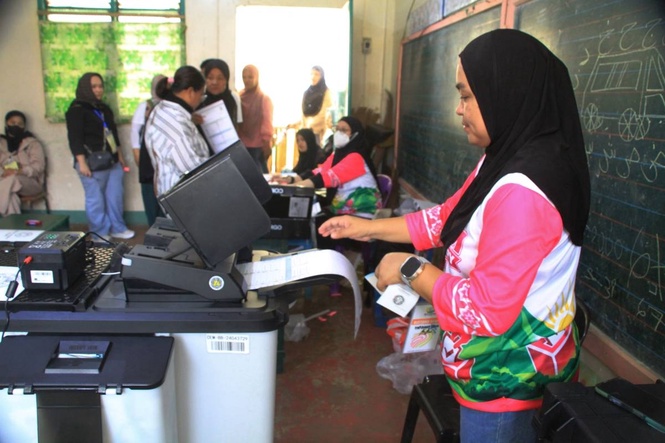
MANILA, Philippines — Bangsamoro voters continued to cast their ballots Monday despite isolated incidents of violence and election-related tensions that tested the first parliamentary elections in the Bangsamoro Autonomous Region in Muslim Mindanao (BARMM).
The incidents, including deadly violence in Cotabato City and the discovery of pre-shaded ballots in Maluso, Basilan, cast a shadow over the historic exercise but did not derail the broader conduct of voting across the Bangsamoro, according to Commission on Elections (Comelec) Chairman George Garcia.
The Comelec reported that 98.1 percent of polling precincts opened successfully, despite security and logistical challenges.
Cotabato City was placed under Comelec's direct control following violence that left three people dead and 15 others wounded before the polls opened.
Maluso in Basilan was similarly placed under Comelec control after pre-shaded ballots were discovered in 36 of its 68 precincts.
In response, the Comelec ordered the reprinting of affected ballots in Maluso. Voting hours were also extended in Basilan to compensate for delays caused by the ballot problem.
The Philippine National Police, meanwhile, maintained that the overall conduct of the Bangsamoro polls remained generally peaceful despite reports of shootings and explosions in some areas.
More than 20,000 police and military personnel were deployed to secure polling places and major routes across the region, with authorities emphasizing the protection of voters and the preservation of the electoral process.
The developments underscored the challenges surrounding an election in a region emerging from decades of armed conflict, political rivalry and underdevelopment.
The polls mark the culmination of a peace process that began with decades of negotiations and armed conflict and eventually led to the 2014 Comprehensive Agreement on the Bangsamoro, the creation of the BARMM and the transition of former rebels toward participation in democratic institutions.
For nearly 2.4 million registered voters, Monday's exercise was not simply about choosing representatives to an 80-member parliament but about demonstrating whether political differences in the Bangsamoro can increasingly be settled through the ballot rather than through confrontation.
President Ferdinand Marcos Jr. described the election as a milestone in the region's continuing journey toward lasting peace, democratic governance and meaningful self-determination, while urging voters to safeguard the integrity of their votes.
The conduct of voters who continued to report to polling places despite tensions in some communities was also evident as the elections proceeded.
The election was never expected to be entirely free of challenges in a region emerging from decades of armed conflict, political rivalry and underdevelopment.
A Comelec official said the problems encountered in particular areas did not automatically translate into a region-wide breakdown of the electoral process.
Instead, election officials, security forces and local stakeholders responded to the challenges within the framework of the law and established electoral procedures.
In Cotabato City, the Comelec assumed direct control following the violence before the polls opened. In Maluso, the commission took control after the discovery of pre-shaded ballots and ordered the reprinting of affected ballots.
Voting hours in Basilan were extended to compensate for the delays brought about by the ballot problem.
The security response included the deployment of more than 20,000 police and military personnel to polling places and major routes across the region.
The election will determine the 80-member parliament, which will subsequently choose the region's chief minister and formally replace the interim arrangement with an elected regional government.
The parliamentary elections mark the transition from the interim arrangement toward an elected regional government under the BARMM.
For the nearly 2.4 million registered voters who took part in Monday's exercise, the results will determine the composition of the parliament that will subsequently select the region's chief minister.