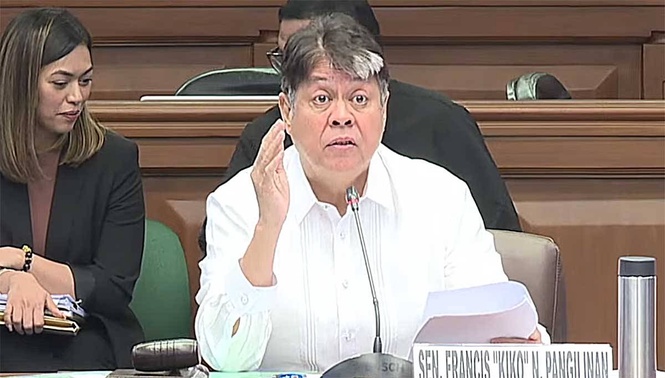
SEN. Francis Pangilinan called on the Department of Agrarian Reform (DAR) to ensure full transparency in identifying agrarian reform beneficiaries, saying public accountability must go hand in hand with the government’s responsibility to empower farmers.
Pangilinan, who chairs the Senate Committee on Agriculture, Food, and Agrarian Reform, led the deliberation of DAR’s proposed P16.935 billion budget for 2027 last Thursday.
“At a time of strong calls for accountability, we are also insisting that every facility, business, and beneficiary supported by the DAR must be readily verifiable: geotagged, with contracts and information open to the public, subject to independent inspection, and proven to be actual, existing, and operational,” he said.
“Climate shocks, so to speak, will not recognize corruption, negligence, or slow bureaucracy. Neither can imports replace the resilience, strength, quality output, and productivity of Filipino farmers,” he added.
Pangilinan said he will press government agencies on the implementation of the full public transparency portal he secured as a special provision for agriculture-related agencies in last year’s national budget.
The portal is designed to strengthen transparency and accountability by providing geotagged project information, government contracts and procurement documents, independent quality-testing results, and a publicly accessible dashboard.
“That is why the proposed 2027 DAR budget must have a clear direction: every peso must provide benefits, deliver results, and be subject to accountability,” Pangilinan said.
“It must ensure farmers’ rights to land, strengthen agrarian reform beneficiaries, and protect local food production — especially in the face of the looming intensification of what they call the worst-ever El Niño,” he added.
Under the Comprehensive Agrarian Reform Program, DAR is mandated to redistribute public and private agricultural lands to landless farmers and farmworkers, provide free legal assistance to agrarian reform beneficiaries, and extend essential support such as infrastructure, irrigation, and credit assistance.
The program also provides for leasehold operations, the resolution and adjudication of agrarian disputes, and the promotion of rural enterprise development, farmers’ organizations, and technical training to help strengthen the livelihoods and productivity of agrarian reform beneficiaries.
Pangilinan said DAR must ensure that the program delivers its intended benefits to the farmers it is meant to serve.
“The direction is right. But are these funds sufficient? The program has a good name, but it must be clear what climate-resilient farm productivity support will actually deliver for agrarian reform beneficiaries,” the senator said.
Agrarian Reform Secretary Conrado Estrella III said that DAR has completed the processing required under the New Agrarian Emancipation Act, with only the distribution of remaining certificates of condonation with release of mortgage in the Bangsamoro Autonomous Region in Muslim Mindanao left to be carried out.
“As we look toward fiscal year 2027, our direction remains clear. Sustain the gains we have achieved, complete our remaining debt condonation obligations, continue land distribution and strengthen tenure security, expand access to agrarian justice, and ensure that our beneficiaries have the means to make their land productive and sustainable,” Estrella said.
Republic Act 11953 condoned agrarian reform debts covering more than P57 billion and hundreds of thousands of beneficiaries, removing unpaid amortizations, interests and penalties attached to awarded agricultural lands.
Beyond completing debt relief, DAR plans to transform agrarian reform beneficiary organizations into self-sustaining cooperatives through improved access to capital, public-private market linkages, technology adoption and institutional capacity-building.
“The goal is to move our beneficiaries from dependence on government assistance toward greater self-reliance, productivity, and sustainability,” Estrella said.
The department also plans to continue distributing individual electronic titles, digitize land tenure records, speed up agrarian cases and bring legal assistance closer to farmers through its Agrarian Reform Justice on Wheels program.