

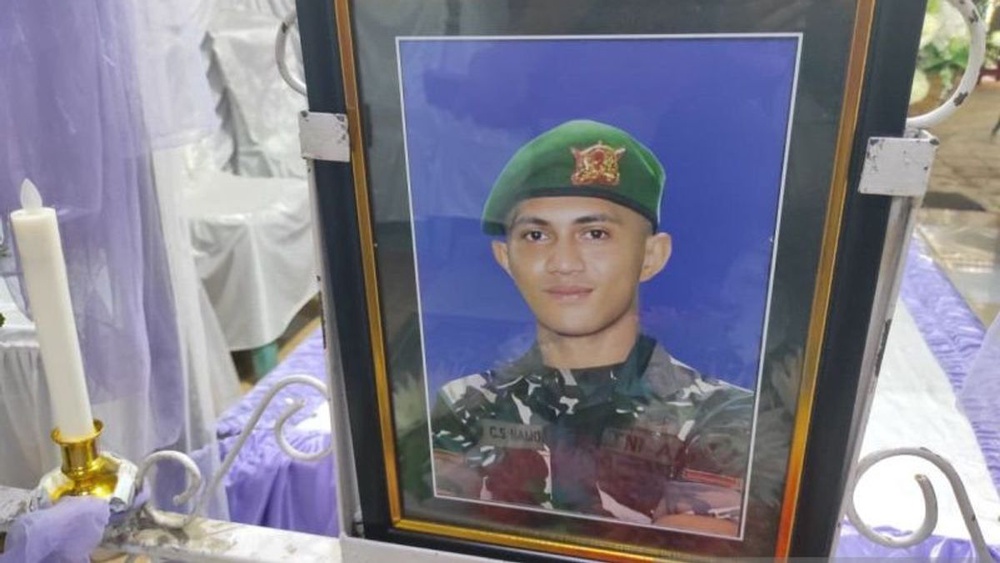
It began with a phone call in the early morning hours, a mother’s voice trembling with dread. Within minutes she found her son collapsed and dying in the intensive care unit, his body a map of bruises and burns. Never the front line of battle, instead a young soldier silenced in the name of “training” that was the fate of 23-year-old Prada Lucky Chepril Saputra Namo. His death has ignited a storm across Indonesia, exposing the dark underbelly of military culture, the systemic silence of institutions, and the human cost of hazing that crosses every red line.
Lucky joined the Tentara Nasional Indonesia (TNI) in May 2025 and was assigned to the 834 Waka Nga Mere Territorial Development Battalion in East Nusa Tenggara (NTT). Mere months later, on August 6, he died after four days in intensive care at Aeramo Regional Hospital in Nagekeo Regency. (CNA)
An internal report, seen by local media (Mothership), reveals that Lucky had been subjected to repeated abuse, including deep bruises, cigarette-burn markings, cuts, and alleged sexual misconduct. His mother recalled he had told her just hours before he collapsed: “I have been beaten by my seniors.” (VOI)
On his funeral, his father himself a soldier spoke with raw anguish: “If he’d died in battle I could have accepted it. But this? By his own brothers in arms?” (CNA)
The formal investigation led to the detention of 20 soldiers, including senior officers, on charges connected to Lucky’s death. (CNA) According to military sources quoted by media, the abuse took place under the guise of “training” and “discipline”, over a span of days in July. (Mothership)
One leaked internal document alleged sexual misconduct and torture, including cigarette burns and stabbing-marks on Lucky’s legs and back. Two hospitals reportedly refused to perform an autopsy on his body, raising further questions about institutional complicity. (VOI)
When two hospitals in Kupang declined the autopsy, his father protested: “I ask the state to step in and punish the perpetrators to the fullest, even death penalty.” (VOI) In the halls of government, parliamentary speaker Puan Maharani urged full transparency and deterrent punishment. (INP | Indonesian National Police)
Despite the detentions, the case has stirred deep unease: why did the chain of command allow multiple individuals to participate in brutalising a recruit? Why did no one intervene? Why did two hospitals balk at an autopsy?
The TNI has long grappled with issues of hazing and abuse. In 2021 a sergeant in Papua died amid similar allegations of mistreatment by senior soldiers. The Lucky case lays bare not just an isolated incident but a culture that allows violence in the name of discipline.
The images that circulated on social media Lucky’s battered body visited by mourners, his father demanding justice sparked widespread indignation across Indonesia. Thousands attended his funeral in Kupang, many without personal connection to the family, united simply by outrage. (Mothership)
On August 12 the coordinating minister for political, legal and security affairs declared that reform was essential, stating: “The government is committed to ensure such incidents do not happen again through legal enforcement and reforms in the internal supervision system within military units.” (CNA)
Within TNI, the incident has triggered a cold light of scrutiny. The regional military command IX/Udayana, which oversees NTT, is under pressure to demonstrate accountability. One spokesman admitted: the investigation must determine each suspect’s role so “appropriate actions can be taken”. (Mothership)
However, critics argue that institutional reform requires more than detentions it demands cultural change. As Puan Maharani emphasised: “The relationship between seniors and juniors should not be based on violence, but rather on mutual respect and appreciation.” (INP | Indonesian National Police)
Some reports indicate that 17 defendants were listed in the initial trial proceedings dating October 2025. (antarafoto.com) While earlier numbers cited 20 suspects, the official count of 17 defendants offers a window into how deeply the alleged abuse was embedded.
A trial that names 17 individuals signal systemic failure, not just rogue behaviour. It suggests that multiple levels of command may have enabled or ignored the violence. This isn’t merely “a few bad apples”; it's a rack of a whole tree rotting from within.
Lucky was not a veteran; he was new, naïve, hopeful. Assigned to a remote base in East Nusa Tenggara, he believed he was doing something noble. Instead, within months he lay dying, his body bearing marks of unspeakable suffering.
His mother’s anguish echoes a wrenching universal fear: a parent’s worst nightmare, not trusting the world outside but the world inside uniform. His father, a soldier himself, confronted the painful truth: the institution tasked with protection had become the site of fatal brutality.
Across armed forces globally, hazing and brutal initiation rituals have plagued units. In Indonesia, where rank and hierarchy in the military are deeply inscribed in culture, the line between discipline and abuse can become dangerously blurred. Lucky’s case forces a reckoning with that blurred line.
When two hospitals refuse to carry out an autopsy, when a station commander allegedly allows violence, when twenty soldiers can be detained each of these is a failure of command responsibility, medical ethics, and justice systems. The TNI has said it does not tolerate such training that “deviates from principles meant to benefit soldiers.” (Mothership)
Yet, acknowledging that statement is one thing implementing it is another. The question looms: will this case become a catalyst for genuine reform, or will it fade as another headline, another tragic recruit lost?
The current trial, opened late October 2025, saw Lucky’s father testify before Military Court III-15 in Kupang. Seventeen defendants appeared, and for the first time the wider public can watch the system’s response in action. (antarafoto.com)
But accountability must go beyond prosecution. For every Lucky whose story becomes public, countless others may suffer in silence. The institution must create safe channels for complaints, protect whistleblowers, and transform training culture into one that empowers rather than punishes.
In a remote military camp far from the bustle of city life, a young soldier died in agony. The curtains may close on his case with verdicts, sentencing, and institutional statements. But the haunting echo remains behind the badge and uniform is a human being, vulnerable, hopeful, and entrusted to protect.
Prada Lucky’s death is more than news it’s a mirror. It forces us to ask: what value do we place on a life when it’s hidden behind chlorinated walls of authority? What responsibilities do we accept when we send young men and women into uniforms and barracks?
His story demands that we not settle for superficial reforms. It demands that institutions stop treating “discipline” as a euphemism for violence. It demands that we measure success not in convictions alone, but in cultures changed, relationships healed, and lives spared.
Lucky may have died alone in the ICU, surrounded by steel beds and beeping machines, but his voice now reverberates in boardrooms, barracks, and parliaments. If justice is to honour him, it must be more than a courtroom verdict it must be a transformation.
Because if we cannot protect one life in uniform from the claws of violence, how can we claim to protect any of us?
AM World (tameer.work88@gmail.com) is a content creator under the Newswav Creator programme, where you get to express yourself, be a citizen journalist, and at the same time monetize your content & reach millions of users on Newswav. Log in to creator.newswav.com and become a Newswav Creator now!
The User Content (as defined on Newswav Terms of Use) above including the views expressed and media (pictures, videos, citations etc) were submitted & posted by the author. Newswav is solely an aggregation platform that hosts the User Content. If you have any questions about the content, copyright or other issues of the work, please contact creator@newswav.com.