
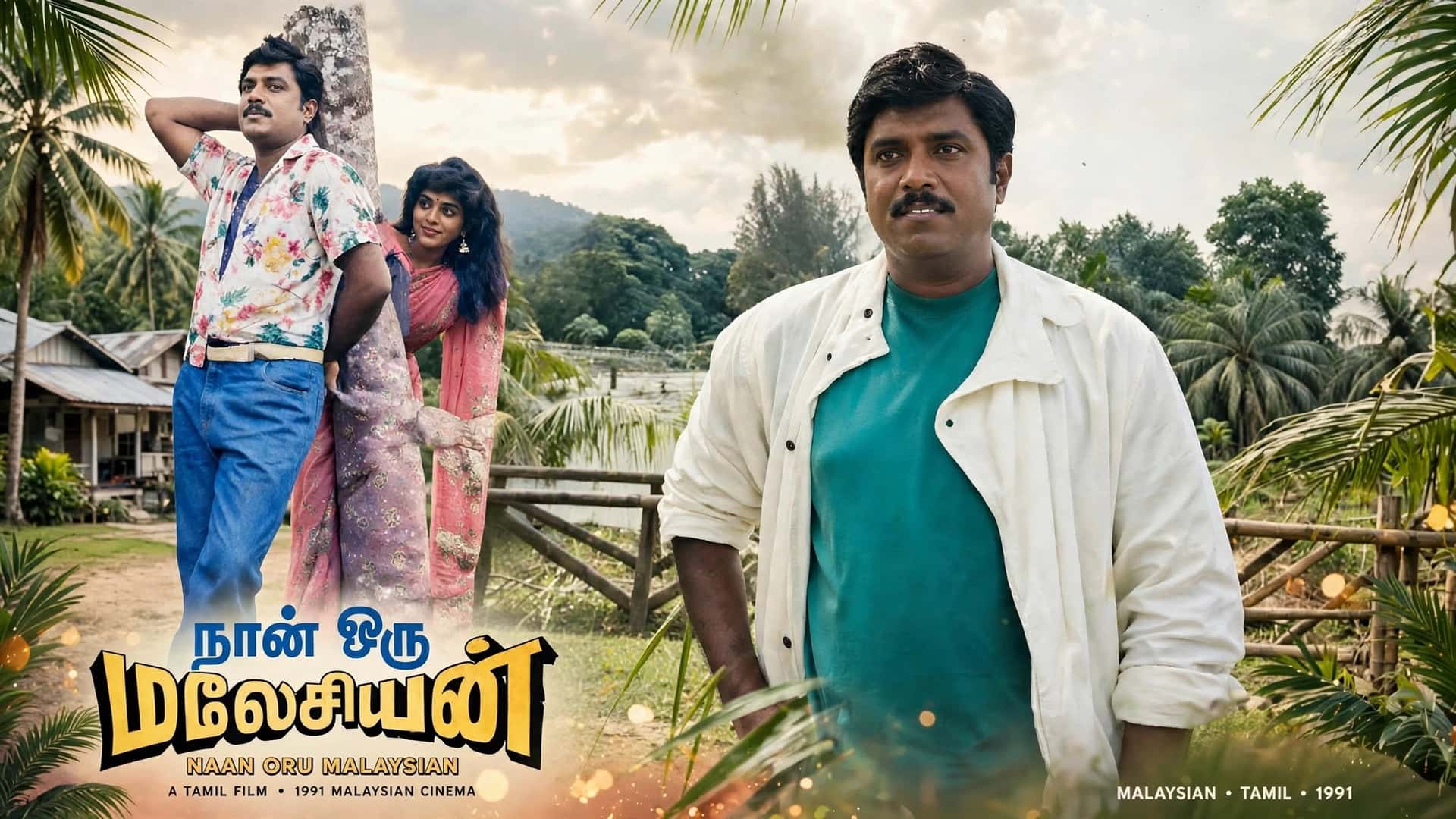
Imagine walking into the legendary Federal Cinema in Kuala Lumpur on Merdeka Day, 31 August 1991. The smell of warm popcorn in the lobby, the low rumble of an eager crowd taking their seats, and then the screen lights up with 35mm local Tamil storytelling.
Long before modern box office debates, Suhan Panchacharam (Suhan Pansha) gave us Naan Oru Malaysian. It wasn’t just a movie; it was a bold statement. Made by Malaysians, shot entirely on home soil, and pulling full-house crowds that grossed RM 150,000 at 1991 ticket prices, it established that our community had stories that belonged on the big screen.
If you re-mastered this classic today with HD scanning and polished digital audio, it wouldn't just be a nostalgia play it would beat many modern local productions at their own game.
The Genius Before Its Time: Framing, Punchlines, and Raw Craft
What often holds back modern Malaysian Indian cinema isn't a lack of expensive camera gear; it's a lack of cinematic nerve. Too many recent projects feel visually static flat medium shots, motionless tripod setups, and predictable angles that feel like television dramas stretched onto a cinema canvas.
Go back to 1991 and watch Naan Oru Malaysian. The visual direction was dynamic. The camera moved with intent tracking shots, energetic dynamic zooms, and hand-to-hand fight sequences where the camera jumped alongside the action. The technical crew wrestled heavy 35mm film stock into fast-paced sequences without relying on modern visual-effects safety nets.
Invention vs. Adaptation (1991 vs. 1992–1997)
| Feature / Element | Naan Oru Malaysian (1991) | Mannan (1992) & Arunachalam (1997) |
|---|---|---|
| Character Dynamics | Arrogant heroine clashes head-on with an estate hero. | Mannan (1992): Arrogant heiress clashes with a factory worker. |
| Punchline Execution | "Amman solran. Naan seyran."
(Delivered once for maximum dramatic impact) | Arunachalam (1997): "Aandavan solran. Arunachalam seyran."
(Repeated continuously throughout the film as a hero mantra) |
| Social Realism & Themes | Balanced commercial tropes with real community issues (e.g., samsu/toddy addiction and Ramayana's Agni Pariksha). | High-budget commercial entertainers focused primarily on hero-centric mass appeal. |
The scriptcraft was remarkably sharp for its era:
- The Character Dynamics (Ahead of Mannan): The story established an arrogant heroine who bullies estate workers, forcing a direct head-on clash with the hero. A year later, Rajinikanth’s mega-hit Mannan (1992) brought that exact dynamic to mainstream Indian cinema. Naan Oru Malaysian hit those story beats first, right here on local soil.
- The Power of the Single Punchline: In Rajinikanth’s Arunachalam (1997), the catchphrase "Aandavan solran. Arunachalam seyran" (God commands, Arunachalam obeys) was repeated continuously to build audience hype. But in 1991, Naan Oru Malaysian delivered a striking parallel line: "Amman solran. Naan seyran." (The Goddess commands, I obey). Suhan Pansha dropped that punchline just once. It didn't need to be repeated ten times; the restraint made it hit harder.
Mythological Themes & Social Realism: The film’s climax drew directly from the Agni Pariksha of the Ramayana the trial by fire. Yet right alongside mythological weight, the script directly confronted one of the most painful realities of the estate community: toddy and samsu addiction.
The story didn't sanitize estate life. It showed how cheap alcohol tore families apart, culminating in the tragic death of a young boy due to his father's addiction. It balanced mainstream commercial beats with a sharp, uncompromising social mirror.
Re-mastering Our Legacy for Today's Multiplexes
Re-releasing Naan Oru Malaysian with modern color grading and digital sound cleanup wouldn't just honor our history it would serve as a crucial wake-up call:
- Proving Commercial Viability: If a 35mm local Tamil film could pull RM 150,000 in 1991, a remastered version in today's multiplexes would show cinema operators that local heritage content can still drive box office traffic.
- A Masterclass for New Filmmakers: It proves that script structure, camera placement, and emotional resonance matter far more than how expensive your digital camera package is.
The Path Forward for Malaysian Indian Cinema
To build a sustainable industry, we must connect the craft of our past with the infrastructure of today:
- Exhibitor Reinvestment: Cinema chains that profit heavily from imported Kollywood blockbusters should channel a fraction of those returns into a dedicated Local Cinema Restoration & Development Fund.
- Script Development Labs: Emerging creators need structured mentorship to learn how early local screenplays successfully balanced high-stakes drama with organic local dialect and real social issues.
- Equitable Screen Allocations: Legacy restorations and modern local releases deserve prime weekend evening slots, not off-peak weekday afternoons where showtimes go to die.
“We keep chasing the glow of foreign screens, forgetting that our own pioneers were already writing blockbusters in our own backyard decades ago. If we don't respect our cinematic history, we will keep begging for space in our own future.” - Annan Vaithegi
Annan Vaithegi (annanvaithegi@icloud.com) is a content creator under the Newswav Creator programme, where you get to express yourself, be a citizen journalist, and at the same time monetize your content & reach millions of users on Newswav. Log in to creator.newswav.com and become a Newswav Creator now!
The User Content (as defined on Newswav Terms of Use) above including the views expressed and media (pictures, videos, citations etc) were submitted & posted by the author. Newswav is solely an aggregation platform that hosts the User Content. If you have any questions about the content, copyright or other issues of the work, please contact creator@newswav.com.