A Trade Delegation Gets Two Politburo Meetings In As Many Days
A roughly 50 member Japanese business delegation led by former Foreign Minister Takeshi Iwaya arrived in Beijing on September 27, and over the next two days it was granted access well beyond what recent Japanese visitors have received. Iwaya, chairman of the Japan International Trade Promotion Association, met Foreign Minister Wang Yi on September 28 and Vice Premier He Lifeng the next day at the Great Hall of the People, according to Kyodo News. Wang and He are both members of the Chinese Communist Party's 21 seat Politburo, and this was the first time China's leadership had met with a Japanese Diet member since ties soured over Prime Minister Sanae Takaichi's November 2025 remarks on a Taiwan contingency. Scheduling two such meetings on consecutive days, Kyodo noted, is unusual.
The contrast with recent months is stark. In April, Liberal Democratic Party heavyweight Yasutoshi Nishimura visited China but was not granted any meeting with government officials. In September, eight cross party junior lawmakers traveled to Beijing but met only Yang Wanming, president of a friendship association, well below Politburo rank. Iwaya's delegation, by comparison, went straight to two Politburo members, according to a Yahoo News Japan analysis.
It was not, however, a full return to normal. The same trade association met Premier Li Qiang during its visits in 2023 and 2025; no meeting with China's premier was reported this time. And Tokyo kept its distance from the whole affair: Chief Cabinet Secretary Minoru Kihara told reporters on September 29 that the government would not comment, describing the trip only as "the activities of a private economic organization." The visit itself had been delayed once already, after the association's previous chairman, Yohei Kono, died unexpectedly ahead of a trip originally planned for June.
Wang Yi Talks Taiwan And History While Avoiding Economics Entirely
According to China's foreign ministry, Wang told Iwaya that Japan China relations need "normalization," called the current situation "severe," and, with Takaichi's Taiwan remarks clearly in mind, said it was necessary for "Japan's leader to urgently correct the erroneous statements made on the Taiwan question as soon as possible." He also invoked history, noting that 2026 marks 80 years since the opening of the Tokyo war crimes tribunal and arguing Japan cannot "face and open up the future" without a correct attitude toward historical questions. Wang specifically praised the delegation's late former chairman, Kono, for having "confronted the crimes committed by Japan's militarism," a line widely read in Japanese reporting as a signal for Iwaya to continue in that mold. Notably, economic cooperation was not mentioned at all in the readout of the Wang Yi meeting. Iwaya, for his part, said he was "concerned" about the state of relations and would work to return them to "the original spirit" of the four political documents that underpin the bilateral relationship.
The Word Beijing Dropped Was Withdraw Not Correct
A closer look at China's own language over the past year shows a subtle but real shift. After Takaichi's remarks on November 17, 2025, foreign ministry spokeswoman Mao Ning demanded Japan "immediately reflect, correct the error, and withdraw the erroneous statement." On December 1, the demand was to "immediately correct and withdraw the malicious statement." On February 9, 2026, spokesman Lin Jian again called for Takaichi to "withdraw" her Taiwan remarks. When Wang Yi met Iwaya on September 28, only "correct" appeared. "Withdraw" was absent, and "immediately" had softened to "promptly," per the Yahoo News Japan analysis of the successive statements.
The distinction matters in practice. Withdrawing would mean retracting the parliamentary answer itself, something the Takaichi government is highly unlikely to accept. Correcting leaves room for a vaguer resolution, such as simply reaffirming Japan's existing commitments under the joint political documents. Still, the same analysis cautions against reading too much into it: the object of Beijing's demand also broadened from "statement" to "words and actions," which could just as easily mean China now wants a policy level correction rather than a narrower rhetorical one, and a foreign ministry spokesperson's routine phrasing is not necessarily comparable to what a minister says face to face.
He Lifeng Keeps Economics And Taiwan In Separate Rooms
The following day's meeting read almost like a different negotiation. Per Chinese state broadcaster Xinhua, He Lifeng told Iwaya that China "consistently welcomes Japanese companies developing in China and sharing in market opportunities," a line that made no mention of Taiwan or history. It was not a new gesture either. A Chinese official used nearly identical wording when meeting Kono in July 2024, according to the same Yahoo News Japan analysis.
He did register one warning. According to Jiji Press, He told Iwaya that "some Japanese politicians are trying to challenge China's bottom line on the Taiwan question," using the term for a line that cannot be conceded rather than the more escalatory "red line" language some other outlets in this dispute have used. Iwaya also pressed for faster export licensing on civilian use rare earths, and He responded that "there is no problem for the civilian sector." That answer, however, largely restates a policy China had already announced on January 6, 2026, when it tightened export controls on dual use goods to Japan while billing civilian use shipments as exempt from the outset. Whether that translates into faster approvals in practice, rather than merely restating the existing rule, is the open question. Iwaya himself told reporters afterward that "China's side is not negative but rather positive" about economic and people to people exchange.
The two tracks have continued in parallel at lower levels as well. Japan's economy minister, Ryosei Akazawa, met China's commerce minister in Jiangsu in May, and Foreign Minister Toshimitsu Motegi briefly spoke with Wang Yi in the Philippines in July, while a separate cross party group of junior lawmakers visited Beijing earlier this month.
What Remains Unconfirmed About A Possible APEC Snub
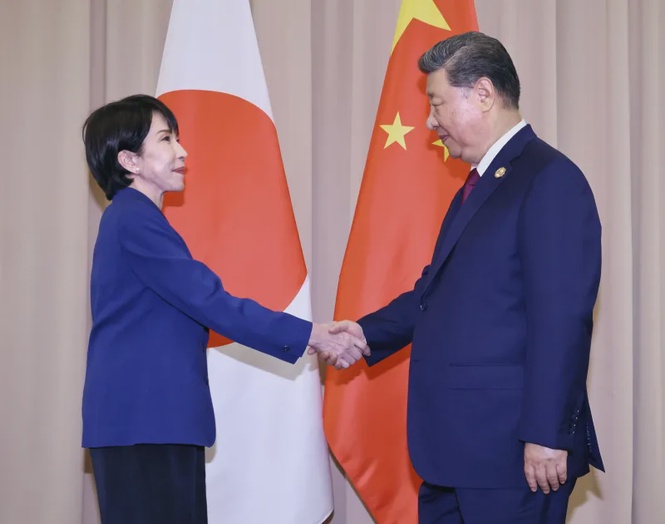
Separately, Japanese television commentary and Nikkei reporting have floated the idea that Xi Jinping could decline a one on one meeting with Takaichi at the APEC leaders' summit, set for November 18 and 19 in Shenzhen, while meeting other leaders normally, along with a related claim that Beijing has been cultivating contacts with Japanese lawmakers seen as more accommodating than Takaichi. Neither claim could be independently confirmed for this article through accessible sources. Nikkei has also suggested that as APEC's host, China faces its own pressure not to appear to be freezing out a member economy, which cuts against the idea of a deliberate snub. Kihara's decision to keep the government at arm's length from the Iwaya visit suggests Tokyo itself is not treating it as evidence of an imminent breakthrough, even as Takaichi has signaled she is open to a bilateral meeting with Xi in Shenzhen.