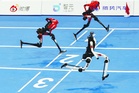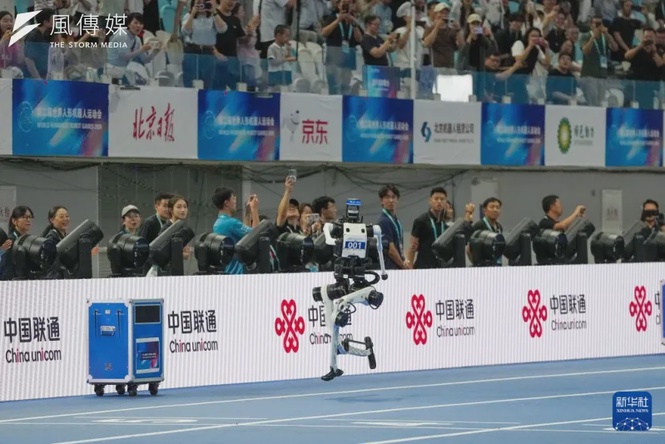
A humanoid robot clocked 100 meters in 9.39 seconds in Beijing on August 22, surpassing Usain Bolt's human world record of 9.58 seconds — then immediately lost control and crashed past the finish line.
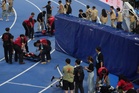
The machine, "Tiangong Ultra," developed by the Beijing Humanoid Robot Innovation Center, competed at the second World Humanoid Robot Games at the National Speed Skating Oval. A second robot, "Glory Lightning," followed in 9.47 seconds. Both times would have drawn headlines anywhere. The aftermath drew something else: machines toppling, failing to brake, and veering off-screen in what Chinese social media quickly labeled a mass wipeout.
The moment captured China's humanoid robotics industry in miniature — impressive speed, and a striking inability to stop.
China Dominates an Already Expanding Field
This year's event dwarfed its 2025 predecessor. Some 666 teams brought 2,056 robots from 16 countries across six continents — a 138% rise in teams and a fourfold increase in robot numbers. China fielded 641 of those teams and 1,975 machines, drawing from 157 companies, 200 universities, and representatives from 27 of the country's elite "985" research institutions. International participants included teams from the United States, Germany, Japan, and a Brazilian national squad.
Events expanded from 26 to 51 disciplines, including new factory, hotel, and logistics scenario challenges, plus a "dexterous hand" category testing precision tasks: picking up beans with tweezers, opening bottles, and measuring small powder quantities. Most track events went fully autonomous, with time windows cut sharply — the 100-meter allowance dropped from three minutes to one.
From 21 Seconds to 9 Seconds in a Single Year
Last year's 100-meter winner finished in 21.50 seconds. This year's clocked 9.39. That is not a refinement — it is a different category of machine.
Speed, however, narrows the margin for error. At higher velocities, every footfall and weight shift must be computed and corrected faster than errors can compound. In the 400-meter race, robots lost control on the curves, scraping the track hard enough to produce sparks. Some had to be assisted off the field. The same robotics center had run a half-marathon in 50 minutes and 26 seconds in April, also under the human world record — but controlled conditions are the operative phrase.
Sprint Records Mask a Deeper Autonomy Gap
Failures followed the machines across disciplines. Robots struggled to stand after falling. Curve stability remained unreliable. Some scenario events still required human intervention, even as organizers described the competition as "more coordinated and more autonomous" than last year.
The gap between a machine that can sprint in under 10 seconds and one that can stop on command, navigate an obstacle, or recover from a stumble without assistance remains wide. Current humanoid robots excel in optimized, controlled environments — and struggle when conditions deviate from their training.
China Bets on Manufacturing Scale Over Algorithm Elegance
The deeper argument at the Ice Ribbon is not about which robot runs fastest. It is about who can move from prototype to mass production.
China's structural advantage is real: integrated supply chains spanning precision motors, electronics, batteries, and automotive components — the same ecosystems that feed humanoid robot assembly. Getting from one lab machine to 100,000 factory units is as much a manufacturing challenge as an engineering one, and China's industrial base is built for exactly that.
Organizers promoted the games with a telling slogan: "Win a medal at the event, land an order at the factory." The scenario competitions — factory assembly, hotel service, firefighting — were designed not as spectacle but as proof of commercial readiness.
That ambition sits squarely inside the US-China technology rivalry, where humanoid robotics has become a contested frontier with implications for manufacturing, services, and potentially defense. US, European, and Japanese companies have active programs, but none backed by state resources at Beijing's scale.
The opening ceremony said the quiet part aloud: robots playing instruments with human musicians, competing in table tennis and tennis against athletes — a choreographed confidence that a technology still learning how to stop was already, somehow, arriving.