
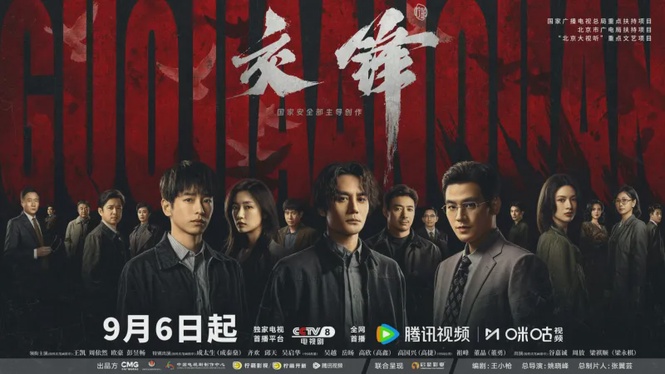
Chinese state television has no shortage of national security and counter-espionage dramas, but one that puts Lee Teng-hui, a Taiwan Strait crisis and cross-strait spycraft at the center of the plot is still a rarity. "Confrontation," a 40-episode series developed under the guidance of China's Ministry of State Security, premiered on CCTV on the evening of September 6 and immediately became the talk of Chinese social media, topping the national ratings on its first day. Some mainland viewers went so far as to call it unusually "bold."
What sets the show apart is that it does not stay inside the vague framing of a generic "cross-strait spy war." Instead, it winds the clock back to the 1990s and confronts, head-on, the era of Taiwan's then-president Lee Teng-hui, his 1995 trip to the United States and the Taiwan Strait crisis that followed.
A Drama That Puts Lee Teng-hui At The Center Of The Story
"Confrontation" is set in the mid-to-late 1990s, using the sharp escalation of cross-strait tensions in that period as its historical anchor. Lee's 1995 visit to the United States sent relations between Taipei and Beijing into a downward spiral. By the time Taiwan held its first direct presidential election in 1996, China was conducting military exercises and missile tests around the Taiwan Strait, and the United States responded by sending carrier battle groups into the area, pushing the region to one of its tensest moments since the end of the Cold War.
Rather than simply dramatizing that history as a strait crisis story, the show turns it into the backdrop for an intelligence war, built around Taiwan's military intelligence apparatus, mainland state security agents, stolen military secrets and decades-long undercover infiltration.
The opening episode sets the tone with narration blaming Lee for a controversial remark, made in a conversation with a Japanese writer, about the "sorrow of being Taiwanese," which the narration describes as having "severely distorted historical facts and undermined the foundation of cross-strait relations" by stoking separatist sentiment. In the episodes aired so far, the plot repeatedly returns to Lee's ambitions to visit Washington, with a character resembling him instructing intelligence officials that what Taipei wants is the mainland's missile program. Taiwan's Military Intelligence Bureau is then shown accelerating its network on the mainland, planting operatives and even offering large sums of money to recruit mainland rocket scientists.
State-run Beijing Daily has drawn a direct line between the plot and the real-life case of Liu Lian-kun, calling it the highest-ranking Taiwan-linked espionage case publicly disclosed since 1949. China's National Radio and Television Administration has framed the series as part of a broader push to bring national security education to the general public, arguing that it helps ordinary viewers understand the methods, secrecy and dangers of espionage.
Compared with the 2021 series "The Rivals," in which Taiwan barely registered as more than a background reference, "Confrontation" makes Taiwan concrete. Symbols and terminology mainland productions have typically avoided, including explicit references to the Republic of China, appear throughout, giving the cross-strait rivalry a far sharper and more specific edge on screen.
Real Espionage Cases Provide The Raw Material
Another reason "Confrontation" has drawn attention is how closely its plot echoes the real Liu Lian-kun case from the late 1990s. The show depicts Taiwanese military intelligence officers turning members of the mainland's military and defense-industrial establishment, as well as running long-term operatives disguised as Taiwanese businesspeople, and Chinese state media have explicitly tied these storylines to historical cases like Liu's. Liu, a former director of ordnance for the People's Liberation Army's General Logistics Department who held the rank of major general, has long been treated by Beijing as one of the most significant Taiwan-linked espionage cases on record.
Rather than reproducing real figures on screen without alteration, the production blends genuine case elements with dramatic license, weaving together military secrets, intelligence outposts, cover identities as Taiwanese businesspeople and years of undercover work.
What mainland viewers and media describe as the show's "bold" edge is not primarily about violence or sexual content, but about how openly it depicts details of the contemporary cross-strait shadow war that have rarely been shown so directly, from the evolution of tradecraft across the pager era through to the dark web and cryptocurrency, down to specific place names, institutional detail, the exploitation of personal vulnerabilities, and unusually frank depictions of Taiwan's Military Intelligence Bureau itself.
A Message Aimed At Home, Not At Taiwan
Mainland spy dramas have traditionally been set during the Chinese civil war, the war against Japan or the early years of Communist rule, and even "The Rivals" was considered unusual for choosing a contemporary setting. "Confrontation" goes further still, anchoring its story firmly in the Taiwan Strait crisis of the 1990s and pulling Lee Teng-hui, a figure Beijing's official narrative treats as emblematic of "separatist forces," directly into the center of the plot. That kind of treatment remains genuinely rare in mainland film and television.
From Taiwan's perspective, the show looks less like a message meant for audiences across the strait and more like a coordinated exercise in domestic mobilization paired with external signaling. By portraying Taiwan's Military Intelligence Bureau as an aggressive force dispatching spies, turning mainland talent and stealing missile and defense-industrial secrets, the series echoes Beijing's long-running rhetoric against "Taiwan independence" and "outside forces." Observers note that the show's primary audience, and the audience it is designed to move, remains the mainland public.
By pairing high ratings with a wave of online discussion, the series reinforces the idea that "spies are everywhere" and that "Taiwan is constantly infiltrating," a narrative that dovetails with Beijing's official push to bring national security education to the general public. At a moment of persistently high cross-strait tension, it also doubles as a form of politically sanctioned entertainment that gives audiences at home an emotional outlet.