
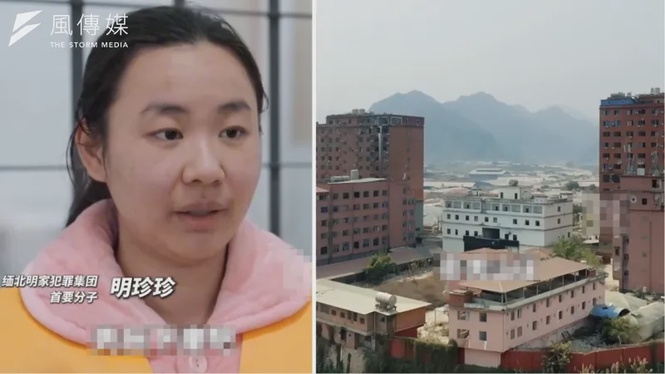
A new Chinese state documentary is offering the most detailed official account yet of how the scam compounds of northern Myanmar operated, portraying them not as shady call centers but as armed fiefdoms held together by detention, torture and public executions. Produced by China's Ministry of Public Security and state broadcaster CCTV, the series draws on interviews with investigators, members of the crime groups and footage gathered during the crackdown.
Among its most striking claims is that one compound housed an underground shooting range, its walls scarred by machine gun fire, where some of the people forced to run scams were executed. Police from Wenzhou in China's Zhejiang Province, who led the investigation, say the killings were meant not only to silence witnesses but to instill fear, showing everyone else trapped inside that trying to flee or resist could cost them their lives.
How A Promise Of High Paying Jobs Became A Trap
For years, the scam hubs of northern Myanmar projected a strange glamour: luxury villas, casinos, sports cars and armed bodyguards, alongside a flood of social media ads promising well paid jobs overseas. Many recruits believed they were heading somewhere to make quick money.
The reality was far darker. An earlier investigation by The Washington Post cited victims and others who described beatings with metal pipes, confinement in chains and waterboarding inside the compounds.
The documentary focuses on Crouching Tiger Villa (臥虎山莊), the largest and most profitable compound run by the Ming family and directly controlled by patriarch Ming Xuechang (明學昌). Cameras sweep through a windowless underground space known as the "shooting range." Zhang Changhui (張昌慧), a senior officer in the criminal investigation unit of the Wenzhou Public Security Bureau, says in the film that it served more often as an execution ground.
"Beating people to death had a clear purpose, which was to intimidate," Zhang says. "In front of everyone, the message was that the only way to survive was to obey and work." To cover up the killings, he adds, the compound's enforcers would also spray victims with machine gun fire and shoot others to make sure they were dead. "This really went beyond the limits of humanity." The bullet holes covering the walls are a silent record of how the low level scam workers known as "piglets" were dealt with in front of others when they missed targets, tried to escape or disobeyed orders.
That brutality was not an isolated case. Survivors and police investigations describe routine beatings, confinement in water cells, severed fingers, forced kidney removal, resale of workers to other groups, and even burial alive. In this world, fraud was not just a criminal business but the dominant trade, protected by armed militias. Missing a quota could mean being punished as an example, and escaping could mean being shot.
What Happened In The October 20 Shooting
The documentary reconstructs in detail the shooting in the early hours of October 20, 2023. With pressure from Beijing mounting, authorities in Kokang (果敢) were preparing to inspect the compounds for people held against their will. When the Ming family learned of the plan, it announced it would send home scam workers who wanted to return to China. Instead, armed men moved people out of Crouching Tiger Villa in batches and took them to two other compounds, Chengde Mansion (承德公館), known as the "Red House," and Donghu Villa (東湖山莊), both managed by Ming Xuechang's granddaughter, Ming Zhenzhen (明珍珍).
Realizing they were not being sent home, some of the workers tried to run. The militiamen guarding them opened fire. Chinese authorities concluded that four Chinese scam workers were killed and four wounded. Rumors that followed, including claims of more than 100 casualties and that four undercover Wenzhou police officers had been killed, were found to be false. All the dead and wounded were people held inside the compounds.
Ming Zhenzhen, who was executed on January 29, 2026, spoke about the incident in an interview before her execution. "Of course we couldn't let it blow up, so we tried to suppress it first," she said. "Since they were already dead, we arranged for people to bury them." The bodies were buried on a cattle and horse farm owned by the Ming family. Investigators later entered the site despite fighting in the area and the risk of landmines, and dug up badly decomposed remains piled on top of one another.
Why The Four Families Were So Hard To Dislodge
In Kokang, the name "Four Families" inspired fear not simply because these clans controlled a few scam compounds. According to official Chinese accounts, the Ming family began amassing wealth from gambling and telecom fraud around 2015, building several compounds, including Crouching Tiger Villa, and using its own armed forces to provide so called protection. At their peak, the family's compounds held close to 10,000 scam workers.
When a criminal organization controls land, weapons, local political power and enormous cash flows at the same time, police are no longer dealing with an ordinary fraud ring. They are facing a paramilitary underground economy.
Throughout 2023, Chinese officials met representatives of the Four Families several times and demanded that they shut down the scam compounds. According to reports, Beijing issued three warnings, but the groups stalled, gave token responses, or refused outright, arguing that fraud was a mainstay of the local economy.
From Arrest Warrants To Death Sentences
In November 2023, Chinese police offered rewards for the capture of Ming Xuechang, Ming Guoping (明國平), Ming Julan (明菊蘭) and Ming Zhenzhen. Ming Guoping, Ming Julan and Ming Zhenzhen were later detained and handed over to China, while Ming Xuechang died during the attempt to arrest him. In September 2025, the Wenzhou Intermediate People's Court issued its first instance verdict, sentencing 11 members of the group to death, including Ming Guoping and Ming Zhenzhen. The court found the group guilty of telecom and online fraud, intentional homicide, intentional injury, illegal detention, running casinos, drug trafficking and organizing prostitution, with gambling and fraud proceeds exceeding 10 billion yuan.
Why The Crackdown Does Not End The Threat
For years, news about scam compounds in northern Myanmar was often treated as a distant Southeast Asian curiosity: people lured to Myanmar, held captive in compounds, or risking their lives to escape. In hindsight, it was a highly globalized criminal model. The compounds may sit in Myanmar, but the victims can be in China, Taiwan, Hong Kong or elsewhere. Scripts can be delivered online, money can move across borders, and the recruiters who bring people in may not even be in the country where the gangs operate.
That is why the fall of the Four Families does not mean the industry has disappeared.