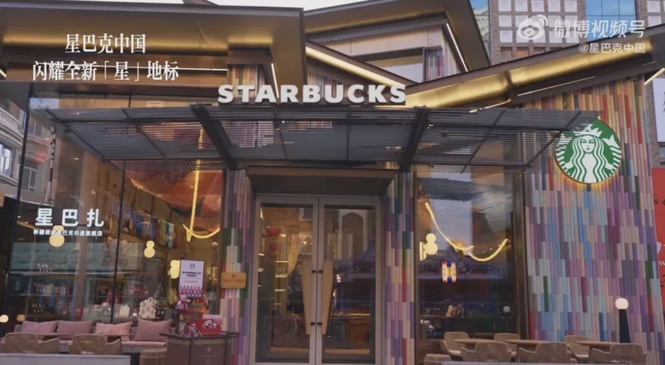
Starbucks opened its first stores in China's Xinjiang region on September 29, setting off an immediate rebuke from a senior U.S. lawmaker and a sharp denial from Beijing.
Two outlets opened in the regional capital, Urumqi. Representative John Moolenaar, who chairs the U.S. House select committee on China, called the move "morally bankrupt" and demanded the stores be shut down, while China's Foreign Ministry used an October 3 briefing to reject what it called politically motivated attacks.
Two Urumqi Stores Built Around Local Flavors
The openings came as a pair. One is a flagship inside the city's International Grand Bazaar, nicknamed "Starbaza," a play on the word bazaar, which Starbucks presents as an intangible cultural heritage store. The other, called the "Silk Road Station," sits inside Tianshan International Airport.
Pomegranate, milk skin (a clotted dairy specialty), and baklava feature in the drinks and pastries, and the interiors lean on traditional crafts and local folk motifs. Liu Wenjuan, chief executive of Starbucks China, said the company will keep investing in Xinjiang to create "a third space unique to Xinjiang," echoing Starbucks' long-running idea of a gathering place that is neither home nor office.
Until now, coffee drinkers in Urumqi looked elsewhere. A friend of this reporter who works in Xinjiang said the only options on days off were Cotti or Luckin, two Chinese budget coffee chains, although the city has no shortage of independent cafes with a regional character.
Congressman Moolenaar Calls The Move Morally Bankrupt
The news became a talking point on Capitol Hill within days. Moolenaar called Starbucks' decision "shocking" and said every cup sold in Xinjiang ties an iconic American brand to what he described as the Chinese Communist Party's brutal repression of Uyghurs. The World Uyghur Congress, an exile advocacy group, joined in, accusing the company of once again ignoring a grave human rights situation.
With U.S. midterm elections approaching, China is rarely far from the political spotlight in Washington, and a coffee chain has now been pulled into it.
The backdrop is a 2022 assessment by the United Nations human rights office, which said Uyghurs and other Muslim minority groups faced allegations of serious abuses, including arbitrary detention and torture. The Chinese government denies the allegations, calls such reports politicized, and says its policies in Xinjiang target terrorism and extremism and aim to keep society stable.
On October 3, Foreign Ministry spokesperson Guo Jiakun hit back, calling claims of genocide in Xinjiang "an outright lie" and accusing U.S. institutions of inventing accusations for political ends. He repeated the official line that Xinjiang enjoys stability, economic growth, ethnic unity, and religious harmony, and said China will keep opening up and welcome foreign investment. On Chinese social media, commenters blamed "foreign anti-China forces" for undermining the country's development.
A Boyu Capital Stake Gives Starbucks Some Buffer
Corporate structure may give the company some room to maneuver. In November 2025, Starbucks agreed to sell control of its China retail business to private equity firm Boyu Capital. The deal closed in April, leaving Boyu with 60% and Starbucks with 40%, while Starbucks retains control of the brand and its intellectual property licensing.
In practice, the Xinjiang stores are run by a Chinese joint venture rather than decided directly by Starbucks' U.S. headquarters. The brand remains American, but operating responsibility has partly shifted, which offers a degree of cushion against pressure from Congress.
Xinjiang Is The Last Big Frontier For The Brand
For Starbucks, Xinjiang is the last large area of the China map left to develop. The bazaar flagship and the airport store are meant to do more than sell coffee: they extend a brand story that blends coffee culture with Silk Road imagery and regional flavors, an attempt to show that the chain is part of local life rather than an outsider.
Xinjiang-limited products are also being promoted at stores nationwide, a sign of a strategy of localization on a national scale. The company has not retreated from China even after a few bumps in the consumer market, and Chinese rivals are pushing outward as well: Luckin Coffee has already moved into the U.S. market with a New York presence.
Multinationals Struggle To Stay Politically Neutral
In U.S. politics, Xinjiang has long been heavily moralized. Whether the issue is the UN's 2022 findings on detention and torture allegations or American forced labor legislation and supply chain checks, any Western brand that enters the region risks being labeled complicit. This reporter reads Moolenaar's choice of "morally bankrupt" as no accident: it targets the social responsibility image Starbucks has spent years building.
Companies need to survive and consumers need to live, a simple logic that has put many American and Chinese multinationals in a bind in western China, especially in Xinjiang and Tibet. Western societies expect firms to take sides on human rights, while China's vast consumer market makes a real exit hard. Starbucks is neither the first nor the last to be caught in this tension, and carmakers, clothing brands, and technology companies have all weighed commercial reality against moral posture.
The same pomegranate Frappuccino now carries two very different meanings. In Beijing's official narrative, the heritage and local flavors Starbucks China highlights are proof of ethnic unity and cultural prosperity. Human rights advocates may read them as a gloss on assimilation policies.
As U.S.-China strategic competition intensifies, pure commercial neutrality is getting harder to sustain, and brands can no longer easily claim they only sell coffee and stay out of politics. By pressing ahead in Xinjiang, Starbucks appears to be betting on the long-term value of the China market and on the risk spreading that its joint venture provides. This reporter sees the lawmakers' criticism as a continuation of Washington's established practice of politicizing economic tools.