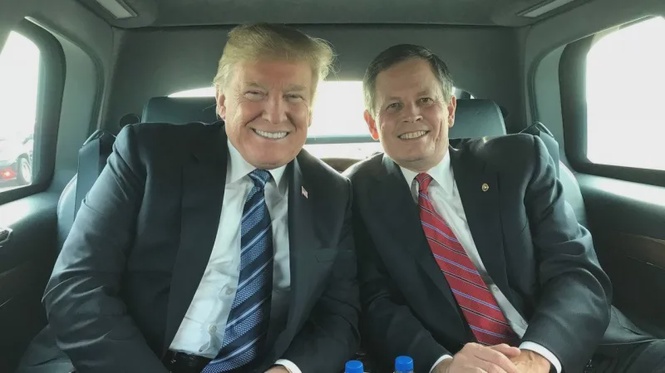
Republican Senator Steve Daines of Montana, a close Trump ally seen as an informal back-channel to Beijing, made a quiet four-day trip to China from August 26 to August 29 — visiting AI firms and aviation startups in Hangzhou and Guangzhou weeks before President Xi Jinping is expected in the United States for a September state visit.
Daines Rides Autonomous Air Taxi, Tours China's AI Frontier
In Hangzhou, Daines visited Zhejiang University and a cluster of companies spanning AI, smart glasses, biotechnology, and space computing — including Rokid, Enohe Technology, Dadi Tianxing Space Technology, and Kujiale. In Guangzhou, he boarded an EH216-S autonomous eVTOL aircraft at EHang, a low-altitude aviation firm whose facility sits next to the Procter & Gamble compound where Daines worked in the 1990s.
Three decades ago, he came to Guangzhou with P&G, part of a wave of US companies entering a fast-growing Chinese market. The city he returned to in late August is one where Chinese firms are now pushing autonomous aircraft and AI platforms outward — and expecting American lawmakers to take notice.
Beijing Signals Pragmatism Through a Senator With No Official Title
The Zhejiang provincial foreign affairs office — the trip's primary public source, as Daines issued no statements of his own — said Governor Liu Jie met with the delegation and pledged to implement the consensus between the two heads of state on industrial innovation, trade, and investment.
The silence from the US side was deliberate. In May 2026, Daines led a bipartisan delegation to Beijing for high-profile meetings with Premier Li Qiang and Foreign Minister Wang Yi ahead of President Donald Trump's own trip to China — a visit that generated significant press. This time, nearly all public information came from Chinese government releases.
Daines has visited China eight times since entering the Senate in 2015. His years in Guangzhou and Hong Kong give him a practical familiarity with Chinese commercial culture that few Senate colleagues share, making him a trusted informal intermediary who can move between the two capitals without the weight of an official title.
Xi's September Visit Raises Uncomfortable Questions for Taiwan
Xi's anticipated September state visit would be one of the most consequential US-China summits in years, with discussions expected to span trade frameworks, AI safety, and investment — all areas that featured directly in Daines' itinerary.
Routing the visit through Hangzhou and Guangzhou rather than Beijing carried its own message. Both cities host some of China's most competitive tech innovators — not legacy state enterprises, but agile firms competing globally. The implicit argument: if Washington treats China's technological rise entirely as a security threat, the conversation will quickly outgrow tariffs and market access, reshaping the architecture of the next global technology order.
For Taiwan, the stakes are real. A stabilizing US-China relationship would not automatically push Taiwan aside — but Taipei should not assume Washington will keep the Taiwan question at the top of every bilateral agenda simply because strategic competition continues. The Daines visit is one more signal that quiet deal-making, on technology and trade, remains very much on the table.