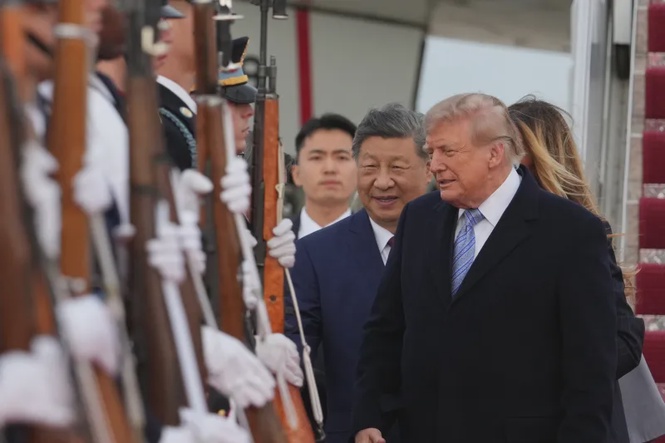
The second Trump Xi summit was billed as a conversation about US China relations. What Taiwan saw was two different Chinas. One is the state, which talks about national interest, sovereignty, security, rejuvenation, and great power status. The other stood on the sidewalk, talking about individual rights, family grievances, political freedom, and historical memory.
Xi Jinping used his September 24 White House summit with President Donald Trump to press Washington to oppose Taiwan independence outright, a demand Beijing has never put so directly to a US president. A few blocks away, a very different China was on display.
The visit was Xi's first US state visit since 2015 and his second face to face meeting with Trump this year. Trump traveled to Joint Base Andrews in person to meet the Chinese leader's plane, receiving him with a red carpet, a 21 gun salute, and a military flyover. The protocol was deliberately elevated, and both leaders had reasons to want the spectacle.
The published agenda covered an extension of the trade truce, rare earths, artificial intelligence, export controls, and Iran. Taiwan was never the headline item, and it was never absent either.
Xi Pressed Trump To Oppose Taiwan Independence
Xinhua reported that Xi told Trump the Taiwan question had to be handled with care and urged the United States to formally oppose Taiwan independence. The verb is the whole argument. Washington's long standing formulation is that it does not support Taiwan independence, a deliberate piece of ambiguity that leaves the island's future undetermined. Opposing independence would place the United States on Beijing's side of the question rather than outside it.
Trump gave nothing away publicly. Asked by reporters whether Taiwan had come up, he said only that the talks had been "quite good," and he later indicated the two had not spent much time on the subject. No change to the American formula was announced.
Beijing pressed the same point through its military. On September 24, Defense Ministry spokesman Jiang Bin invoked the 1982 August 17 Communique, calling on the United States to abide by the three joint communiques and halt weapons sales to Taiwan. He described Taiwan as the most important issue in the relationship.
For Taipei this is not a debate about diction. The August 17 Communique, in which Washington undertook to reduce arms sales to Taiwan over time, has been read narrowly by successive US administrations. Reviving it now would bear on deliveries already paid for and still undelivered, on the credibility of deterrence, and on the pace of Taiwan's rearmament. Taiwanese officials said after the summit that arming Taiwan remains an important American interest.
Taiwan's Security Agencies Gamed The Summit In Advance
Taiwan's national security apparatus began running scenarios before Xi left Beijing, mapping the likely red lines on both sides, Trump's transactional instincts, and the package Beijing might assemble. Collection went well beyond the published schedule to staff level contacts, think tank traffic in Washington, congressional movement, and the possibility of private understandings that would never appear in a communique.
Beijing ran the mirror image of the same exercise. Chinese analysts assessed how far Washington would go on Taiwan, how much Trump values a deal for its own sake, and what domestic pressures constrain him, from approval ratings before the midterms to energy prices and the political cost of appearing soft on China.
What Xi needed before landing was not the public American position, which is easy to read, but the internal disagreements behind it. Which voices in Congress, the Pentagon, the think tanks, and business differ from the White House. Who can move Trump. Which policies have give in them, and which ones touch a domestic wire that cannot be touched. The result was a contest conducted at a distance, and it is the reason Taipei cannot treat a summit like this as a spectator sport.
Paid Welcomers Faced Protesters Across The Street
Chinese leaders now travel into a predictable split screen, and the economic strain and social friction of the past few years have sharpened it. On one side, crowds waving the five star red flag, most of them older. On the other, Chinese demonstrators calling for democracy and human rights. They face each other across the road, chanting in turn. This is not incidental street theater. It is a scale model of how politically divided the overseas Chinese community has become.
According to accounts from readers in the United States, the welcoming contingents organized around such visits are paid, typically a few tens of dollars a day, and many of those who turn out are Chinese students. Documented participation in what is framed as defending national dignity can later be cited as useful material when applying for civil service posts back home.
The conduct of the visiting party drew attention of its own. Footage circulating online showed a man identified as a senior Chinese official making an obscene gesture toward protesters from inside a vehicle, though the clip has been disputed. Outside Xi's hotel, men in plain clothes wearing caps, sunglasses, and face masks filmed the demonstrators on their phones.
A Petitioner Was Arrested Near Xi's Motorcade
On September 23, shortly after Xi reached Washington, a Chinese petitioner named Yang Haihan was reported detained by police near the motorcade route. Yibao, a newspaper published by a Washington based civil society group, reported that Yang and his father, Ma Yongtian, had planned to intercept the convoy in the hope of forcing Chinese officials to notice them. Ma had come to the United States over rights grievances years earlier and had attempted the same thing during Xi's 2015 visit.
A system that manages information tightly at home responds to protest abroad the way it does at home, with surveillance and hostility. Set that against the official script of the week, in which China and the United States can be partners, and against Xi's written remark that the great rejuvenation of the Chinese nation and making America great again are not incompatible.
The Polished China And The Street China
Both Chinas were in Washington at once. The one Beijing came to show is a country capable of negotiating with the White House, of offering trade and investment, of taking a seat in global governance. It is a real China, and it is the one that sets policy.
The other is the China that does not get a delegation. It appears on sidewalks, in phone footage, in the record of a petitioner arrested near a motorcade, and it is trying to make the outside world look at what happened to it. It has no state to speak for it, which is precisely why it shouts.
The arrival ceremony, the closed door talks, and the state dinner will keep producing the polished version, and that version is what most of the world will remember from this week. Washington's streets showed the other one plainly enough. For Taiwan, which has to read Beijing accurately rather than politely, both are the real thing, and both have to be dealt with at the same time.
Original Article In Chinese