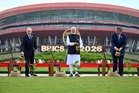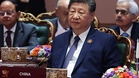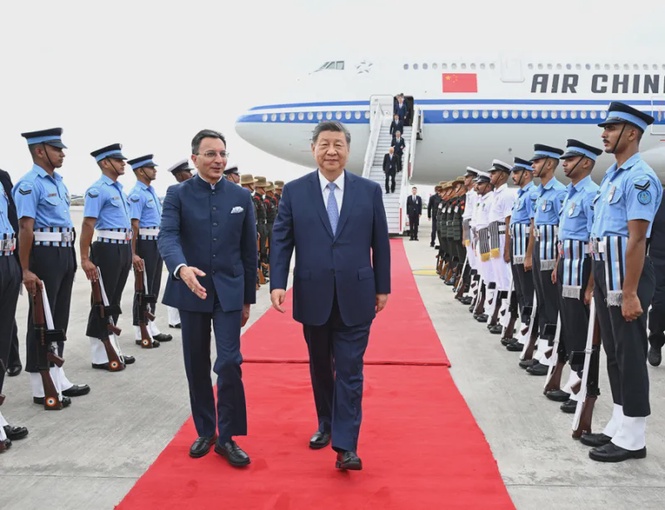
Chinese President Xi Jinping arrived in New Delhi on September 12 for the 18th BRICS Leaders' Summit, marking his first official visit to India since 2019 and the most visible diplomatic step in a fragile, years-long effort to stabilize one of Asia's most consequential bilateral relationships.
China And India Trade Confrontation For Cautious Coexistence
The two countries have moved carefully since the 2020 Galwan Valley border clash in the Himalayas, which left soldiers dead on both sides and sent relations into deep freeze. A disengagement arrangement reached in 2024 helped reduce frontline tensions, and the two years since have seen a partial restoration of direct flights, renewed people-to-people exchanges, and warming economic ties.
The relationship, however, remains freighted with unresolved disputes. Chinese and Indian forces still face each other across contested stretches of the Line of Actual Control. India continues to monitor Chinese military infrastructure in Tibet closely. Trade imbalances, market access restrictions, and visa limitations add further friction, as does New Delhi's wariness of Chinese investment in sensitive industries.
The Tibet and Dalai Lama factor complicates matters further. India's long accommodation of the Tibetan exile community and the Dalai Lama is a perennial irritant for Beijing, which views it as support for separatism. In 2025, the Dalai Lama announced that decisions on the reincarnation succession would rest with the Ganden Phodrang Trust — an arrangement Beijing flatly rejected. U.S. congressional attention to the succession has further internationalized the dispute, though Beijing's response to the Dalai Lama's 91st birthday this year was notably more restrained than in previous years.
India also remains in the Quadrilateral Security Dialogue alongside the United States, Japan, and Australia — a grouping Beijing views as a containment architecture. Prime Minister Narendra Modi received both Xi and Russian President Vladimir Putin at the BRICS summit, a sequence that illustrated India's studied refusal to choose sides. New Delhi never endorsed Beijing's Belt and Road Initiative, and it has deepened technology and supply-chain cooperation with Washington even while maintaining substantial trade with China.
The most accurate description of the current relationship is not partnership, nor rivalry in any conventional sense, but something harder to label: competitive coexistence — a managed state of mutual wariness in which both sides find dialogue useful without trusting each other.
Xi's BRICS Move Sends A Message To Washington
The summit's backdrop matters as much as its agenda. Xi's India visit comes as a potential meeting with U.S. President Donald Trump is being discussed, and Beijing's sequencing appears deliberate. By appearing first at the flagship forum of the Global South — alongside leaders from Russia, Iran, Saudi Arabia, and Indonesia — China signals that it enters any bilateral conversation with Washington from a position of alternatives, not supplication.
Speaking at the summit, Xi delivered a speech titled "Sharing the Responsibilities of the Times, Boldly Acting as a Vanguard Force," calling on BRICS nations to champion innovative development, peace and stability, civilizational exchange, and reform of global governance. He announced that China will assume the BRICS chairmanship in 2027, offered China's engagement in stabilizing the Middle East Gulf region, and proposed a "BRICS AI-Enabled New Industrialization Initiative" centered on open-source cooperation — a formulation that doubles as a response to U.S. technology export controls. His call to defend the WTO-centered multilateral trade system against protectionism was a pointed reference to Trump's tariff agenda.
BRICS has expanded from its original five members — Brazil, Russia, India, China, and South Africa — to 11, now including Saudi Arabia, Iran, Egypt, the UAE, Ethiopia, and Indonesia. Beijing frames the expansion as evidence that the Global South is coalescing around an alternative vision of world order. The goal, in China's telling, is not to immediately displace the dollar or replicate NATO, but to make the redistribution of global governance power an increasingly unavoidable international conversation.
A Strategic Layover Before The Main Event
Xi's India visit fits a recognizable pattern in Chinese diplomacy: consolidate standing on the periphery before engaging the primary adversary. By demonstrating relevance in a forum spanning emerging markets that represent a substantial share of global population and economic output, Beijing arrives at any Trump negotiation with a clearer picture of its leverage.
Whether the expanded BRICS can function as an effective buffer against Western economic pressure — or whether it remains a platform for competing national interests loosely bundled under a cooperative brand — depends on choices by member states whose priorities frequently diverge from Beijing's. India, for its part, has shown it can sit at the BRICS table and the Quad table simultaneously without committing to either as a primary alignment.
That ambiguity is precisely what makes New Delhi valuable to Beijing — and what makes China's diplomatic push there so carefully calibrated.