
This event reminded me of Ripley's ' Believe It or Not' edutainment where bizarre life events, weird occurrences that defy the norm and the supernatural are depicted. https://share.google/aimode/qqXPz4nOjvoGKJNYT
These are exhibition curating absurdities of life. They may be real or unreal.
What happened in a village in the province of Liaoning, China, is real.
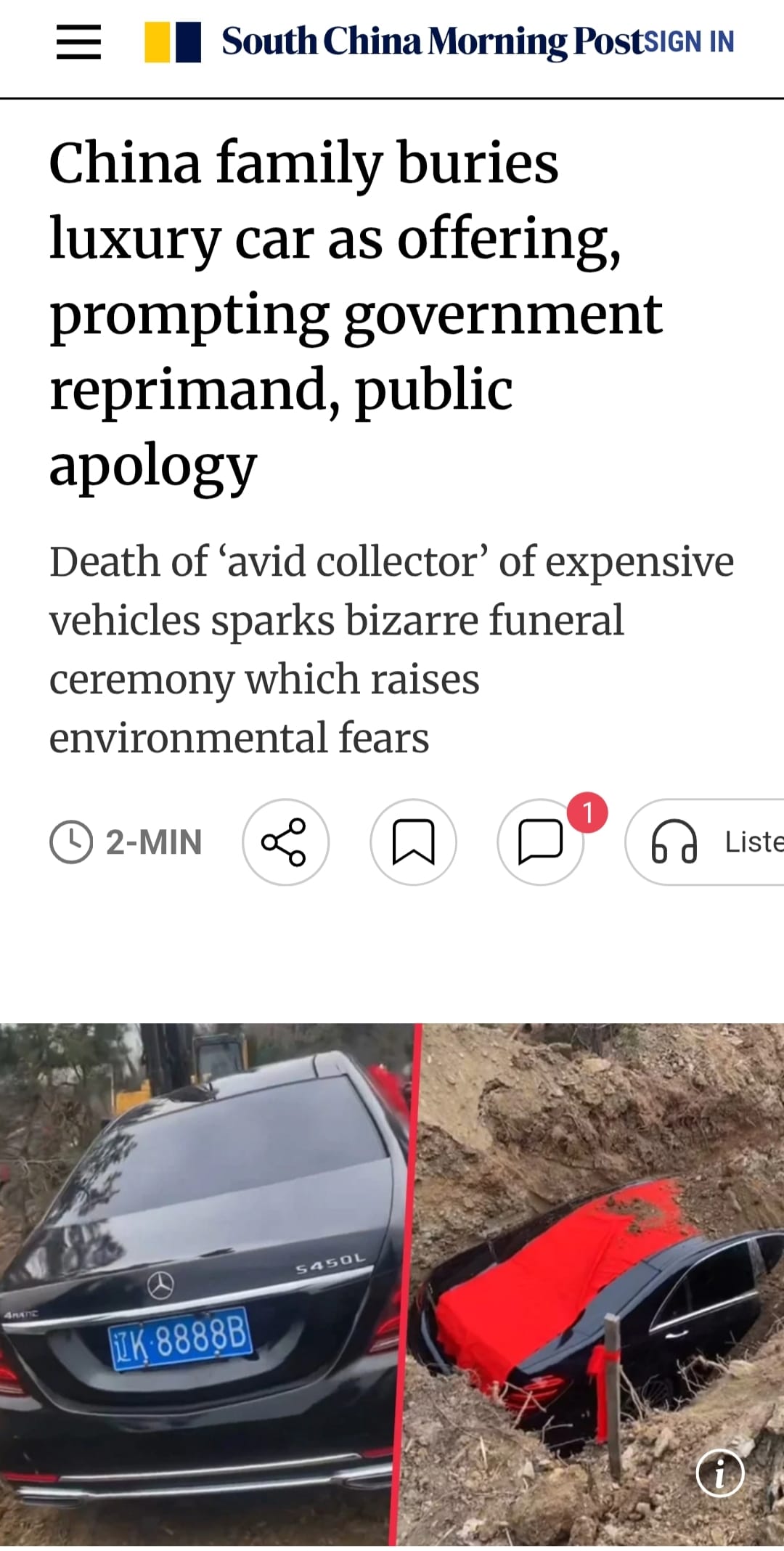
Buying a new Mercedes Benz and bury it together with the deceased in his grave in the the belief that he will enjoy it in his Afterlife.
The deceased, a wealthy man who have made it in China's economic transformation was a collector of luxury cars before his death.
Nothing is mentioned about his wish or will , but it's obvious the children and relatives had decided to honour him with a real Mercedes instead of paper effigy.
The grand send-off of burying a real Mercedes Benz worth 1.1 million yuan together with him in the graveyard had caused the authority to step in and fined them for environmental issues plus excavation cost.
Why do humans sometimes act irrationally? https://chatgpt.com/s/t_69eab53dc8e081918601c451ba039e27
It's due to the thinking process.
The human mind consists of mass of neurons and neurotransmitters. It sometimes can misfire and it also has a powerful mechanism called imagination.
When these two go haywire it can perform extraordinary feats and wonders beyond normal behavior.
Other possible causes.
Myths, customs, traditional beliefs may also contribute to this odd behavior.
False beliefs, Pantangs, superstitions, may also play a part. We are susceptible to self deception. Fiction gets mixed up with reality.
To the family members and the villagers it must be real. They must have believed a real Mercedes Benz instead of paper effigy would definitely go to the next world for their Old Man.
What is myth? https://share.google/aimode/dsD1MrRNiuV8bwQnp
Psychology.
Psychology can explain some of these irrational human behavior.
How the human mind works.
In his book - ‘ How to deal with adversity’ author Dr Christopher Hamilton describes humans as ‘ Ontological Misfits’ https://chatgpt.com/s/t_69ea25468f98819184be4f862a54a452
He wrote that human beings are psychologically messy. We can invent ideals to escape our own condition, to long to be something else. ( In this case the relatives delusion for the deceased to have a good life after death).
We invent god's and other ideals like: personal, ethical, political or aesthetic. And we believe it as truth, although all have not been proven scientifically.
Psychology has identified three elements at play when humans minds go bonkus.
They are:-
- Cognitive Dissonance.
- Religion and Tradition.
3. Confirmation Bias.
Cognitive Dissonance https://youtu.be/G1-vaIe2FGM?si=9RYuTjbR2VChprhg
Inconsistency in beliefs and values system.
Simplified explanation.
“I believe one thing… but I’m doing another… so I need to justify it.”
We often deceive ourselves by believing what we expect.
In this case the family members have two thoughts at the same time.
One thought is that - burning of paper money, house, or cars, is not sufficient although traditionally it's practiced by the Chinese of Taoism faith for the dead.
They had decided to take it to the next level - burying a real car?
Maybe someone in the family decided that to bury a ‘real’ car may be more realistic or ensure a faster path (better than a paper car) to reach the demise in the afterlife. This irrational belief somehow convinced the members. ( Groupthink)
So it is by these thoughts that a consensus decision was made.
2. Religion and Tradition.
These are also powerful elements that can influence people into performing irrational feats.
Long held dogmas, customs, traditions, and beliefs are powerful. In order to appease the spiritual realms we often ignore rational thinking. This may often result in human sacrifices and deaths.
Years of indoctrination had already taken root in the subconscious mind. Some examples:
- Belief in the End Times.
- Reincarnation
- Eternal life.
Karma.
Christianity.
"For God so loved the world, that he gave his only Son, that whoever believes in him should not perish but have eternal life. John 3:16:
Most Abrahamic faith believe in eternal life. Believe is central to get a place in heaven or hell.
Faith is belief in the unseen. It is the most important element to provide hope for believers of the Abrahamic faith. In order to enter heaven one must believe and confirm.*
( *Beware: Scammers have use this technique to con people like the fake investment schemes). They promise wealth and a better life by convincing people to invest with the promise of higher returns in their investment schemes.)
For the Chinese, the belief of burning materialistic things in paper replicas to represent in the Afterlife have been practiced for a long time. It's a tradition.
Note: You see a lot of these burnings during Cheng Beng time. ( All Souls Day).
Confirmation Bias.
“I already believe this… so I only notice things that prove I’m right.”
Cognitive dissonance is often what fuels confirmation bias. Because the feeling of being wrong is so unpleasant, we tend to seek out information that confirms what we already believe and ignore evidence that challenges us. It is a powerful survival mechanism for our egos, ensuring our internal narrative remains consistent, even if it isn't always strictly logical.
To the villages and family members of the village they strongly believe that burying a real Mercedes Benz ( instead of a paper effigy) will ensure that deceased get his vehicle in the afterlife.
Other examples of such beliefs are the End Times cult. Group of believers sold off all their possessions and went up the hills to wait for God to destroy Earth. When it didn't happen they say it's because of their prayers that saved the world from ending.
Conclusion.
Believe or not is the inherent weakness of humans. We are susceptible to these biases.
So in future when making decision try not to be like the villagers in Liaoning. China.
Engage mind. Think rationally and do not allow these factors to influence you.
Cognitive Dissonance.
Confirmation Bias.
Religion, Tradition.
Jack Ung (jack.uct1953@gmail.com) is a content creator under the Newswav Creator programme, where you get to express yourself, be a citizen journalist, and at the same time monetize your content & reach millions of users on Newswav. Log in to creator.newswav.com and become a Newswav Creator now!
The User Content (as defined on Newswav Terms of Use) above including the views expressed and media (pictures, videos, citations etc) were submitted & posted by the author. Newswav is solely an aggregation platform that hosts the User Content. If you have any questions about the content, copyright or other issues of the work, please contact creator@newswav.com.