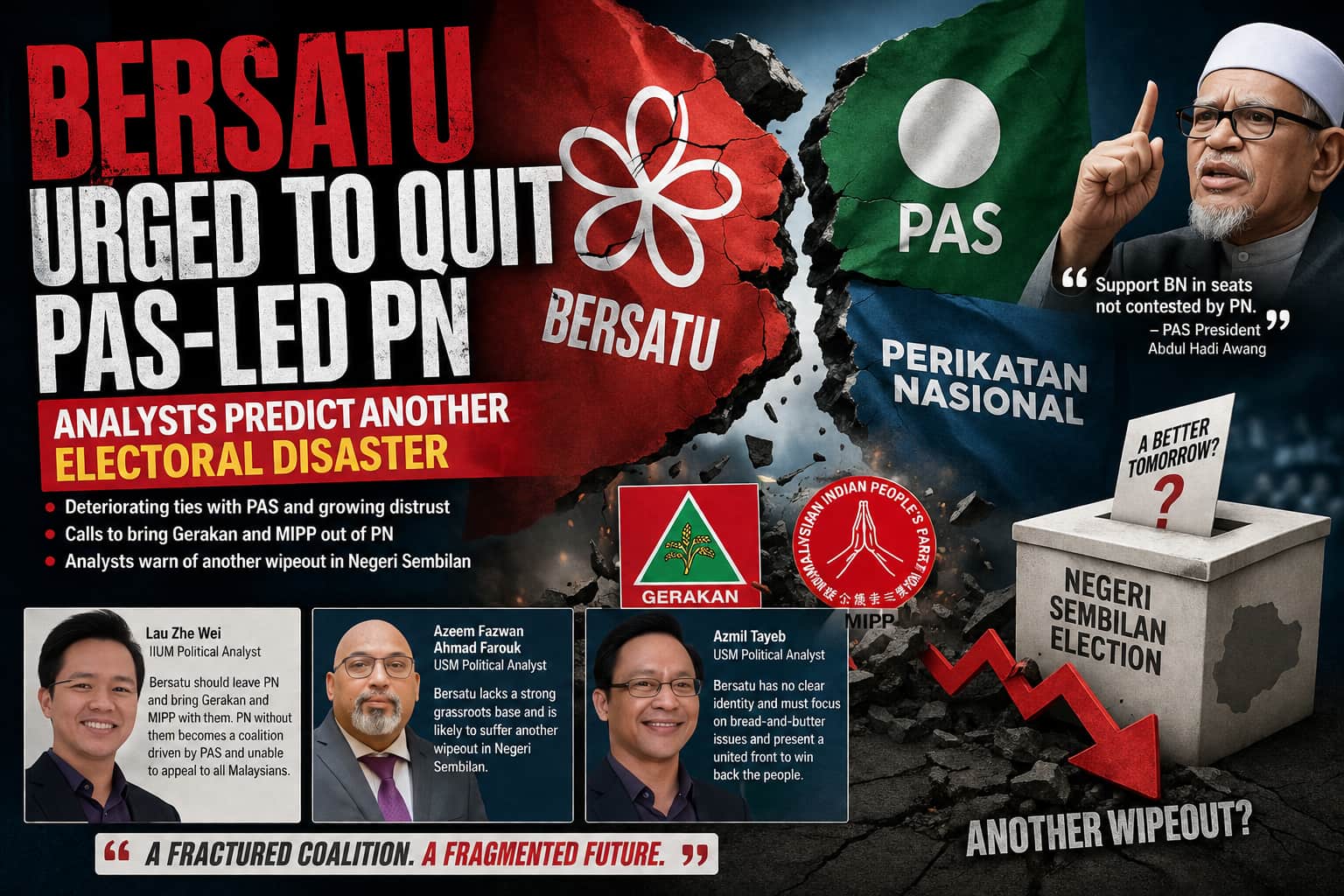
Calls are growing for Bersatu to make a clean break from Perikatan Nasional (PN), with political analysts arguing that the party has little to gain from remaining in an increasingly fractured coalition dominated by PAS.
Some even believe Bersatu should persuade Gerakan and the Malaysian Indian People's Party (MIPP) to leave alongside it, a move that would fundamentally reshape the opposition bloc.
International Islamic University Malaysia (IIUM) political analyst Lau Zhe Wei said Bersatu's deteriorating relationship with PAS has reached a stage where remaining in PN offers little strategic advantages. According to him, the coalition has become increasingly centred on PAS, while Bersatu's political influence has steadily diminished.
Lau suggested that if Bersatu decides to leave, it should encourage Gerakan and MIPP to follow suit. Such a move, he argued, would strip PN of its multiethnic image and expose it as a coalition driven primarily by Malay conservative politics.
He said that without Gerakan and MIPP, PN would effectively become a coalition defined by PAS' ideological direction, rather than one capable of appealing to Malaysia's diverse electorate.
His remarks come amid growing tensions between PAS and Bersatu, which have worsened significantly over recent months. The relationship reached a breaking point after PAS officially ended political cooperation with Bersatu last month, although both parties technically remain members of PN.
The split has become increasingly visible on the campaign trail. PAS president Tan Sri Abdul Hadi Awang recently urged supporters to vote for Barisan Nasional (BN) candidates in constituencies where PN was not contesting, while PAS also declined to campaign for Bersatu candidates.
Lau believes these developments contributed heavily to PN's disastrous performance in the Johor state election, where the coalition failed to win a single seat. He argued that PAS effectively divided the opposition vote instead of consolidating it, leaving Bersatu politically isolated.
The political landscape has become even more complicated ahead of the Negeri Sembilan state election. While the PAS-led PN has entered into an electoral understanding with BN, Bersatu is contesting 24 seats under its own logo instead of the PN banner. Gerakan and MIPP, meanwhile, are contesting one seat each under the coalition's symbol.
Adding further speculation over Bersatu's future, party president Tan Sri Muhyiddin Yassin recently hinted that Bersatu could leave PN after the state election and establish a new political coalition.
However, analysts believe Bersatu faces an uphill battle regardless of its future alliances.
Universiti Sains Malaysia (USM) political analyst Azeem Fazwan Ahmad Farouk predicted that Bersatu could suffer another complete electoral wipeout in Negeri Sembilan, arguing that the party lacks a sufficiently strong grassroots base to compete independently.
He said Bersatu's internal divisions and organisational weaknesses make it extremely difficult for the party to recover, particularly without PAS' electoral machinery.
Another USM analyst, Azmil Tayeb, said Bersatu's challenges extend beyond its dispute with PAS.
According to Azmil, Bersatu has struggled to establish a distinct political identity despite competing with both Umno and PAS for the same pool of Malay voters. Without offering policies or leadership that clearly differentiate itself from its rivals, the party has given voters little reason to choose Bersatu over more established alternatives.
He added that Bersatu must move beyond internal disputes and present a united leadership while focusing on bread-and-butter issues such as the economy, employment and the rising cost of living if it hopes to regain public confidence.
At present, he said, the party is more widely associated with internal infighting than with offering credible policy solutions.
Azmil also warned that PN's increasingly fragmented image could hurt not only Bersatu but PAS and the coalition's remaining partners in the Negeri Sembilan election. Voters, he argued, are unlikely to place their confidence in an opposition coalition that appears divided and uncertain about its own future.
With Bersatu openly contemplating a post-election political realignment, the coming weeks could determine whether PN survives as a united opposition coalition or undergoes its most significant restructuring since its formation.
By: Kpost
Information Source:
Kpost (ckhorsk@gmail.com) is a content creator under the Newswav Creator programme, where you get to express yourself, be a citizen journalist, and at the same time monetize your content & reach millions of users on Newswav. Log in to creator.newswav.com and become a Newswav Creator now!
The User Content (as defined on Newswav Terms of Use) above including the views expressed and media (pictures, videos, citations etc) were submitted & posted by the author. Newswav is solely an aggregation platform that hosts the User Content. If you have any questions about the content, copyright or other issues of the work, please contact creator@newswav.com.