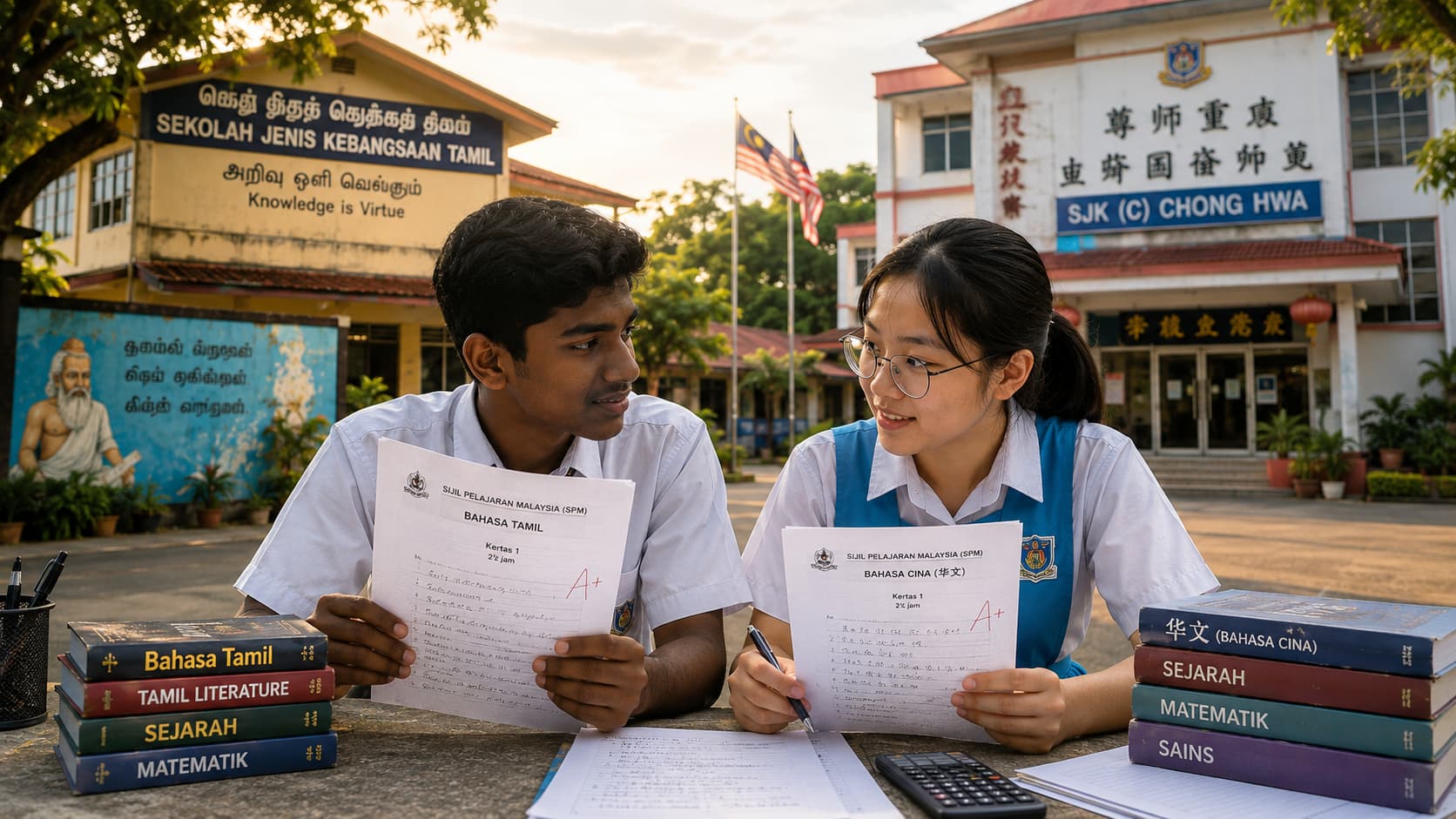
The Ministry of Education's recent confirmation that Tamil and Chinese language subjects will remain part of the national examination framework deserves recognition.
In a multilingual nation like Malaysia, preserving mother-tongue education is not merely a cultural gesture. It is an educational responsibility. The assurance sends an important signal that linguistic diversity continues to have a place within the country's formal education landscape.
Yet the announcement also raises a larger question that Malaysia has quietly avoided for decades.
Is protecting a subject the same as protecting the institution that teaches it?
For many within the Malaysian Indian community, the answer is no.
The inclusion of Tamil language examinations is undoubtedly welcome. However, it also highlights the difference between symbolic recognition and structural equity. While Tamil as a subject may now be firmly acknowledged within the national examination system, many Tamil vernacular schools continue to face challenges that go far beyond examinations.
This is why the national conversation should not stop at whether Tamil can be tested.
It must begin asking whether Tamil schools themselves are receiving the same institutional commitment afforded to other parts of the education system.
Recognition Is Not the Same as Equity
For decades, education debates involving Tamil schools have often revolved around language preservation.
But language was never the only issue.
The deeper concern has always been institutional equality.
Many Sekolah Jenis Kebangsaan Tamil (SJKT) continue operating under the status of Sekolah Bantuan Kerajaan (Government-Aided Schools). Under this arrangement, the government pays teachers' salaries and supports aspects of school operations, but many infrastructure responsibilities remain dependent on school boards, community organisations, temples, alumni groups, and fundraising efforts.
This creates a reality unfamiliar to many Malaysians.
Parents and community leaders frequently organise donation drives, fundraising dinners, charity events, and public appeals simply to repair buildings, upgrade facilities, expand classrooms, or improve learning environments.
The question is not whether these communities are willing to contribute.
They always have.
The question is why they continue to shoulder burdens that many believe should already form part of a comprehensive national educational commitment.
When a school's future depends partly on fundraising campaigns, educational equality becomes difficult to measure solely through policy announcements.
Protecting a subject is important.
Protecting the institution that delivers that subject is equally important.
The Academic Paradox Nobody Talks About
Educational inequality does not always appear through outright exclusion.
Sometimes it appears through a decimal point.
One of the least discussed frustrations among high-performing Tamil school students emerges much later in their academic journey, particularly when competing for prestigious scholarships, matriculation placements, and highly competitive tertiary education opportunities.
Malaysia's scholarship ecosystem often operates within extremely narrow margins.
The difference between an A and an A+ can be significant.
For students competing for Public Service Department (JPA) scholarships, elite sponsorship programmes, or top-tier placements, cumulative academic performance becomes critical.
Many students from Tamil school backgrounds consistently excel in Tamil language and literature subjects while maintaining strong performances across Mathematics, Science, and other academic disciplines.
Yet concerns frequently arise regarding grading outcomes in certain humanities-based subjects, particularly Moral Education.
A student may achieve exceptional results in multiple subjects but find their overall academic profile weakened because one subject remains at an A rather than an A+.
To policymakers, this may appear statistically insignificant.
To a student competing nationally for limited scholarships and university opportunities, it can alter an entire future.
The issue is not about lowering standards.
The issue is whether assessment systems consistently reflect academic excellence across different educational pathways.
When competition becomes increasingly intense, even small grading disparities can produce significant long-term consequences.
The Reality Beyond the Classroom
The challenges facing Tamil schools extend beyond grades and examinations.
Many SJKT communities continue dealing with ageing infrastructure, delayed maintenance projects, limited access to advanced digital learning technologies, overcrowded facilities in urban areas, and shrinking resources in certain rural locations.
While Malaysia increasingly speaks about artificial intelligence, digital transformation, and future-ready education, some schools are still struggling with issues that should have been resolved years ago.
Educational transformation cannot occur equally when schools begin from unequal foundations.
The digital economy does not pause for infrastructure delays.
The future workforce will not wait for bureaucratic approvals.
Students sitting inside under-resourced classrooms today will eventually compete against graduates from Singapore, China, India, South Korea, and other rapidly advancing education systems tomorrow.
That reality should concern every Malaysian regardless of ethnicity.
Because educational inequality ultimately becomes economic inequality.
A Strategic Asset Hidden in Plain Sight
Perhaps the greatest irony in this debate is that Malaysia already possesses something many advanced economies actively seek.
Multilingual talent.
A significant number of SJKT students graduate with varying levels of competency in Tamil, Bahasa Melayu, and English.
In an increasingly interconnected global economy, this is not merely cultural heritage.
It is economic capital.
The twenty-first-century workforce rewards communication, adaptability, cross-cultural understanding, and cognitive flexibility.
Research across multiple education systems has repeatedly highlighted the advantages associated with multilingual learning, including stronger executive functioning, problem-solving ability, and adaptive thinking.
Malaysia often discusses becoming a high-income nation driven by innovation, technology, and knowledge industries.
Yet many of the students capable of contributing to that vision continue emerging from institutions that struggle for equal recognition, funding, and long-term planning.
Instead of viewing Tamil schools primarily through cultural or political lenses, policymakers should begin viewing them through a national development lens.
The question should no longer be:
"How do we preserve Tamil schools?"
The better question is:
"How do we maximise the potential of the students graduating from them?"
Beyond Announcements, Towards Institutional Commitment
The government's recent assurance regarding Tamil language examinations is a positive step.
But positive steps should not become the final destination.
They should become the starting point for a broader conversation about educational equity.
True commitment requires more than protecting subjects within examination frameworks.
It requires sustained investment in school infrastructure, teacher development, digital readiness, student support systems, scholarship accessibility, and institutional growth.
It requires ensuring that SJKT development becomes a permanent component of mainstream educational planning rather than an issue revisited only during budget announcements or election cycles.
Today's education is tomorrow's future.
Every neglected classroom becomes a missed opportunity.
Every overlooked student becomes unrealised national potential.
Malaysia cannot afford those losses.
Because a nation does not become stronger simply by preserving a language examination.
It becomes stronger when it invests fully in the schools, teachers, and students who bring that language and the future it represents to life.
Annan Vaithegi, who believes educational equity is not measured by the subjects a nation protects, but by the opportunities it creates for every child entrusted to its schools.
Annan Vaithegi (annanvaithegi@icloud.com) is a content creator under the Newswav Creator programme, where you get to express yourself, be a citizen journalist, and at the same time monetize your content & reach millions of users on Newswav. Log in to creator.newswav.com and become a Newswav Creator now!
The User Content (as defined on Newswav Terms of Use) above including the views expressed and media (pictures, videos, citations etc) were submitted & posted by the author. Newswav is solely an aggregation platform that hosts the User Content. If you have any questions about the content, copyright or other issues of the work, please contact creator@newswav.com.