
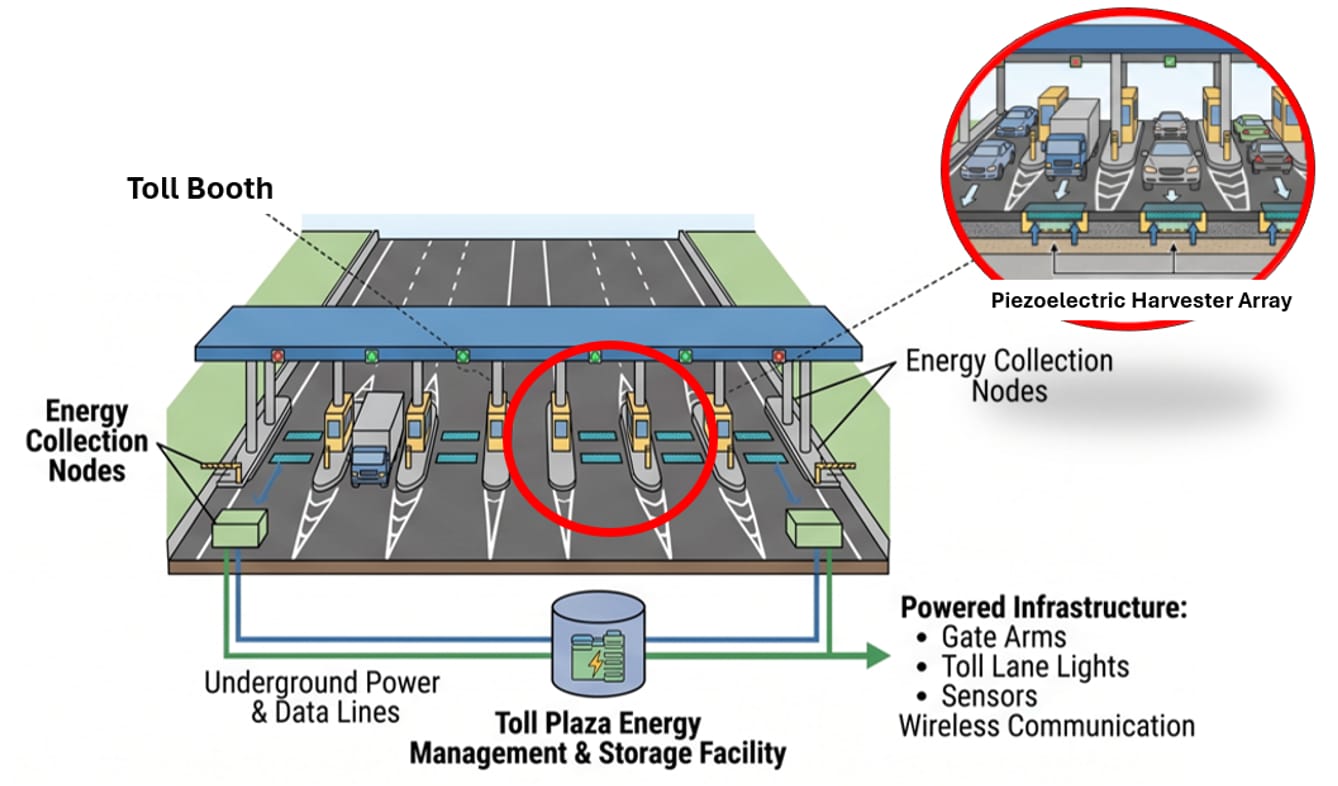
Every single day, millions of vehicles travel across highway and road networks, expending immense amounts of kinetic energy that silently dissipates into pavements as vibrations, heat, and abrasion. Rather than viewing traffic-induced road vibration purely as a destructive force requiring billions of dollars in routine pavement maintenance, modern transport engineering recognizes it as a massive, unexploited sustainable energy reservoir. As global net-zero commitments push nations toward cleaner power grids and decentralized generation, capturing kinetic energy directly from roadway stress cycles provides a continuous, localized electricity source via piezoelectric system (Figure 1) that operates independently of weather conditions or time of day. Converting passive highway corridors into dynamic, energy-generating infrastructure assets represents a critical step toward sustainable urban, unlocking clean power hidden directly beneath our tires without consuming an additional square meter of valuable land.
The core physical principle of road vibration energy harvesting relies on intercepting dynamic stress cycles generated whenever heavy vehicle tires roll over a road surface. High-density traffic exerts significant compression forces, creating transient mechanical strain waves within the underlying pavement matrix. The magnitude of harvestable kinetic power correlates directly with vehicle axle weight, traffic volume, vehicle speed, and structural pavement stiffness. In high-density traffic corridors (e.g., industrial port routes, multi-lane expressways and toll plaza area) thousands of vehicle passages per hour deliver a relentless, highly predictable stream of mechanical energy pulses. This continuous kinetic force offers a remarkably consistent power density capable of generating localized electricity for roadside applications, turning heavily congested transportation corridors into dynamic off-grid power plants.
Converting mechanical road vibrations into usable electrical energy relies on specialized transducers, known as piezoelectric harvesters. Piezoelectric materials possess unique electromechanical properties that produce an internal electrical charge when subjected to dynamic mechanical stress. Table 1 summarizes the types, criteria and outputs of different piezoelectric energy harvesters. Arranged in specialized configurations beneath the asphalt wearing layer, these piezoelectric units flex and compress under passing vehicle tires. The rapid and continuously repeated succession of high-frequency tire impacts generates high-voltage, low-current electrical spikes. When paired with specialized rectification, impedance matching, and power conditioning circuits, these embedded piezoelectric arrays provide a reliable and continuous power output. Electromagnetic harvesters are typically integrated into surface-mounted infrastructure, such as speed bumps, toll plaza deceleration ramps, and bridge expansion joints. As a vehicle's tire depresses a heavy mechanical top plate or surface treadle, the resulting downward linear stroke drives a rack-and-pinion assembly, scissor mechanism, or hydraulic fluid line that spins a compact rotary electric generator. Unlike deeply embedded micro-strain piezoelectric crystals, electromagnetic speed humps and heavy-duty deceleration plates can extract substantial watt-scale or even kilowatt-scale energy bursts per vehicle pass, making them exceptionally effective at high-load, low-speed deceleration zones.
Global proof-of-concept (POC) deployments over the past two decades provide crucial empirical benchmarks for evaluating technology viability under real-world traffic conditions. In China, the POCs focus heavily on pavement-compatible packaging and force-amplification mechanisms to survive heavy traffic loads. Subsequent international implementations shifted focus toward targeted deceleration zones to overcome structural fatigue and maximize overall energy conversion efficiency. In Portugal, the application successfully commercialized surface-mounted kinetic road plates installed at toll plaza approaches and urban speed-calming zones, harvesting energy directly from slowing vehicles to power toll gantries and digital speed warning displays. In the United States, researchers at academic institutions and various state transport departments developed heavy-duty hydraulic-electromagnetic speed bumps deployed at port weigh stations and distribution centers. These international field trials demonstrated that capturing kinetic energy specifically at points where vehicles are actively braking avoids creating parasitic engine drag on high-speed traffic.

Translating laboratory theoretical efficiency into real-world asphalt performance presents fundamental engineering hurdles governed by materials science and physics. Assessing the Technology Readiness Level (TRL) reveals a distinct divide between experimental research and commercially viable field adoption. Globally, electromagnetic speed humps, hydraulic deceleration ramps, and surface-mounted kinetic road plates stand at TRL 6 to TRL 7, having successfully demonstrated operational prototype performance in real-world highway environments. Conversely, fully embedded piezoelectric road pavement mixes remain at TRL 4 to TRL 5 globally, largely due to ongoing challenges regarding long-term pavement fatigue, material brittleness, and asphalt recycling compatibility. Academic research has validated piezoelectric array models and electromagnetic designs in controlled laboratory settings, but full-scale operational field deployments on public expressways remain unexecuted. Deploying road vibration harvesters across Malaysia's extensive transportation network requires addressing severe local environmental and structural operational realities. Asphalt pavement temperatures in Malaysia frequently exceed 60°C during peak afternoon solar exposure, leading to significant bitumen softening that alters mechanical resonance frequencies and diminishes strain transfer to embedded piezoelectric sensors.
For road vibration energy harvesting to transition from the laboratory to commercial positioning in Malaysia, technology integration may align with smart infrastructure frameworks that set ambitious decarbonization targets, placing a strong emphasis on energy efficiency, decentralized generation, and smart green mobility solutions. Integrating kinetic road harvesting provisions into the road construction specifications would establish the essential regulatory framework needed to encourage private concessionaires to invest in self-powering smart highway infrastructure. A practical implementation roadmap for Malaysia requires a phased, risk-mitigated strategy spread across short- and long-term horizons over the coming decade. Unlocking the latent kinetic energy embedded within Malaysia's vast asphalt network offers an opportunity to advance sustainable transport infrastructure and off-grid power generation. Allowing billions of daily traffic stress cycles to dissipate uncollected as wasted noise and pavement wear represents a costly oversight in an era defined by urgent decarbonization and energy transition goals. Bridging the gap between academic laboratory prototypes and full-scale commercial highway adoption requires proactive coordination among different stakeholders. By establishing dedicated operational protocols and standards, Malaysia may transform its passive gray highways into dynamic, self-powering green transportation corridors, setting a visionary precedent for smart infrastructure within the Asian Highway Network (AHN).
This article is prepared in collaboration between SEDA Malaysia and Universiti Sains Malaysia.
Author(s):
Assoc. Prof. Ts. Dr. Mohd Rosli Mohd Hasan
Head of Sustainable Asphalt Research Group (SARG)
School of Civil Engineering,
Universiti Sains Malaysia,
MALAYSIA
Assoc. Prof. Dr. Lingyun You
National Technology Innovation Center for Digital Construction
School of Civil and Hydraulic Engineering,
Huazhong University of Science and Technology,
430074 Wuhan, Hubei,
CHINA