
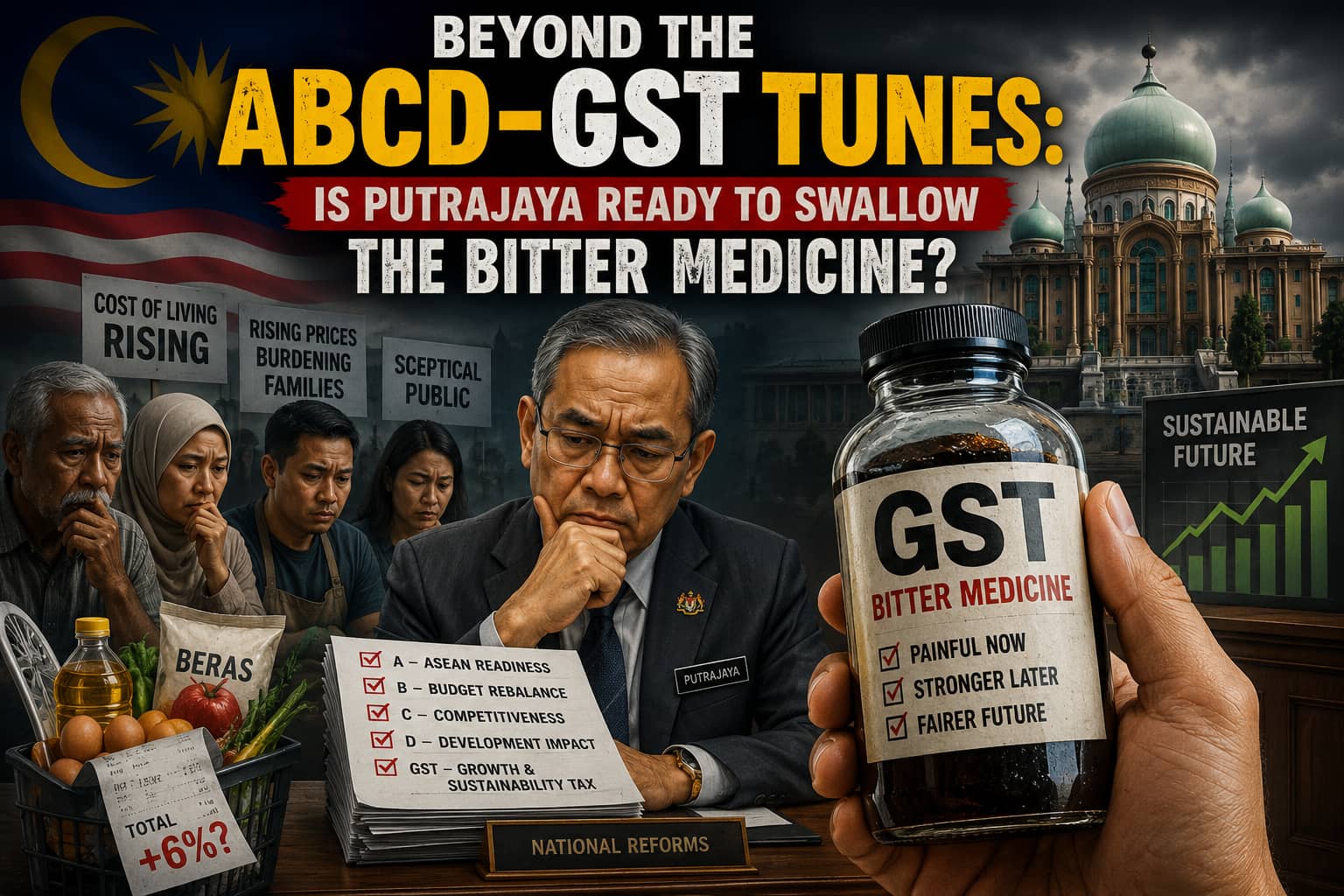
Walk into any local kedai runcit in the Klang Valley, or sit down for a plate of nasi lemak at a bustling stall in Machang, Kelantan, and the background noise remains unchanged. The rhythmic clink of metal spoons against ceramic cups is accompanied by a low, anxious hum of conversations about the rising cost of living. For the average Malaysian, the math of daily survival has become increasingly complicated. In an era where global supply chain crises and geopolitical tensions dictate the price of raw ingredients, local wallets are feeling tighter than ever.
Yet, beneath the domestic anxieties of grocery bills lies a profound structural crisis within the Malaysian state machinery itself. The federal government is walking a fiscal tightrope, trying desperately to manage an expansive national budget while attempting to lower the federal deficit to a targeted 3.5% of Gross Domestic Product (GDP). It is against this backdrop of macroeconomic strain that Machang MP Wan Ahmad Fayhsal Wan Ahmad Kamal threw a political hand grenade into the Dewan Rakyat. He urged the government to abandon its political baggage and reconsider the reintroduction of the Goods and Services Tax (GST) as a necessary pillar for substantial national taxation reform.
To the political observer, the irony is delicious, if not entirely surreal. The GST, which was introduced by the Najib Razak administration in 2015 and scrapped by the Pakatan Harapan (PH) coalition in 2018 amid public outrage, was once the ultimate weapon of political destruction. Political campaigns were fought, won, and lost on the catchy rhythm of anti-GST songs. Yet today, opposition lawmakers find themselves arguing that the current Sales and Service Tax (SST) system is an insufficient, multi-layered mechanism that fails to widen the federal revenue base effectively. The proposal by Wan Ahmad Fayhsal to rebrand the mechanism as a lower-tiered, 3% "Cukai Madani" signals a growing systemic realization: populism may win elections, but it cannot fund a modern state.
The Structural Limits of the SST Trap
For the past several years, Prime Minister Datuk Seri Anwar Ibrahim’s administration has consistently defended its decision to stick with the SST framework. In a written parliamentary reply, the Prime Minister reiterated that the government will retain the SST over the GST, arguing that the current system acts as a shield protecting lower-income groups—specifically the B40 community—from broad-based tax burdens. From a purely political perspective, this stance is entirely logical. Reintroducing a consumption tax that touches every layer of society during a period of acute domestic inflation would be equivalent to political suicide ahead of the general elections due before February 2028.
However, an institutional analysis of Malaysia's fiscal architecture reveals deep vulnerabilities within this defensive approach. The SST is fundamentally a cascading tax, meaning it is levied at specific production stages without a robust mechanism for input tax credits. This creates structural opacity, making it highly susceptible to tax evasion and shadow economy leakages. In contrast, when the GST was operational in 2017, it accounted for approximately 20% of the government's total revenue, representing 3.2% of the country’s GDP. By abolishing it, Malaysia severely contracted its independent fiscal space, forcing successive administrations to rely heavily on volatile corporate taxes and direct petroleum dividends from Petronas.
Furthermore, the state's current revenue strategy relies heavily on intensifying enforcement, introducing specialized levies like the carbon tax, and accelerating administrative digitalization through the full rollout of e-Invoicing. While these digital tools enhance transparency and streamline collection, economic data suggests they act merely as band-aids on a deeper wound. The fundamental problem is that Malaysia’s tax-to-GDP ratio remains structurally lower than its regional peers. Without a comprehensive consumption tax that captures value-added revenue at every transactional stage, the government remains poorly equipped to handle massive macro-economic shocks.
The Vicious Circle of Subsidy Rationalization
The debate over the GST cannot be divorced from Malaysia’s massive, culturally entrenched public subsidy apparatus. For decades, cheap fuel and subsidized essential items have formed an unwritten social contract between Putrajaya and the Malaysian electorate. However, the global landscape has changed dramatically. With external market vulnerabilities threatening to push commodity prices higher, the financial burden of keeping the retail price of RON95 fuel artificially low has become entirely unsustainable.
The Unity Government has embarked on an aggressive policy of subsidy rationalization, shifting away from blanket assistance toward targeted cash transfers like the Sumbangan Tunai Rahmah (STR) scheme. The institutional intention is noble: stop wealthy elites and foreign nationals from exploiting cheap fuel, and redirect those saved billions back into the national coffers. Yet, this strategy has triggered an intense domestic dilemma. The middle-income class (the M40 group) finds itself squeezed between a reduction in indirect subsidies and an exclusion from direct cash assistance, leading to a palpable sense of socio-economic disenfranchisement.
A cultural and institutional analysis suggests that by refusing to implement a broad-based tax like the GST, the government has compromised its ability to fund critical public infrastructure. When the national budget is consistently swallowed by operational expenditures and domestic subsidies, development expenditures are inevitably compromised. This reality was highlighted during recent parliamentary debates, where opposition leaders noted that prolonged delays in fiscal transformation force the state into an unhealthy loop of cutting allocations for key ministries like Education and Health whenever an international economic crisis hits.
A Cultural Awakening Beyond Populist Rhetoric
To truly understand why the consumption tax debate remains gridlocked, one must analyze the unique political psychology of the Malaysian electorate. In Malaysia, taxation is rarely viewed through a purely economic lens; instead, it is interpreted as a reflection of governmental trust and institutional integrity. The historical backlash against the 2015 GST was not merely a reaction to increased prices, but a profound cultural protest against perceived state corruption and financial mismanagement during that specific political era.
Consequently, the word "GST" has transced its technical definition as a value-added consumption tax; it has become a powerful linguistic symbol of government overreach and public exploitation. This explains why the current administration recognizes the mathematical merits of the system but continuously pushes the timeline forward, stating that the domestic market requires a preparation period of up to two years before businesses can realistically update their accounting infrastructure. The fear is that any premature reintroduction would trigger immediate psychological panic among consumers, regardless of whether the implementation rate is set at a low 3%.
However, a shift in public awareness may be on the horizon. As structural challenges such as an aging population, climate change adaptation, and the transition toward green energy loom closer, the demand for high-quality public services will expand exponentially. If Malaysia aspires to transition into a high-income nation under its current economic frameworks, its citizens must eventually confront a difficult truth: a progressive, comprehensive welfare state cannot be funded indefinitely on a regressive, narrow tax base.
The Verdict: Rebranding a Necessary Bitter Pill
Ultimately, the argument presented by lawmakers to decouple tax reform from political shame is a sign of policy maturity that the nation desperately requires. Rebranding the mechanism as a "Cukai Madani" at a lower initial rate could serve as a viable middle path, allowing the state to build a resilient fiscal foundation while softening the psychological impact on a wary public.
However, implementing such a reform requires immense political courage. It demands that leaders from both sides of the aisle stop using tax policies as short-term political cudgels and start treating them as long-term national architecture. Until Putrajaya can establish a transparent, institutional guarantee that every ringgit collected via consumption tax is directly reinvested into public healthcare, rural development, and transparent social safety nets, the ghost of the GST will continue to haunt the corridors of power.
What Do You Think? I’d Love to Hear Your Opinion in The Comments Section.
We stand at a historic defining moment for our nation's economy. The choice before Malaysia is no longer about selecting the most comfortable political option; it is about choosing how we intend to build a sustainable future for the next generation. We can continue down the path of short-term fixes, relying on volatile commodity revenues and localized tax tweaks while our regional neighbors build robust, diversified financial ecosystems. Alternatively, we can choose to look past old political slogans, accept the uncomfortable realities of structural tax reform, and demand a transparent system where public contributions are visibly and effectively reinvested into the growth of our communities. The math does not lie, and the clock is ticking.
AM World (tameer.work88@gmail.com) is a content creator under the Newswav Creator programme, where you get to express yourself, be a citizen journalist, and at the same time monetize your content & reach millions of users on Newswav. Log in to creator.newswav.com and become a Newswav Creator now!
The User Content (as defined on Newswav Terms of Use) above including the views expressed and media (pictures, videos, citations etc) were submitted & posted by the author. Newswav is solely an aggregation platform that hosts the User Content. If you have any questions about the content, copyright or other issues of the work, please contact creator@newswav.com.