
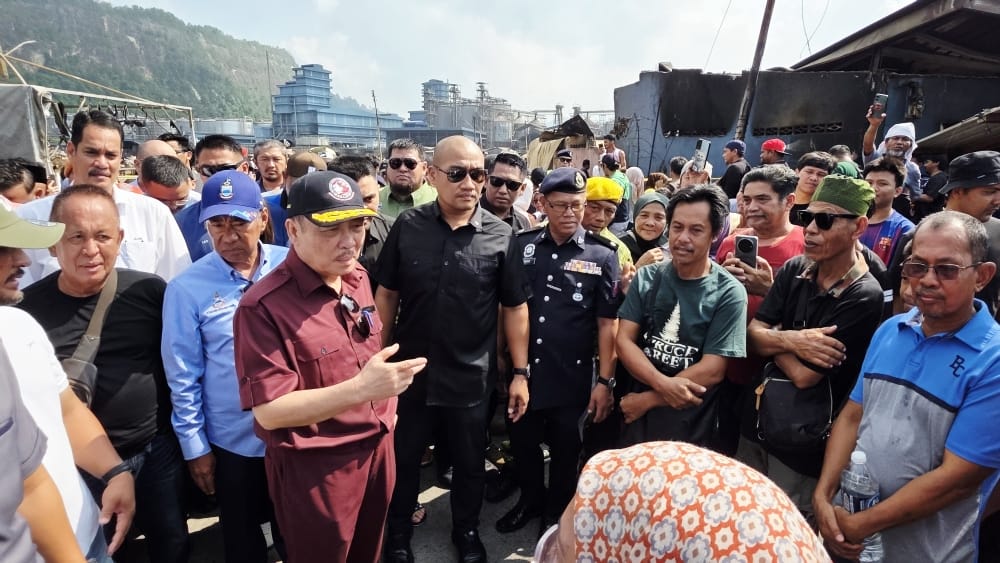
SANDAKAN, On the morning of April, 2026, the horizon of Sandakan’s coastline was not greeted by the sunrise, but by a towering wall of black smoke that signaled the end of an era for one of Sabah’s largest water villages. A massive fire tore through Kampung Bahagia, a sprawling stilt settlement, obliterating an estimated 1,000 homes across four hectares in a matter of hours.
While the smoke has since cleared and the eight temporary relief centres (PPS) were officially closed on May 2, 2026, the embers of a much larger socio-political debate are just beginning to glow. The tragedy has forced the Sabah state government and the Federal administration into a high-stakes crossroads: should they rebuild the "informal" settlement as it was, or seize the moment to execute a radical, legalized redevelopment that could redefine the future of Sandakan?
The April 19 Inferno: A Catalyst for Change
The fire broke out at approximately 3:16 AM, a time when most residents were asleep. According to Business Today, Sandakan Fire and Rescue Station chief Jimmy Lagung reported that 21 firefighters battled the blaze, which was exacerbated by the wooden structures and the proximity of the houses.
The aftermath was staggering:
- 1,000 homes destroyed.
- An estimated 9,007 residents affected (Antara News).
- Initial financial aid of RM2,000 per family promised by Chief Minister Datuk Seri Hajiji Noor (TVS).
For decades, Kampung Bahagia has existed in a legal grey area a "water village" that housed both Malaysian citizens and a significant population of migrants. The fire has effectively wiped the slate clean, presenting a grim opportunity for the government to step in.
The Legalization Strategy: A Formal Future?
Just two days after the fire, the Sabah government signaled a shift in policy. Chief Minister Hajiji Noor announced that the state is considering a plan to transform Kampung Bahagia into a formal and recognized settlement (TVS).
The proposed redevelopment includes:
- Land Reclamation: To move away from unstable stilt structures and create solid ground for modern housing.
- Gazetting the Village: Batu Sapi MP Datuk Khairul Firdaus Akbar Khan has pushed for the village to be officially gazetted, allowing for systematic infrastructure like proper drainage, electricity, and fire hydrants (Daily Express).
- Structured Resettlement: Moving residents into planned housing projects (PPR) to prevent the recurring cycle of "fire-and-rebuild" that has plagued Sabah’s coastal areas for years.
The Federal Guardrail: Anwar’s Call for Caution
While the local push for redevelopment is strong, Prime Minister Datuk Seri Anwar Ibrahim has introduced a note of caution. On April 23, 2026, the Prime Minister emphasized that while the project is urgent, it cannot be carried out "hastily" (The Vibes).
The Federal Government's hesitation stems from the sheer scale and complexity of the task. Anwar noted that any long-term housing development requires deep cooperation between the Ministry of Housing and Local Government (KPKT) and the state administration. The concern is not just about the cost, but about the legal status of the inhabitants.
"This project is quite large and requires thorough planning... it cannot be carried out hastily without taking into account the needs of the state and established development strategies." PM Anwar Ibrahim (Daily Express).
Impact on Malaysia: The National Implications
The redevelopment of Kampung Bahagia is not merely a local issue in Sandakan; it serves as a litmus test for how Malaysia handles its "informal" coastal populations.
- Security and Sovereignty: Water villages have long been identified as challenges for coastal security. Formalizing these settlements allows the government to better monitor and regulate who is living within Malaysian borders.
- The Migrant Dilemma: A significant portion of the fire victims are non-nationals. While the state has provided humanitarian aid regardless of nationality, the long-term plan to provide "legalized housing" raises the question of whether this includes the migrant community, a sensitive topic in Sabah politics.
- Infrastructure Sustainability: As highlighted by Dr. Joseph Tangah in Daily Express, Sabah faces acute drainage and land degradation issues. Redeveloping a massive water village requires a shift from "temporary fixes" to high-cost, sustainable engineering to prevent future flooding and fire hazards.
Data and Facts: The Scale of the Crisis
| Metric | Details | Source |
|---|---|---|
| Houses Destroyed | ~1,000 | Bernama |
| Estimated Affected Population | 9,007 individuals | Antara News |
| Initial Aid | RM2,000 per head of household | Sabah State Govt |
| Relief Centres Closed | May 2, 2026 | Bernama |
| Area Affected | 4 Hectares | Business Today |
- Relief Logistics: Eight centres, including SMK Batu Sapi and SK Kampung Bahagia, were mobilized to house the displaced (Bernama).
- Student Support: Education Minister Fadhlina Sidek confirmed RM300 in aid for each affected student was credited to school accounts to ensure education was not disrupted.
What Do You Think? I’d Love to Hear Your Opinion in the Comments Section.
The fire at Kampung Bahagia is a tragedy, but based on the data, it is also a "clean break" from a system that was fundamentally unsafe. For decades, these water villages have been ticking time bombs of fire hazards and poor sanitation.
The state’s move to "legalize and redevelop" is the only logical path forward, but it will be a political minefield. The Federal Government’s cautious approach is a necessary check to ensure that "redevelopment" doesn't become a euphemism for creating exclusive zones that exclude the very people who lost their homes. However, if the government fails to act now while the land is vacant, we will see the "spontaneous" rebuilding of illegal stilt houses within months, returning us to square one.
The success of the Kampung Bahagia project will determine the blueprint for other settlements in Semporna, Tawau, and Kota Kinabalu. It is time to trade the "shack-on-water" model for a "dignity-on-land" approach, even if the price tag is high.
Summary of Main Impacts:
- Economic: High cost of land reclamation and housing construction requires Federal-State synergy.
- Social: Displacement of thousands who may not qualify for officialized housing schemes.
- Environmental: Opportunity to fix decades of drainage and waste management issues in Sandakan's coastal zone.
AM World (tameer.work88@gmail.com) is a content creator under the Newswav Creator programme, where you get to express yourself, be a citizen journalist, and at the same time monetize your content & reach millions of users on Newswav. Log in to creator.newswav.com and become a Newswav Creator now!
The User Content (as defined on Newswav Terms of Use) above including the views expressed and media (pictures, videos, citations etc) were submitted & posted by the author. Newswav is solely an aggregation platform that hosts the User Content. If you have any questions about the content, copyright or other issues of the work, please contact creator@newswav.com.