
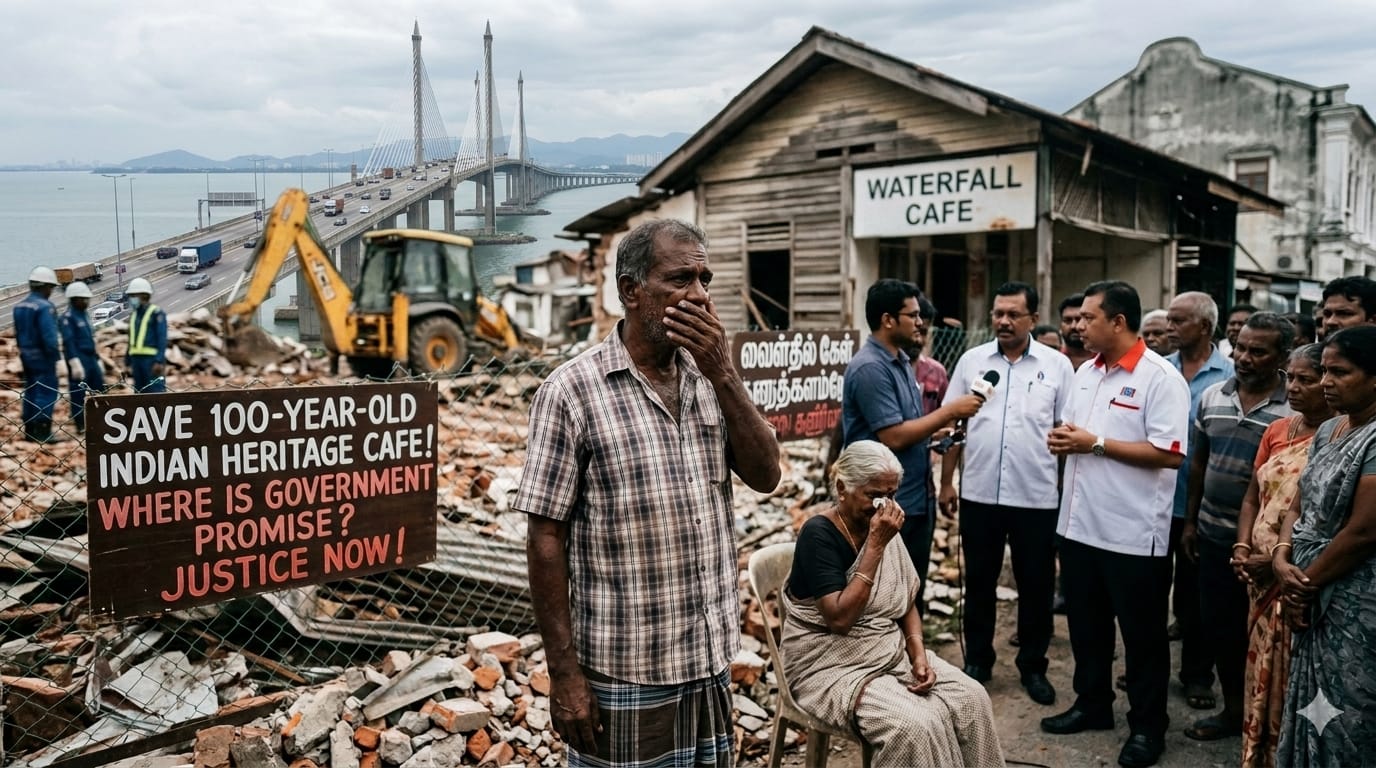
When a 103-year-old café is demolished, the issue is no longer just about walls, roofs, or unpaid rent. It becomes a question of memory, dignity, and whether some communities are always expected to move quietly when development arrives.
The demolition of the Waterfall Cafe at Penang Botanic Gardens has shaken many beyond its immediate owners and regular customers. For some, it was just a café. For others, it was a landmark woven into family routines, weekend walks, morning tea conversations, and the lived history of Penang itself.
A place can serve coffee for a century and still be dismissed in a single day as a mere tenancy matter.
That is where the pain begins.
The state’s explanation has been legalistic: arrears, disputes, failed negotiations, notices served, relocation options discussed. Governments often speak the language of files, clauses, and procedure. On paper, these arguments may sound orderly.
But communities experience events differently.
They do not mourn legal documents. They mourn what is lost.
They remember the owner opening shutters before sunrise, generations of workers earning a livelihood, families gathering after visits to the gardens, and an old business surviving wars, political transitions, economic crises, and changing times only to fall in an era that claims to celebrate heritage.
This gap between official explanation and public emotion is not minor. It is the heart of the controversy.
When the government says a relocation was offered, while those affected say communication was unclear or inadequate, the ordinary citizen is left in the middle wondering a dangerous question: are we being treated as if we are too small to matter, or too naive to question?
That is the "dumb factor" many people feel in such disputes not stupidity, but the feeling of being spoken over rather than spoken with.
Penang proudly markets itself as a place of culture, history, architecture, food memory, and layered identity. It celebrates heritage zones, murals, and old-world charm. Tourists are invited to admire the soul of the island.
Yet heritage cannot be selectively romantic.
If colonial shophouses matter, why not century-old community businesses?
If streetscapes matter, why not the human stories operating inside them?
If memory is valuable, why does it often become negotiable when those preserving it are less powerful?
This is why many Malaysian Indians see the Waterfall Cafe issue through a deeper lens. It is not only about one café. It reflects a long-standing anxiety that Indian spaces temples, old businesses, estate histories, community institutions are often acknowledged culturally but treated weakly in planning priorities.
The fear is simple: visible during festivals, invisible during redevelopment.
That fear may be uncomfortable to hear, but ignoring it does not make it disappear.
Was relocation offered? Perhaps. Was it fair, practical, equivalent, and respectful of heritage value? That is a different question entirely.
Relocation is often presented by authorities as a reasonable compromise. But not all locations are equal. A heritage business is not a photocopier that can be moved from one room to another.
Place matters.
Foot traffic matters.
History matters.
Atmosphere matters.
A café tied to the Botanic Gardens for generations carries identity precisely because of where it stood. Move it elsewhere and one may preserve a business name while erasing much of its meaning.
This is the mistake many planners make: they count square footage but not sentiment, rental terms but not rootedness.
Then comes the politics.
Whenever such controversies erupt, familiar faces appear. Statements are issued. Press conferences are called. Some defend the state. Others champion the owner. Publicity rises as the building falls.
The community has seen this movie before.
Crisis politics is not the same as community service.
Firefighting after demolition is not the same as prevention before it.
Whether it is leaders such as P. Ramasamy raising the matter publicly or others rushing to position themselves, the deeper truth remains: if durable policy existed, these dramas would be rarer.
The Malaysian Indian community does not need only louder defenders after damage is done. It needs stronger systems before the bulldozers arrive.
That means legal literacy.
Too many communities engage only when crisis hits. Lease terms, land status, tenancy rights, arrears processes, heritage applications, judicial review options these should not become last-minute discoveries. Community organisations, chambers, lawyers, and NGOs should be educating business owners long before disputes escalate.
That means stronger institutions.
Instead of depending on whichever politician is trending this week, communities need permanent advocacy bodies that track vulnerable heritage sites, provide legal referrals, negotiate with authorities early, and build public awareness campaigns rooted in facts rather than outrage alone.
That means accountability.
Elected representatives should be asked hard questions before elections and after them:
Which heritage businesses in our constituency are at risk?
What mediation mechanisms exist between state agencies and long-standing tenants?
How many Indian cultural or commercial sites have formal protection?
What is the emergency plan when disputes emerge?
If no one asks early, everyone shouts late.
There are also practical models Malaysia should consider.
Land Trust structures could allow culturally significant businesses or community spaces to be held through protected entities rather than treated purely as disposable tenancies.
Heritage Status applications should extend beyond buildings with pretty facades to include living businesses with historic continuity.
Mediation panels involving planners, owners, community groups, and historians could intervene before conflict hardens into demolition.
These are not radical ideas. They are what mature societies do when they understand that development and memory must coexist.
Because progress without memory is not progress. It is replacement.
To be fair, governments also face real constraints: unpaid obligations, land management rules, public asset responsibilities, and precedent concerns. Not every old structure can remain forever unchanged.
But fairness is judged not only by legal rightness. It is judged by process, transparency, empathy, timing, and proportionality.
Did all sides understand the options clearly?
Was independent mediation attempted seriously?
Was heritage value assessed transparently?
Was relocation genuinely equivalent or merely convenient?
These questions matter because trust is built through process, not press statements.
The Waterfall Cafe now lies in rubble. But the larger issue standing before Penang is whether development will continue to treat minority heritage as negotiable until public anger makes it inconvenient.
For Malaysian Indians, the lesson is painful but clear.
Do not rely solely on verbal promises.
Do not wait for crisis politics.
Do not assume visibility equals protection.
Organise. Document. Register. Lawyer up early. Build NGOs. Demand policy. Support independent community institutions. Vote with memory.
And above all, unify beyond party colours when heritage is threatened.
Because a divided community is easy to console after loss.
A united community is harder to ignore before it.
Penang can still choose wisdom from this controversy. It can create stronger heritage protections, fairer mediation systems, and more inclusive planning that respects all communities who helped build the island.
But if it merely moves on to the next headline, then the rubble at Waterfall Cafe will symbolise more than one demolished business.
It will symbolise a warning.
That when people fail to secure their place in policy, even a century of belonging can be cleared in a morning.
“Heritage survives not by nostalgia alone, but by laws strong enough to defend memory.”
Annan Vathegi
Annan Vaithegi (annanvaithegi@icloud.com) is a content creator under the Newswav Creator programme, where you get to express yourself, be a citizen journalist, and at the same time monetize your content & reach millions of users on Newswav. Log in to creator.newswav.com and become a Newswav Creator now!
The User Content (as defined on Newswav Terms of Use) above including the views expressed and media (pictures, videos, citations etc) were submitted & posted by the author. Newswav is solely an aggregation platform that hosts the User Content. If you have any questions about the content, copyright or other issues of the work, please contact creator@newswav.com.