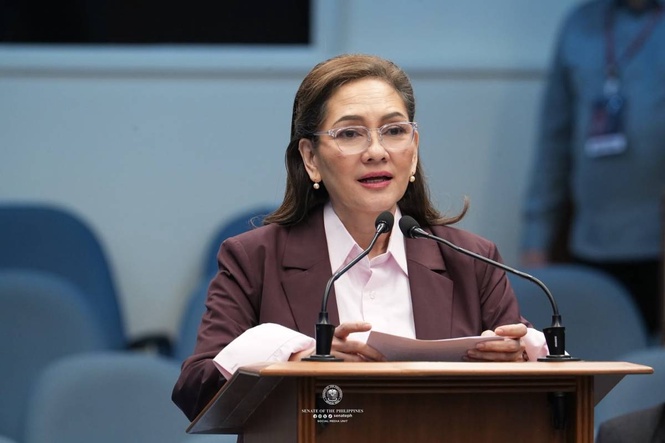
SEN. Risa Hontiveros has filed Senate Bill 2567 on Tuesday, which seeks to protect women candidates, elected and appointed officials, political party members, campaign volunteers and advocates from abuse directed at them.
”These attacks do not merely target women, they undermine democratic participation,” Hontiveros said.
The measure covers economic, institutional, physical, psychological, sexual and technology-facilitated violence, as well as doxxing and what it defines as “semiotic violence,” or the use of words, images and symbols to undermine women’s credibility, authority or participation in politics.
Under the bill, economic violence would be punishable by six months to six years in prison, a fine of P100,000 to P500,000, or both, at the court’s discretion.
Psychological violence would carry imprisonment of one to six years and a fine of P100,000 to P500,000. Doxxing and technology-facilitated violence or online political abuse would be punishable by two to six years in prison and a fine of P200,000 to P1 million.
Institutional violence committed by a public officer, political party officer or responsible official of a political organization would carry one to six years in prison and a fine of P200,000 to P1 million. Public officers convicted of the offense would also face perpetual disqualification from public office and forfeiture of retirement benefits.
It seeks to penalize semiotic violence with six months to three years in prison, a fine of P100,000 to P300,000, or both.
The bill proposes a penalty one degree higher than that prescribed under existing laws for acts of physical or sexual violence committed to prevent or punish a woman’s political participation.
Beyond criminal penalties, the measure would require political parties, coalitions and party-list organizations participating in elections to adopt safeguards against violence against women in politics. These would include internal reporting channels, confidentiality protections, training and administrative sanctions for violations.
The bill proposes a requirement that political parties and party-list organizations allocate at least 30 percent of their campaign support resources to women candidates or nominees. Where applicable, they would also adopt a “zipper system” that alternates women and men in the ranking of nominees.
The Commission on Elections would be tasked with establishing an election-period rapid response mechanism through violence against women desks to receive complaints, help preserve evidence, and coordinate referrals and protective measures.
Hontiveros cited women’s continued underrepresentation in Philippine politics, saying women accounted for 90 of the 318 members of the House of Representatives, or 28.3 percent, while five of the Senate’s 24 elected members, or 20.8 percent, are women.
”Ensuring safe and inclusive political participation for women is not merely a matter of gender equality, it is essential to the health and legitimacy of our democracy,” she said.