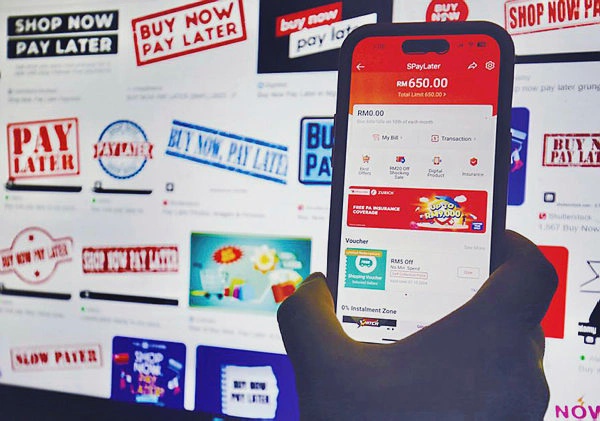
Buy now, pay later may ease planned purchases, but confusing affordable instalments with affordable spending can lead to financial trouble.
THERE is something dangerously powerful about a sale – especially an online sale. Give a Malaysian RM100 and tell her there is an 88% discount, free shipping, cashback, vouchers, an additional discount if she spends another RM30 and a midnight flash sale and suddenly that RM100 has somehow become RM700.
This was me during the recent 8.8 sale. I went online with absolutely no intention of spending money.
I came out having bought things I did not know I needed, could not remember ordering and in some cases, had completely forgotten about by the time the parcel arrived.
The real temptation, however, was not even the discounts.; it was those four little words at checkout: Buy now, pay later (BNPL).
Ah. Four innocent words capable of turning a perfectly responsible adult into someone who suddenly believes her future salary belongs to her present self.
You see something you like, you look at the price and you see: “Pay in four instalments.” And your brain immediately goes: “Okay-lah.” RM300 suddenly does not feel like RM300; it feels like RM75!
That is practically nothing until you buy five more things. Then RM75 becomes RM150, RM150 becomes RM300 and suddenly your next salary is already fully booked before it has even entered your account.
This is where I think young Malaysians are particularly vulnerable. We live in a time where looking like you have money can sometimes be easier than actually having money.
Social media has made luxury look normal. Nice cafe? Normal. Weekend staycation? Normal. New sneakers? Normal. Latest phone? Normal. Concert tickets? Normal.
A RM20 matcha? Apparently a basic necessity. What we don’t see is the repayment schedule sitting quietly in the background.
Instagram shows you the holiday. It does not show you the credit card statement.
TikTok shows you the handbag. It does not show you the person checking their banking app afterwards and thinking: “Okay, next month I am not going anywhere.”
And BNPL makes this lifestyle even easier because it breaks a big amount into tiny, friendly-looking pieces.
The problem is, those tiny pieces have a habit of multiplying – RM40 here, RM60 there, RM25 because it was “too cheap to leave behind” and RM80 because “I have been wanting this for so long”.
Before you know it, your future salary is working overtime to fund the decisions of your past self.
I know this because my husband has started receiving parcels at home with the expression of a man who has been appointed, without consent, as the household logistics manager.
One day, he looked at the growing pile of boxes and asked, very calmly: “Everything you bought-ah?” I laughed. Then came the more dangerous question. “How much did all this cost?”
Suddenly, I remembered that I had somewhere else to be. The funny thing is, I genuinely could not remember everything I had ordered.
That is perhaps the most worrying part of the whole BNPL culture. When you have to hand over RM500 in one go, you feel the pain. When the same RM500 becomes five or six small payments scattered across the months, the pain is easier to ignore – until all those “small” payments arrive together. And this is where our Malaysian upbringing should kick in.
For Indian families, especially, there is always that one voice in the background – Amma or Appa.
Or an aunty who does not even live with you but somehow knows everything about your finances.
“Why did you buy this?”
“You already bought the last time.”
“There’s still one at home.”
“Money grow on trees-ah?”
The older generation may not understand BNPL but they understand one thing very well: If you don’t have the money, don’t spend it. Simple. Brutal. Effective.
Of course, BNPL is not inherently bad. Used sensibly, it can be useful for managing planned purchases and spreading out payments. The problem is when we confuse affordable instalments with affordable spending.
Because RM100 paid over four months is still RM100. It does not magically become cheaper. It has merely become easier to forget. And perhaps that is the biggest trap of modern consumer culture.
We are borrowing from “future us” to make “present us” happy. Future us, unfortunately, has no say in the matter. Future us just gets the bill.
So, perhaps before clicking “pay later”, we should ask ourselves one very old-fashioned question: “Do I actually need this?” And if the answer is: “But it is 88% off…” close the app. Walk away. Drink some water. Call Amma.
Because sometimes, the most expensive words in online shopping are not “buy now”; they are: “Aiyo, never mind-lah. Pay later.”
Hashini Kavishtri Kannan is the news editor at theSun.
Comments: letters@thesundaily.com