.jpeg)
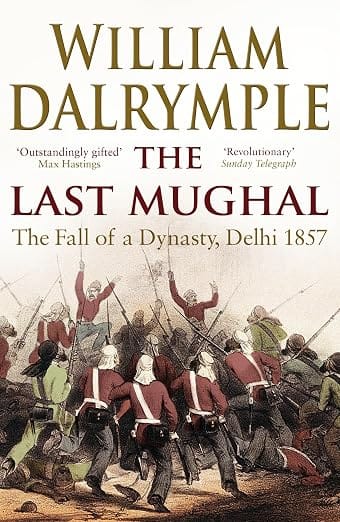
The Last Moghul (The Fall of a Dynasty, Delhi 1857)
Author: William Dalrymple (2006)
In our secondary-school history lessons, we were taught that the 1857 rebellion by sepoys serving in the East India Company’s army was caused by their unease about handling Enfield rifles and cartridges greased with beef and pork fat. The sepoys needed to bite open the cartridges before loading their rifles. This was unacceptable to Hindu and Muslim soldiers alike. They revolted, but the British managed to suppress the resistance and continued to rule India for another 90 years. Unfortunately, that may be only part of the truth about what actually happened.
This book suggests that there was more to the rebellion than meets the eye. It gives a minute-by-minute account of what transpired before and during the months following the outbreak of the 1857 uprising. Some disgruntled Indian soldiers in the East India Company’s army—Hindus and Muslims alike—refused the high command’s order to use the newly commissioned Enfield rifles. Mangal Pandey was court-martialled and hanged soon afterwards. Before long, some of his contemporaries also refused orders and were imprisoned.
Resentment towards the British had begun well before the introduction of the Enfield rifle. Its roots went much further back.
India was already in a different league before Western imperial forces entered the country. The British were awed by the Mughals, who ruled India and displayed extraordinary wealth. Sir Thomas Roe, the first official ambassador sent by the British Crown under King James I, was mocked for his choice of gifts for the Mughal court. The gifts, which included paintings, a carriage, maps, and a cloak, were regarded by the Mughals as cheap and worthless. The Mughals reciprocated with superior maps, priceless linen and other treasures. It proved to be a diplomatic nightmare for the British East India Company (BEIC).
Early BEIC arrivals were respectful of local people and integrated well into the community. Some married Indians and embraced the Indian way of life. The Anglo-Indian community thrived.
Over the years, however, attitudes changed. Possibly influenced by the increasing influx of missionaries, the newcomers began to look upon Indians with scorn. They regarded the local population as uncultured heathens, increasingly emphasising religion and promoting the incorporation of Christianity into everyday life. Morning prayers were introduced in government offices and even in the army, offending the local people. Then came the controversy surrounding the Enfield cartridges. It began with a group of sepoys refusing to obey British orders. They were court-martialled, humiliated and stripped of their uniforms.
By 1837, Mughal hegemony in India had dwindled to the confines of Delhi. Emperor Bahadur Shah II, also known as Zafar, and his family were largely restricted to the Red Fort, as was their influence. Zafar—a poet, a Sufi and an old man—was quite comfortable with this arrangement. The British paid him a regular pension.
The detailed events surrounding the Sepoy Rebellion—also known as the Sepoy Mutiny, the Indian Rebellion and India’s First War of Independence—were documented in the Mutiny Papers, written in Urdu and Persian. They provide a detailed account of the sequence of events from the perspectives of the British, the royal family and ordinary people caught up in the turmoil.
The rebels—disgruntled Indian soldiers in the BEIC army—freed their imprisoned comrades and rushed to the Red Fort, where they strong-armed Zafar into becoming their nominal leader. Meanwhile, another group of devout religious leaders and volunteers joined the fray. Over the years, they had witnessed the Christianisation of India and had long wanted to change the status quo. Zafar, whose mother was Hindu, was a fair-minded man who managed Hindu–Muslim relations well. The jihadists, however, sometimes created unnecessary tensions between the two communities. One such incident occurred during Eid al-Adha in 1857, when they were determined to slaughter cows for the occasion. To avert unnecessary friction, Zafar decreed a ban on cow slaughter.
The uprising is sometimes described as the ‘Raj’s Stalingrad’. It witnessed considerable brutality and cultural destruction. The British tried to inflame ethnic tensions by pitting one group against another. Both sides—the rebels and the British—worsened the situation through widespread looting and robbery. The Hindu community, which included many merchants and business owners, bore the brunt of these losses. The unrest soon spread from Meerut to Delhi to Kanpur to Lucknow and, by June 1858, was said to have been quenched in Gwalior.
There was also considerable betrayal within the warring factions. Zafar’s younger wife, keen to install her son as heir to the 82-year-old emperor, sought British assistance to achieve this end. The rebels’ lack of cooperation and communication proved a blessing for the British, who mobilised resources from Bengal, Punjab, and the North-Western Provinces to retake Delhi. They also employed psychological warfare, bribery and covert operations to provoke communal divisions in the city.
Moreover, a solar eclipse that occurred amid the turmoil sent many rebels scurrying home, as they interpreted it as a bad omen from the universe. The mutiny, however, also spurred many local leaders—including Nana Sahib of Kanpur, Rani Lakshmibai of Jhansi, Tatya Tope, Babu Veer Kunwar Singh of Bihar and Rao Tula Ram of Haryana—to rise to the occasion.
After Delhi fell, Zafar took refuge at Humayun’s Tomb. He and his family were subjected to a sham trial. His princes were executed, and Zafar and his wives were exiled to Rangoon for treason, formally bringing the rule of the last Mughal emperor to an end. The British East India Company later transferred governance of India to the Crown.
Zafar spent his remaining years in melancholy. He wrote poems lamenting the grief and heartbreak of exile from his homeland, sometimes using burnt sticks to write moving Urdu poems on walls. He died a broken man in 1862, aged 87. The British buried him in an unmarked grave to prevent the site from becoming a focus for future anti-British uprisings. In 1991, workers discovered the grave during excavation, and later erected a shrine over it.
Farouk Gulsara (asokansham@gmail.com) is a content creator under the Newswav Creator programme, where you get to express yourself, be a citizen journalist, and at the same time monetize your content & reach millions of users on Newswav. Log in to creator.newswav.com and become a Newswav Creator now!
The User Content (as defined on Newswav Terms of Use) above including the views expressed and media (pictures, videos, citations etc) were submitted & posted by the author. Newswav is solely an aggregation platform that hosts the User Content. If you have any questions about the content, copyright or other issues of the work, please contact creator@newswav.com.