-T5N-List-(Twitter)-(1).jpg)
By P Gunasegaram
Avid readers of the first volume of Kee Thuan Chye’s epic biography of DAP stalwart Lim Kit Siang will recall that it ended abruptly in 1987 with the arrest of Lim, his son Guan Eng and over 100 others under Mahathir Mohamad’s infamous Operation Lalang.
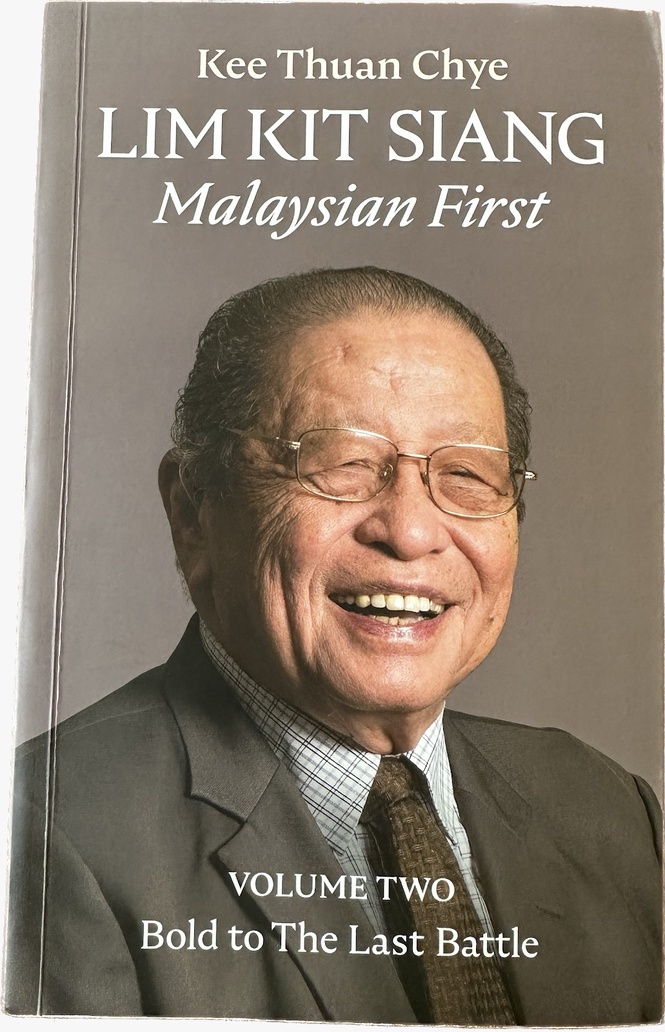
Some two years after that first volume None but the Bold former journalist, playwright, actor, and author, Kee has finally come up with the second volume, a task which took four years in all.
The second book (Lim Kit Siang Malaysian First, Volume Two, Bold to the Last Battle, 547 pages, RM88) picks up from that fateful day on October 27, 1987, moving through one of the most important periods and landmarks for Malaysia culminating in the defeat of Umno in 2018, the fall of Pakatan Harapan two years later, and finally, the retirement of Kit Siang or simply Kit as he is popularly known from active politics in 2022.
It ends before the fifteenth general elections in November. As with the first book, the second is also a narrative account of history as it unravelled in Malaysia, with the later publication reflecting much more contemporary happenings.
Therefore it will be of interest to many who want insights into the events leading up to Harapan’s fall from government, including the infamous Sheraton Move, Mahathir’s shock resignation, and the subsequent failed effort to re-submit Mahathir as PM again.
When I got my hands on None but the Bold I had to resist the temptation to find out why the decision was taken to put forward Mahathir as PM if Harapan won despite his bad record as prime minister for 22 years and his age of well over 90. I had to wait for 450 pages.
The book starts with the chilling recounting of the stories of those arrested in 1987 under Mahathir’s Operation Lalang. How it happened, the rough, cold, calculated treatment they received, the inculcation of terror in the way they were arrested, the bare windowless cells they were put into with no blankets or beds or pillows….it goes on.
The first eight chapters dealt with detention. While Lim was not treated too badly, the tales of many of the others quoted in the book are quite horrifying, including that of women activist Irene Xavier who said she was beaten with a stick.
Operation lalang was a pivotal point in Mahathir’s stamping of his authority on Malaysia, including the draconian attack on the judiciary in 1988 and the installation of judges sympathetic to the government, destroying its independence.
Kit and his son, Lim Guan Eng, were the last of the detainees to be released in April 1989, after some 18 months in detention. Some saw the late release as punishment by Mahathir.
Among other interesting things (there are too many to mention) was the 1990 election post the 1987 detentions by Mahathir when DAP formed an alliance with Tengku Razaleigh Hamzah’s breakaway faction from Umno, Semangat 46.
What started off as a promising campaign took a steep downturn when Tengku Razaleigh, who had formed an alliance with Joseph Pairin Kitingan’s PBS, was falsely accused of wearing a traditional headgear bearing a cross. The book has many things to say about the elections.
For DAP, they won 14 of 20 seats contested in Penang then. 17 seats were needed to form the state government but Semangat 46 won none. The highlight was Kit beat DAP stalwart and long-time chief minister Dr Lim Chong Eu, forcing him into retirement.
There is a good discussion of the New Economic Policy and its use and abuse including the mention of Mahathir ally and strongman Daim Zainuddin’s doctoral thesis in a chapter entitled “Who wants to be a Millionaire”.
This was a snide reference to the route that many Malays took to become rich through share allocations and becoming sleeping partners in ventures where there was a requirement that firms must have a bumiputera partner to get government contracts.
The advent of money politics under Mahathir’s rule came in for some treatment, including how Pairin lost control of Sabah through defections of many assemblymen, MIC’s Maika scandal, the Bank Negara Malaysia foreign exchange scandal and others.
Another incident was that involving Guan Eng who spoke out on behalf of an underaged girl allegedly raped by former Malacca chief minister Rahim Tamby Chik. There was a shocking cover-up and miscarriage of justice for which Guan Eng eventually went to jail.
Mahathir won by a landslide in 1995, on the back of a strong economy and Kit was thrashed by Penang chief minister Koh Tsu Koon in the Tanjung Bungah state seat but won the Parliamentary seat in Tanjong.
Complaints about Guan Eng began to surface - that he was not amenable to suggestions. Kit was not receptive to those complaints. Guan Eng was convicted of both sedition and malicious publication but in a surprise decision, in 1998 the Court of Appeal led by Gopal Sri Ram, handed down a custodial sentence of 18 months, instead of the previous fine. The Federal Court upheld the custodial sentence and Guan Eng went to jail. Kit was devastated. Guan Eng was freed six months earlier for good behaviour in 1999.
Meantime deputy prime minister Anwar Ibrahim was detained under the infamous Internal Security Act and subsequently charged for corruption and sodomy, marking the birth of Parti Keadilan Rakyat and the reformasi movement.
Mahathir called snap elections in 1999 and won but the results were poorer. DAP did badly ostensibly because of an alliance with PAS. Mahathir exited as PM in 2003. New PM Abdullah Badawi called elections in 2004 and won hugely on his anti-corruption platform, taking over 90% of parliamentary seats.
In victory, Abdullah magnanimously set in motion the move to pardon Anwar and the latter was released from prison and resumed political life.
The 2008 elections marked a turning point for the opposition after a pact between PKR, DAP and PAS finally bore fruit, winning the opposition Penang, Selangor, Perak, Kedah and Kelantan. Guan Eng became the chief minister of Penang.
Some of the factors cited include the waving of kerises at Umno’s assemblies, the murder of a Mongolian model associated with Deputy PM Najib Razak, the Lingam tapes, PKFZ, the Bersih rally, and the brutal treatment of the Hindraf rally.
Meanwhile, Sodomy 11 against Anwar came up under PM Najib who took over from Abdullah in 2009 following the latter’s poor showing in 2008. Anwar faced trial.
Fast forward to 2013 and the opposition made further inroads - Najib performed worse than Abdullah in 2008. He blamed it on the Chinese tsunami although evidence indicated otherwise.
The move to make Anwar menteri besar of Selangor by forcing a by-election in Kajang came to a halt when the by-election was delayed and the decision on Anwar’s trial brought forward. Predictably, he was found guilty.
Anwar went to jail again in Feb 2015. Two days later PAS spiritual leader Nik Aziz died. Pas eventually left the coalition. In 2014, Karpal had died in a tragic accident.
And then came 1MDB and all the attendant problems and Najib’s complicity in the whole thing eventually became exposed. Najib took drastic measures to keep it under wraps, sacking his deputy Muhyiddin Yassin and promoting Ahmad Zahid Hamidi to his position.
Against all odds, Mahathir joined the Harapan coalition with his party Bersatu. The only compelling reason for taking him in seemed to be the thought then prevailing that he was needed to win the 2018 elections. Mahathir had worked his charm successfully.
Paradoxically, Mahathir was the one who killed the Harapan government’s tenure. Many, as Kee pointed out, including this writer, argued against his inclusion but it fell on deaf ears. And subsequent evidence indicated he was not needed - his Bersatu won just 13 seats out of 52 contested.
Kit retired from the scene in 2022 before the 15th general elections which resulted in a stalemate and eventually Anwar becoming PM through an alliance with Umno. No one thought that would be the result. Such is politics, as Kee’s book showed through numerous other stories.
No book can be written about Kit without taking in a sweep of Malaysia’s history just prior to and after May 13, 1969 because Kit was right there in the thick of it all. Kee does an admirable narrative of the whole. His focus on Kit meant that much of the story was told through Kit’s and the DAP’s eyes. As largely a narrative, it lacked critical analysis.
But I would still heartily recommend this book to anyone who is interested not only in Lim Kit Siang but who wants to follow the contemporary unveiling of a rapidly evolving Malaysia. It’s a herculean effort by Kee, and this book, and the earlier first volume are both well worth a read.
It’s an entrancing, enlightening and even entertaining story of Kit, modern Malaysia and its main actors, a not-to-be-missed true story on the national stage written by a playwright.
P Gunasegaram is a content creator under the Newswav Creator programme, where you get to express yourself, be a citizen journalist, and at the same time monetize your content & reach millions of users on Newswav. Log in to creator.newswav.com and become a Newswav Creator now!
The User Content (as defined on Newswav Terms of Use) above including the views expressed and media (pictures, videos, citations etc) were submitted & posted by the author. Newswav is solely an aggregation platform that hosts the User Content. If you have any questions about the content, copyright or other issues of the work, please contact Newswav.