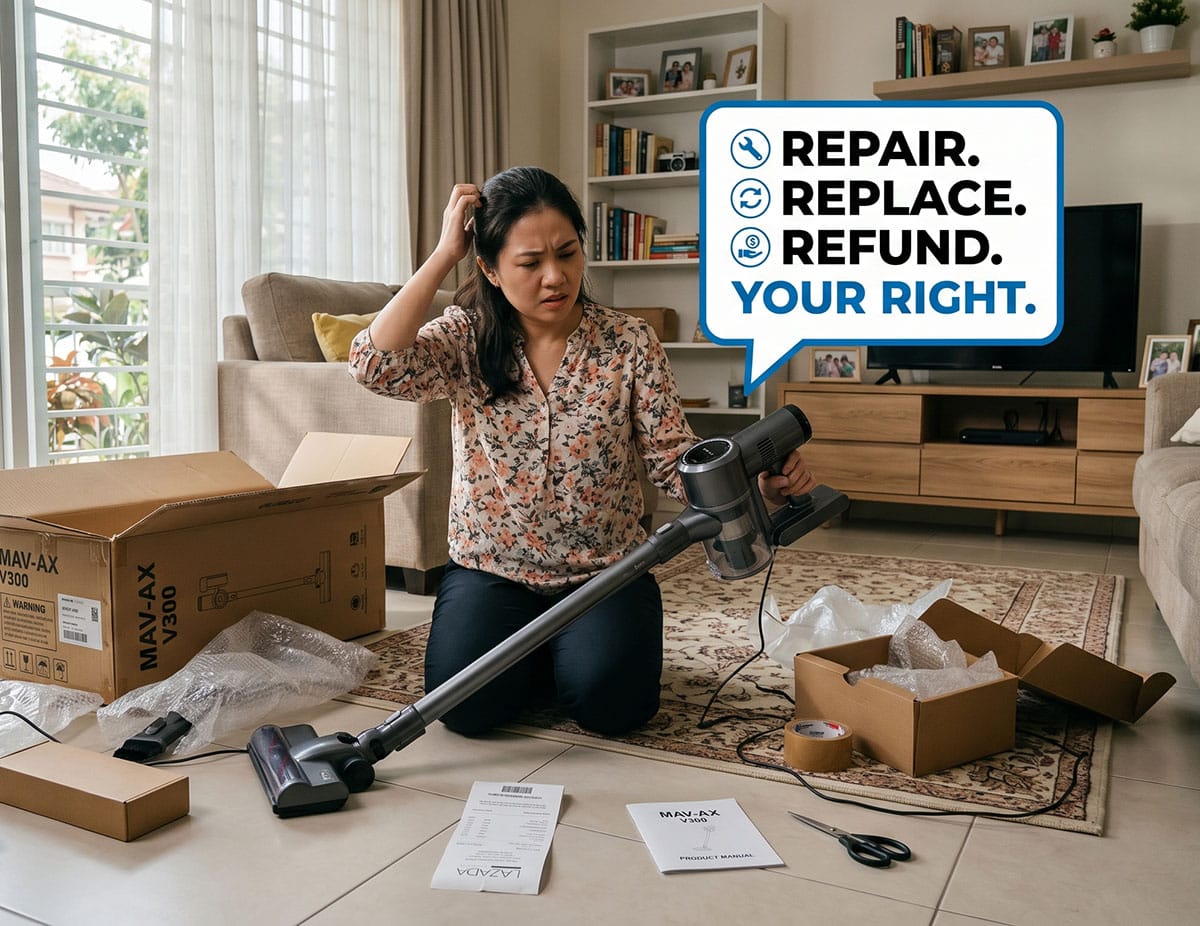
A law that protects you from defective products is finally coming to Malaysia.
You bought something. It arrived faulty. You contacted the seller. They asked for photos. Then more photos. Then a video. Then they told you to send it back at your own expense. Three weeks later, a replacement arrived. It was also faulty.
If that story sounds familiar, you are not alone. And if you have spent years wondering whether there is actually anything you can do about it beyond leaving a one-star review, the answer is finally starting to look like yes.
What Is a Lemon Law and Why Does Malaysia Not Have One Yet
The term "lemon" to describe a defective product comes from economist George Akerlof's famous 1970 paper on how information gaps between buyers and sellers lead to market failures. A lemon is a product that looks fine from the outside but is rotten at the core. The buyer pays full price. The seller knows the product is defective. And under most legal systems, including Malaysia's current one, the buyer has limited recourse.
Lemon Laws have existed in the United States since the 1970s, with individual states passing legislation that requires manufacturers to repair, replace, or refund products that repeatedly fail to meet quality and performance standards. Singapore, Australia, and most of Europe have similar frameworks. Malaysia, despite having a Consumer Protection Act since 1999, has never had one. Until now.
What Was Announced and What It Means
During the tabling of Budget 2026, Prime Minister Anwar Ibrahim confirmed that the government will amend the Consumer Protection Act 1999 to incorporate Lemon Law elements. This was not a surprise announcement pulled out of thin air. A six-month legal feasibility study was conducted from June to November 2024 after the Ministry of Domestic Trade and Cost of Living acknowledged the existing law had significant gaps in protecting consumers from defective goods.
The study confirmed what any Malaysian who has ever tried to return a faulty product already knew from personal experience: the current legal framework is fragmented, inconsistent, and heavily weighted in favour of sellers. The Consumer Protection Act, the Contracts Act, the Sale of Goods Act, and the Hire-Purchase Act all technically apply to consumer disputes, but navigating all four of them to seek redress for a defective blender or a car that will not start is not something ordinary Malaysians can realistically do.
The Lemon Law amendment is designed to fix that by creating a single, clear framework. Once enacted, sellers and manufacturers will be legally required to repair, replace, or refund products that are repeatedly defective and fail to meet acceptable quality and safety standards. The burden of proof shifts. The consumer is no longer at the mercy of the seller's goodwill.
Who Benefits and How Much
The short answer is: every Malaysian who buys anything.
The more exciting answer for many Malaysians is: especially car buyers.
The automotive angle is where the Lemon Law gets most attention, and for good reason. A car is one of the largest purchases most Malaysians will ever make outside of a house. The consequences of buying a defective vehicle are not just financial. They are practical, daily, and deeply frustrating. A car that spends more time in the workshop than on the road is not a minor inconvenience. It is a disruption to your entire life.
My own 2013 Perodua Alza has been reliably on the road for years without serious issues. Perodua has a strong reputation for durability and that has held up. But I know people who have not been as lucky with other brands. Persistent engine problems. Electrical faults that no dealer can seem to trace. Air conditioning that stops working within six months of delivery. Under the current system, these buyers have limited options beyond repeated workshop visits and escalating frustration. Under a proper Lemon Law, they would have a legally enforceable path to a replacement or a refund.
The protection extends beyond vehicles too. Electronics, home appliances, furniture, clothing, and any consumer product that repeatedly fails to meet quality standards would fall under the new framework. That faulty product from an online store that took months to replace under warranty? A well-implemented Lemon Law would make that whole ordeal significantly shorter and more enforceable.
What the Law Will Likely Require
While the specific amendment has yet to be fully tabled, the general framework based on how Lemon Laws operate in comparable countries suggests the following consumer rights. First, a right to repair within a reasonable timeframe. If the seller or manufacturer cannot fix the defect after a specified number of attempts or within a set period, the consumer moves to the next stage. Second, a right to replacement with a product of equivalent value and specification. Third, a right to a refund if replacement is not feasible or acceptable.
The Tribunal for Consumer Claims Malaysia, known as TTPM, is expected to be the primary avenue for filing claims. The good news is that TTPM already exists, already handles consumer disputes, and filing fees are as low as RM5 per claim. You do not need a lawyer. The process is designed for ordinary Malaysians to represent themselves, with claims handled up to RM50,000 in value.
If you are currently dealing with a defective product and the Lemon Law has not yet been enacted, you can still file a complaint with KPDN through TTPM. There is a special negotiation task force for motor vehicle complaints specifically, handling tripartite negotiations between the ministry, buyers, and dealers.
What You Should Do Right Now
The Lemon Law is coming, but it has not arrived yet. In the meantime, the best thing you can do is prepare, because whenever the amendment is enacted, the strength of your claim will depend heavily on documentation.
Start keeping records of everything. Every repair attempt, date, and workshop invoice. Every communication with the seller or manufacturer, whether by email, WhatsApp, or phone call. Every time you reported the same defect. If it is a car, note the kilometres at each repair visit. If it is an appliance or electronic device, photograph the defect before sending it in. These records form the foundation of any future claim.
The stronger your paper trail, the stronger your case.
My Take
I once bought a product from an online store that arrived faulty. What followed was weeks of back-and-forth messages, photos, more photos, a return shipment at my own cost, and eventually a replacement that took so long to arrive that I had largely given up on it. By the time it came, the whole experience had left me feeling like the process was designed to exhaust me rather than help me.
That is exactly what a Lemon Law is meant to change. It shifts the assumption. Instead of the consumer having to fight for what they are owed, the law makes it the seller's responsibility to make things right within a defined timeframe and with clear consequences if they do not.
What concerns me most, and this is the same gap we see with SKSPS and SOCSO for gig workers, is awareness. The Lemon Law could sit on the books for years while most Malaysians continue to suffer silently with defective purchases simply because nobody told them the protection exists. A law without awareness is just words on paper.
KPDN needs a proper public campaign. QR codes in shopping malls. Notices on e-commerce platforms at checkout. Pop-ups when you register a new product's warranty. Something that actually reaches the people the law is meant to protect, not just the legal community and automotive enthusiasts who were already following this story.
Because the real lemon here is not just the product. It is a consumer protection system that has spent decades not telling Malaysians what they are actually entitled to.
Kamarul Azwan (k.azwan@gmail.com) is a content creator under the Newswav Creator programme, where you get to express yourself, be a citizen journalist, and at the same time monetize your content & reach millions of users on Newswav. Log in to creator.newswav.com and become a Newswav Creator now!
The User Content (as defined on Newswav Terms of Use) above including the views expressed and media (pictures, videos, citations etc) were submitted & posted by the author. Newswav is solely an aggregation platform that hosts the User Content. If you have any questions about the content, copyright or other issues of the work, please contact creator@newswav.com.