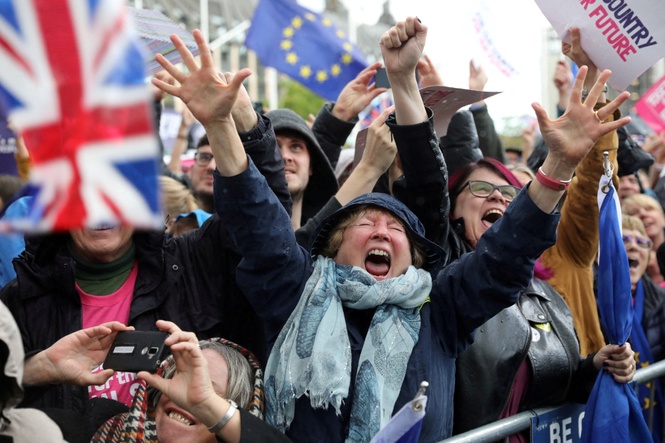
BRUSSELS, June 20 — Is it Brejoin, Breturn — or perhaps Bre-entry?
A decade after the Brexit referendum, the UK is experiencing a form of “divorce regret” with surveys showing most Britons now believe leaving the European Union was a mistake.
Cue a raft of colourful terms to describe a possible fairytale reunion — and a more serious political debate on whether that’s something London should pursue.
The jostling ahead of an expected Labour bid to unseat Prime Minister Keir Starmer has further spotlighted the issue — after likely challenger Andy Burnham spoke of wanting to one day see the UK back in the EU.
But what of the scorned partner: would the EU take Britain back?
AFP spoke with half a dozen European diplomats, granted anonymity to discuss the matter. All said their countries would be ready — in principle — to re-tie the knot.
In a polarised world, argued one, Europe had much to gain by re-admitting a nuclear power with one of the world’s largest economies and a seat at the United Nations Security Council.
But they all also warned London would need to show it was committed to the marriage and its attending duties.
“They are not yet conceptually willing to accept the burdens that come with membership,” said a second diplomat.
Some went further, suggesting the 27-nation bloc had managed to get more done without a difficult ex with a penchant for special requests.
“Things are easier now,” said another diplomat. “We are no longer having to constantly work around opt-outs on every file. There’s more cohesion”.
New EU, old UK
Britain never joined the euro or the free movement Schengen area, and had notoriously negotiated a rebate on its common budget contributions — all taken now as signs of half-hearted Europeanism.
One of the diplomats mused half-jokingly that Britons were perhaps most missed for their fine command of English, leaving EU documents riddled with stilted euro-speak.
Others have fonder memories: Sebastien Maillard, of British think tank Chatham House, said countries leaning towards liberalism in economics or Atlanticism in geopolitics miss Britain as a counterweight to France’s sovereigntist instincts.
But from “strategic autonomy” to “European preference” and joint borrowing, the bloc has of late embraced policies championed by Paris that might have been a hard sell in London.
“The UK doesn’t really get the full measure of how much the EU has changed over the last 10 years,” Maillard said.
The new course was largely brought about by external factors — a pandemic, Russia’s invasion of Ukraine, the rise of China and US President Donald Trump.
But Brexit also sharpened the bloc’s focus — proving to the doubters in its ranks that leaving was a bad idea, said one diplomat.
“It has led to a more mature debate about the EU,” he said, noting right-wing populists across Europe no longer advocated for their countries to quit the bloc.
“It’s no longer about, ‘do we want to be in or outside of the EU?’, but about ‘what kind of EU do we want to be in?’.”
Smaller fish to fry
Would Britain really want back into the club as it is now?
The political situation in the island nation, with the hard-right, anti-EU Reform UK party running high in the polls, calls for caution.
European nations are wary of weaving closer ties now — only to possibly have to unravel them later.
What’s more, some noted it would be almost unthinkable to allow Britain to re-enter on its previous special terms.
Meanwhile, drawn-out negotiations to ease the pain of divorce are proving difficult — raising questions about further rapprochement and renewed EU complaints of British “cherry-picking”, a leitmotif of the Brexit era.
Talks for London to access an EU defence scheme collapsed over the price tag for Britain.
And a reported UK proposal to join the single market for goods but not the free movement of capital, services, and people, was given short shrift in Brussels, where most insist on a package deal or nothing.
Progress has been made in other areas.
London and Brussels are hoping to present several deals at a July 22 summit, namely on food and animal safety standards, a youth mobility scheme, and the linking of their emissions trading systems.
That’s hardly the stuff of dreams — those longing for a romantic Bre-union might say — but for now, small steps may have to do. — Reuters