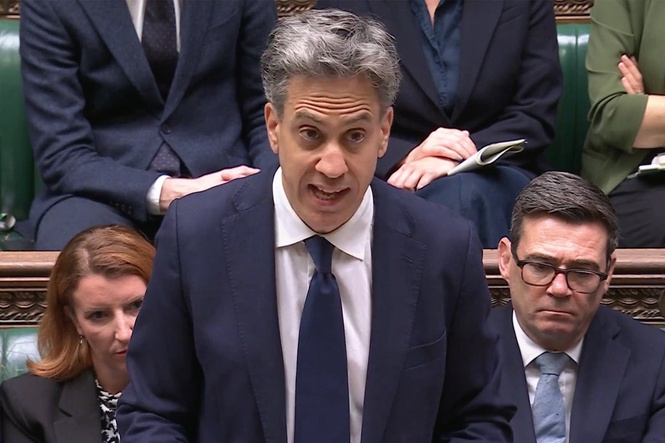
The expansion of Israeli settlements in occupied territory is wrong and should be reversed. Britain’s leverage over Benjamin Netanyahu’s government, however, is limited.
As a nation, we have some historical responsibility for the situation in Israel-Palestine, but that does not give us much power now. Hence the logic of British policy over recent decades, which has emphasised working with other countries – above all, the United States – to maximise our influence.
We have to be realistic, therefore, about how much difference will be made by the announcement by Ed Miliband, the foreign secretary, of a ban on Israeli goods and services connected with unlawful settlements.
The Independent was similarly sceptical a year ago about the effect of “recognising” the state of Palestine, which was the last supposedly significant change in British policy. We supported that declaration, despite there being no viable Palestinian state to recognise, because we thought it was important to express support for such a state – and to make clear our opposition to the shift of Israeli government policy against the two-state solution.
But we had no illusion about the effect of the declaration on the Netanyahu government – and indeed it has continued to go in the wrong direction, making it harder than ever to imagine an independent and secure Palestinian state alongside the Israeli one.
Like recognition of statehood, therefore, these sanctions are unlikely to have any more than a symbolic effect. In fact, British diplomats are understood to have told American officials that the new measures announced today are “largely symbolic” and will not change Britain’s wider relationship with Israel.
There is nothing wrong with that – except for the suspicion that Mr Miliband and Andy Burnham are trying, at the same time, to sell their actions as a dramatic and historic check on the government of Israel.
Mr Burnham has been accused, as Sir Keir Starmer was before him, of adopting a more demonstratively hostile stance towards the Israeli government in order to try to reverse the defection from Labour of voters for whom the Palestinian cause is paramount. With a critical by-election coming up in Sir Keir’s former constituency, where a pro-Palestinian independent candidate came second at the general election, Labour is accused of tailoring its foreign policy to suit its domestic interests.
There are, ultimately, only two audiences that matter on this issue, and neither of them is the electorate of Holborn and St Pancras in central London. One audience is the Israeli electorate, who will go to the polls in seven weeks to deliver their verdict on Mr Netanyahu’s government. Those who want to keep the hope of a Palestinian state alive need to focus on strengthening the “peace” tendency among Israeli voters.
Tom Tugendhat, the shadow foreign secretary, said in response to Mr Miliband’s statement in the House of Commons that sanctioning settlements was “performative politics”, “acting without prudence” and “enacting policies that the Foreign Office knows won’t work”. He also said it would be seen by moderate Israelis as an unfriendly act, one that would push them towards Mr Netanyahu. We are not sure that this is true, but it is a risk that should be taken seriously.
The other audience for British policymakers is the American government. Not Donald Trump himself, probably. He is too compromised by having been suckered into launching an unwinnable “forever war” against Iran by Mr Netanyahu. And certainly not Mike Huckabee, the US ambassador to Israel, whose ravings on the subject have been as colourful as they are irrelevant.
Ultimately, Britain must remain engaged with the institutions and personnel of American foreign policy, however, so that when Mr Trump has moved on, as the US constitution requires him to do by January 2029, we might be able to persuade a future administration to put meaningful pressure on the Israeli government to do the right things.
That means arguing for a viable Palestinian state from first principles – rather than from electoral calculation – and for adopting policies, however “symbolic”, that will put meaningful pressure on the Israeli and US governments.
Read MoreNew empires are rising in the Middle East – and the stakes have never been higher
The West’s firewall against the far right is going up in smoke
Putin has no interest in peace – and Trump is falling into his trap
Anger over immigration cannot justify intimidation
Andy Burnham must take his chance to bury Nigel Farage
Kemi Badenoch is right – we must spend less on welfare and more on defence