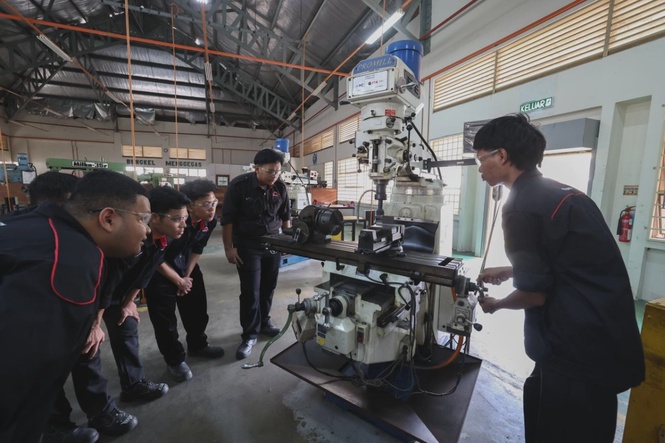
The Malaysian Employers Federation (MEF) has called for a broader assessment of TVET graduate employability that looks beyond headline numbers to job quality.
KUALA LUMPUR: The Malaysian Employers Federation (MEF) has called for a broader assessment of Technical and Vocational Education and Training (TVET) graduate employability to better reflect their skills, career progression and contribution to the workforce.
MEF senior adviser for Government, Media and International Engagement Datuk Dr Syed Hussain Syed Husman said the federation supported Higher Education Minister Datuk Seri Dr Zambry Abdul Kadir’s call for the employability of Polytechnic and Community College (PolyCC) graduates to be assessed beyond headline employment percentages.
READ MORE: Malaysia puts TVET at centre of industrial policy for economic transformation
He said the 2025 employability rates of 98.5 per cent for polytechnic graduates and 98.8 per cent for community college graduates were encouraging, but the quality and relevance of employment should also be considered in evaluating TVET outcomes.
“A graduate may be employed, but the critical question is whether the job utilises the skills acquired. We should distinguish between being employed and being appropriately employed,” he said in a statement today.
In this regard, Syed Hussain suggested that future TVET performance indicators should also take into account employment in fields relevant to graduates’ training, starting salaries and wage progression, career development, employer satisfaction and job readiness.
He said other indicators could include industry-recognised certifications, participation in lifelong learning, reskilling and upskilling, as well as graduates’ progression into higher-value and higher-skilled occupations.
He emphasised that technical competency remained fundamental, but graduates also needed strong communication, teamwork, problem-solving and adaptability skills to succeed in different workplace environments.
“We must remember that skills alone are not enough. Employers need people who can apply those skills in the real workplace, communicate effectively, work as part of a team, solve problems and adapt when circumstances change,” he said.
Syed Hussain said stronger collaboration between industry and educational institutions was essential to ensure TVET programmes remained aligned with changing workforce needs.
He proposed a stronger industry-to-classroom-to-workplace model, with employers involved in industry demand forecasting, curriculum design, practical training, competency assessment, certification, recruitment and continuous upskilling.
He said that such an approach would help ensure graduates were better prepared for the workplace while allowing TVET institutions to respond more quickly to technological and industry changes.
Syed Hussain also said that efforts to further strengthen TVET needed to be matched by the creation of more high-skilled employment opportunities for graduates.
He said producing skilled graduates without creating enough high-value jobs could lead to skills underemployment, while attracting high-value investments without developing the right talent could result in skills shortages.
Therefore, he said education, TVET, industrial and investment policies needed to move in the same direction to create sufficient opportunities for skilled graduates.
“If we want our TVET graduates to have good jobs, we must create more good jobs. Education policy and investment policy must move together.
“The Government must continue to bring in investments that are driven by technology, engineering, automation, digitalisation, advanced manufacturing, renewable energy, electric vehicles (EVs), aerospace, semiconductor-related activities, logistics, cybersecurity and other high-value sectors,” he said.
He said MEF remained committed to working with the Ministry of Higher Education, National TVET Council, PolyCC institutions and relevant agencies to strengthen industry-education collaboration and build a demand-driven, industry-led and future-ready TVET ecosystem.