AS of Sept 18, Kedah’s Muda Dam, the second-largest reservoir in a state known as the nation’s rice bowl, stood at just 11.88% of normal capacity. Nationwide, about a quarter of Malaysia’s 43 monitored dams had slipped into “cautionary” territory.
On Sept 4, the Air Pollutant Index in Serian, Sarawak, breached 500. By Sept 16, 38 areas across Peninsular Malaysia were recording unhealthy air quality. These are early warning signs of the pressures a Super El Nino could bring, threatening water and food security, public health and ecosystems across Malaysia.
Malaysia’s Pre-Budget Statement 2027, released on Aug 18, refers to accelerating flood mitigation, disaster preparedness and climate-adaptation plans under Focus Area 10, “Building Energy, Food, Climate and Cyber Security”.
What it does not spell out is how nature itself can help deliver on that commitment. Budget 2027 must prioritise investment in nature-based solutions (NbS) that address these interconnected challenges while building resilient communities, protecting biodiversity and supporting a sustainable economy.
WWF-Malaysia calls for three measures: a dedicated NbS allocation under Focus Area 10 for watershed, forest and coastal and marine ecosystem restoration; funding for ecological connectivity and wildlife-safe infrastructure; and RM1 billion for the Ecological Fiscal Transfer (EFT), with its application expanded to support NbS implementation while working towards dedicating at least 1% of the national budget to nature and biodiversity.
As Natural Resources and Environmental Sustainability Minister Datuk Seri Arthur Joseph Kurup recently noted: “Our tropical rainforests are not just carbon sinks. They are critical global infrastructure that regulates watersheds, stabilises rainfall and safeguards clean water supplies.”
Recognising nature as critical infrastructure is central to why Malaysia must invest more in NbS. These solutions protect, restore or sustainably manage ecosystems to address climate and societal challenges while benefiting both people and nature.
Nature secures water and food
Healthy forests function as natural water infrastructure, retaining water during droughts and regulating river flows.
Ulu Muda, Kedah’s 163,810ha forest, is vital to water security in Kedah and Perlis and supports roughly 40% of Malaysia’s rice production.
Along the coast, mangroves and coral reefs help protect communities from storm surges and erosion while sustaining fish stocks. The ocean supplies more than a third of Malaysia’s animal protein and supports more than 120,000 fishers and fish farmers.
Malaysia aims to protect at least 10% of its marine areas by 2030, yet less than 6% is currently protected. Protecting and restoring these ecosystems requires sustained investment.
Forests, mangroves and coral reefs provide essential services that underpin Malaysia’s food security, economy and well-being.
Nature sustains biodiversity and livelihoods
Malaysia retains nearly 55% forest cover, maintaining a commitment made at the 1992 Rio Earth Summit. But the headline figure does not tell the whole story.
Forest plantations and degraded forests, although often included in overall forest-cover figures, do not provide the same biodiversity and ecosystem benefits as healthy natural forests.
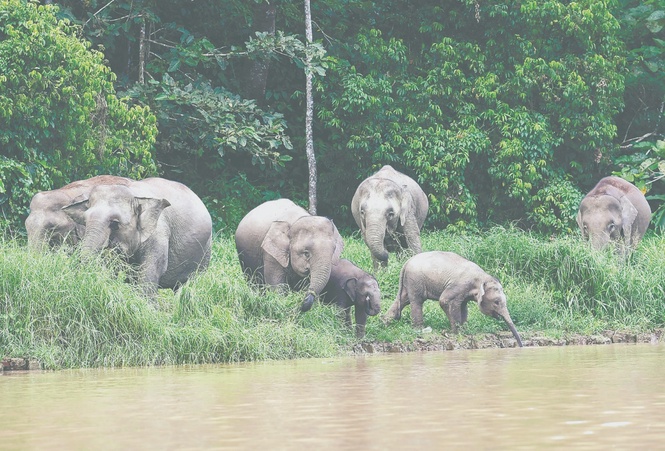
Intact, well-managed forests help secure clean water, reduce landslide and flood risks, store carbon and support livelihoods. Yet, development pressures are fragmenting habitats and weakening the ecological connections wildlife depends on.
Perhilitan has explicitly linked the rise in human-wildlife conflict to habitat fragmentation. Its data shows reported cases rising from 11,818 in 2020 to 15,492 in 2024.
Similar pressures are unfolding at sea, where warming waters and unsustainable coastal development affect mangroves, fisheries, coral reefs and sea turtle nesting habitats.
Malaysia already has frameworks, such as the Central Forest Spine Master Plan and national marine conservation targets. NbS – including habitat restoration, reconnecting fragmented landscapes and protecting critical ecosystems – can help reduce human-wildlife conflict, strengthen climate resilience and safeguard the natural systems on which people, wildlife and the economy depend.
Malaysia is not starting from zero. We endorsed the UN Environment Assembly’s NbS framework in 2022, while the World Bank’s 2026 Country Climate and Development Report for Malaysia makes the economic case for integrating NbS into national planning.
What is missing is investment to match the ambition. The EFT, which incentivises states to maintain protected areas, increased from RM150 million in 2023 to RM250 million in 2025, but remained at that level in 2026.
By comparison, Malaysia allocated RM3.8 billion in 2026 for flood mitigation and early warning systems alone. Flood protection remains essential. But the contrast highlights the need to invest in the natural systems that can also help reduce disaster risks.
Expanding EFT to support NbS would create stronger incentives for states to invest in ecosystem restoration and management that improve climate resilience, water security, disaster-risk reduction and community well-being.
Opportunity to acting now
The pressures are already visible. Dams are running low, farmers and fishers are operating under constraints, haze is affecting communities and habitat fragmentation is bringing wildlife into closer contact with people.
These are not isolated problems. They reflect growing pressure on the natural systems that protect our well-being, livelihoods and resilience. We need to invest in restoring and protecting these natural infrastructures today to reduce far greater costs tomorrow.
The rakyat is entitled to ask how the government and future leaders will safeguard the forests, rivers and coasts that underpin our water, food and economic security.
Budget 2027 presents an opportunity for the Madani government to answer that question. The evidence is already here, as is the need. What is required now is investment that matches the scale of the challenge.
WWF-Malaysia